
Struggling with traffic that doesn’t convert and products that stay invisible? So, how do you think the right SEO approach turns visibility into consistent revenue, not just numbers?
Running an online store is not as simple as listing products and waiting for orders. Many businesses struggle with traffic, conversions, and visibility. You might even find yourself asking mid-way through your growth journey, Can an ecommerce SEO agency increase sales?
The short answer is yes, but only if you do them correctly. The biggest challenge isn’t just to generate traffic; it’s to get targeted traffic that is actually ready to purchase from you. That can be accomplished through an effective and focused SEO strategy.
Table of Contents:
● Why Sales Drop in E-commerce
○ Common Causes of Low E-commerce Sales
● What an SEO Agency Actually Does
● Key Ways SEO Drives E-commerce Growth
● How to Choose the Right Partner
● Why ROI Matters More Than Quick Wins
● How An E-Commerce Seo Agency Helps You Grow
● FAQs
Why Sales Drop in E-commerce
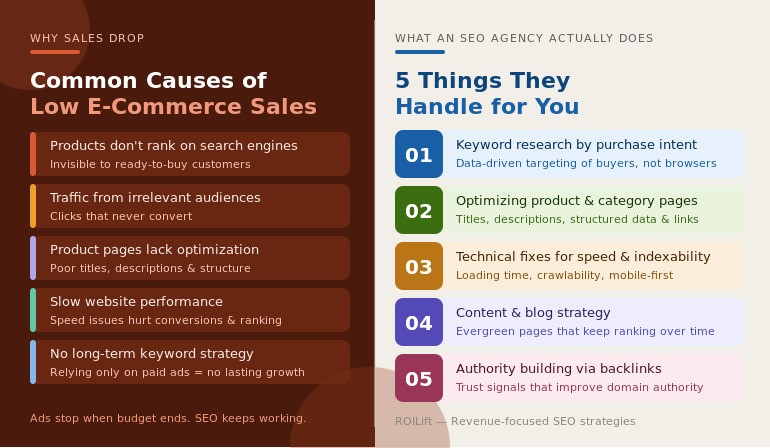
Low sales rarely happen without a reason. Most of the time, it’s a mix of visibility issues and poor targeting.
Common causes of Low E-commerce Sales:
- Your products don’t rank on search engines
- Traffic comes from irrelevant audiences
- Product pages lack optimization
- Slow website performance affects conversions
- No long-term content or keyword strategy
Many store owners invest heavily in ads but ignore organic growth. Ads stop bringing traffic the moment you stop paying. SEO builds a system that keeps working in the background.
What an SEO Agency Actually Does
An e-commerce SEO agency focuses on improving how your store appears in search engines. But it’s not just about rankings.
Here’s what they actually handle:
- Data-driven keywords by intent to purchase
- Optimizing product and category pages
- Technical fixes to improve loading speed and indexability
- Content / Blog strategy
- Authority building through backlinks
Instead of driving traffic endlessly, they align your store with what consumers are actively searching for.
Key Ways SEO Drives E-commerce Growth
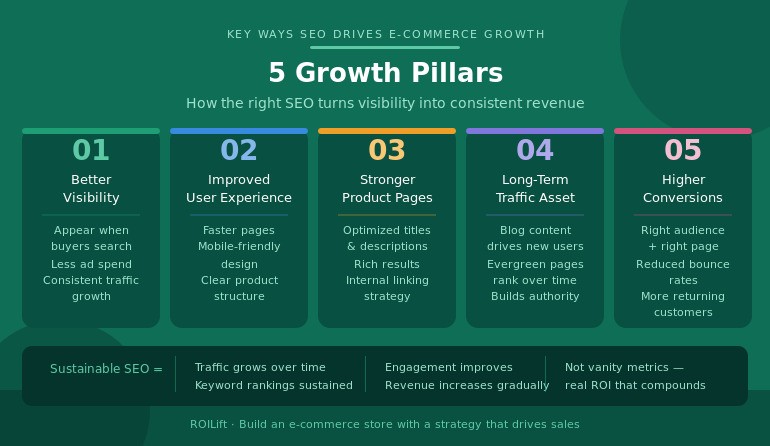
SEO is not a single tactic. It’s a combination of small improvements that create long-term growth.
- Better Visibility for High-Intent Searches
- Your products appear when users are ready to buy
- Less dependency on paid ads
- Consistent organic traffic growth
- Improved User Experience
- Faster loading pages
- Clear product structure
- Mobile-friendly design
- Stronger Product Page Performance
- Optimized titles and descriptions
- Better internal linking
- Use of structured data for rich results
- Long-Term Traffic Asset
- Blog content brings in new users regularly
- Evergreen pages keep ranking over time
- Builds trust and authority
- Higher Conversion Rates
- Right audience + right content = better sales
- Reduced bounce rates
- More returning customers
This is why SEO is not just marketing. It becomes part of your sales system.
How to Choose the Right Partner
Not every agency delivers real growth. Choosing the wrong one wastes both time and money.
Keep these points in mind while doing your search:
- A clearly defined strategy rather than vague assurances;
- An emphasis on return on investment (ROI)
- Experience with e-commerce platforms;
- Transparent reporting;
- Pricing is paid for good performance.
While many organizations are searching for the best digital marketing company in the USA, it is more important to find a firm that truly understands your specific needs and how they relate to accomplishing them through digital channels.
Why ROI Matters More Than Quick Wins
Temporary spikes in traffic can give an appearance of success; however, they do not always turn into sales. SEO should be used to create a long-term plan as well as a short-term one.
Examples of sustainable SEO would be as follows:
- Traffic level increases over time
- Keyword ranking improvement sustained or gradually improved over time
- Increased engagement measures over time
- Gradual revenue increase over time
Understanding Why E-commerce Matters is another reason to build an e-commerce business. E-commerce is more than just an online store; it is about creating a business that can scale without needing to continually reinvest in advertising.
How An E-Commerce Seo Agency Helps You Grow
An e-commerce SEO agency provides an effective and budget-friendly way of accomplishing this.
It helps you grow by:
- Focusing on revenue-driving SEO rather than vanity metrics
- Providing affordable SEO services without sacrificing quality.
- Building strategies around your product and audience
- Balancing cost with long-term ROI
- Acting as a local SEO provider in the USA with an international perspective
- Improving traffic and conversions concurrently
Keeping things simple and easy to understand through a focus on simplistic, result-oriented methods.
Final Thoughts
SEO is not magic, but when executed well, it can be one of the most steady ways to increase your online store’s growth rate. SEO gives you visibility, trustworthiness, and a steady stream of sales over time. The most important factor is having the optimal process for strategy and then using the best people available to execute that strategy.
The digital marketing company can greatly improve your sales, assuming you are working on a quality plan that incorporates user intent, consistency, and strategy. It isn’t about taking the quick wins; it’s about creating a structure that supports long-term growth and stability.
ROILift assist retailers to answer the number one question: Can an e-commerce SEO agency increase sales? They ensure this by using actual results to build strategies to help retailers reach 100% of their revenue potential. They also focus on creating low-cost solutions that have a high level of ROI. This way, customers will experience steady growth, increased website traffic and users, and higher conversions.
Build out an e-commerce store with a strategy that drives sales!
FAQs
Can an e-commerce SEO agency really increase sales?
Can an e-commerce SEO agency really increase sales?
Why are my e-commerce sales low despite getting traffic?
This usually happens when traffic is not targeted or product pages are poorly optimized. SEO helps attract users who are ready to buy, not just browse.
How long does it take to see results from e-commerce SEO?
SEO is a long-term strategy, and results typically start showing in 3–6 months. Consistent efforts lead to steady growth over time.
What does an e-commerce SEO agency actually do?
They handle keyword research, on-page optimization, technical fixes, content creation, and link building. Their goal is to improve visibility and conversions.
Is SEO better than paid ads for e-commerce?
SEO provides long-term, sustainable traffic, while ads stop when the budget ends. A balanced strategy using both works best.
How does SEO improve conversion rates?
By optimizing user experience, page speed, and product content. It ensures the right audience lands on the right pages.