table of Content
- 1.How to Compare SEO Services in Austin Before You Hire an SEO Agency
- 2. SEO Agency in Austin That Offers True Local Search Results
- 3. Transparent SEO Services For Austin Businesses
- 4.Local Expertise Is What Separates Austin SEO Services
- 5. Additional Factors to Consider For Best Local SEO Services in Austin
- 6.Scorecard For Your Comparison to Choose the Best SEO Agency in Austin
- 7. Final Words: Now You Know What You Need to Ask in Discovery Call
- FAQs
Key Takeaways
- Link building services in Austin produce ranking lift only when every proposed backlink passes all pre-checks.
- An Austin link from a site that ranks for Austin category queries compounds authority faster than a higher-DR link from a generic national blog that has no local or topical signal.
- The common mistake is chasing links by Domain Rating alone, ignoring editorial independence, placement context, and durability.
- A credible SEO link building Austin provider runs the pre-flight before proposing a target, documents the pass or fail on each check, and declines low-passing opportunities even when they count toward monthly link quota.
Businesses in Austin hiring link building services regularly end up with 20 to 50 links per quarter.
However, a link from a Domain Rating 60 site that is topically unrelated is worth less to your Austin rankings than a dofollow editorial mention from a Domain Rating 32.
The job of credible local link building Austin work is to filter aggressively before outreach, not to maximize volume.
Here are the 7 pre-flight checks any Austin business can run on any proposed link in 10 minutes.
Topical Relevance to Your Austin Category
Google Search Central’s link best practices also make clear that link quality signals (topical relevance, editorial placement, site trust) determine whether a link passes authority or gets ignored by the algorithm.
How To Test It?
Open the site, scan the last 10 to 15 posts. Count how many address topics relevant to your service category. Check whether the site ranks organically for queries in your category using Ahrefs, Semrush, or a simple Google site: operator.
At least 40% of recent posts cover your category or an adjacent topic, and the site ranks on page 1 for at least 5 category-relevant queries.
The link building service is a failure if the site covers 10+ unrelated categories with no topical focus, or ranks for zero queries in your space.
How To Test It?
Check Domain Rating (Ahrefs) or Domain Authority (Semrush) as a starting signal, then look at referring domain trend over the last 12 months. A site with DR 50 that has lost 20% of its referring domains over the year is a declining asset; a site with DR 32 that has gained 30% is a rising one.
DR or DA above your current site’s own DR (to pass authority upward rather than sideways).
The link-building strategy fails if DR is significantly below your own, the referring domain trend, or visible spam signals in the backlink profile.
Editorial Independence
Would this site exist, publish, and link to your business if SEO were not a factor? The answer separates editorial links (valuable) from paid link schemes (risky).
How To Test It?
Read the site’s “write for us” or “contribute” page. Check whether they publicly solicit guest posts with a payment or exchange arrangement.
Look at the outbound link pattern on 5 recent posts; natural editorial sites link to varied sources based on topic, while paid link sites link to many unrelated commercial sites in repetitive patterns.
You have partnered with the right link-building agency services in Austin if the site exists primarily to serve a real audience. Outbound linking is varied and editorial, and there is no public “pay for placement” solicitation.
Placement Context
Where on the page does the link sit? An editorial in-content link passes authority; a footer link, sidebar link, or “sponsored” block link often does not.
How To Test It?
Look at example posts where the site has linked to businesses. Note whether links sit inside the article body, in author bylines, in editorial resource recommendations, or in sidebar widgets and footer rolls.
In-content editorial placement, with the link surrounded by relevant discussion that explains why your business is being referenced.
Footer link blocks, sidebar “partners” or “sponsors” widgets, author bio boxes (unless the author is a named expert at your business), or any pattern that signals a bulk commercial placement.
Durability
Will this link still exist in 24 months, or is it a short-term placement that disappears when the content archives, the site redesigns, or a payment lapses?
How To Test It?
Does content from 3 years ago still have the same URL and content, or has the site redesigned recently with URL changes?
Check whether the site uses date-based URLs (which can be deprecated) or evergreen URLs. For paid placements, confirm whether the “sponsorship” is monthly, annual, or permanent.
Sites that have preserved 3+ year-old content at stable URLs and use evergreen URL structures are the ones that truly cater to the durability factor.
Site has redesigned twice in the last 3 years with mass URL changes, uses date-based URLs that tend to deprecate, or the placement is month-to-month paid.
Signal For Best Link Building Services In Austin
Does the link carry a specific Austin or Texas geographic signal that Google can use to associate your site with the Austin market?
How To Test It?
Look at the linking page’s content, the site’s primary focus, and whether Austin or Texas appears in the domain, the editorial policy, or the topic of the linking piece.
The site is explicitly Austin-focused (Austin in the domain or primary editorial focus), or the linking piece specifically covers Austin topics.
Fail: the link comes from a site with no Austin signal and from a piece that does not mention Austin or Texas. These links can still pass category authority but do not help local or submarket rankings.
Link Attribute
Is the link dofollow, nofollow, sponsored, or ugc?
Only dofollow links pass full PageRank authority; the others still produce brand value but should not be counted the same way in link reports.
How To Test It?
View page source on the linking page (right-click, View Page Source, Ctrl+F for your URL). Check the rel attribute on the anchor tag.
Links are weighted lightly if, rel=”nofollow” or rel=”ugc” without editorial context. These are not harmful, but they are not the links that move rankings.
How To Grade a Link Using the 7 Checks
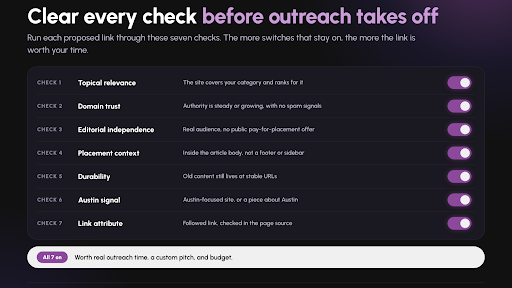
Each proposed link is run through the 7 checks and scored:
- Passed all the above benchmarks: These are the links that produce the strongest compound authority effect over 12 to 24 months. Invest real outreach time, custom pitching, and budget. Links in this tier typically come from established Austin publications.
- Passed 5 or 6 of 7: These are strong links with one or two specific weaknesses (often Check 6 Austin Signal missing for a national publication, or Check 7 attribute defaulting to nofollow).
- Passed 4 of 7: The link may still carry some value, but the weaknesses compound in ways that often do not justify the outreach effort. Without that strategic case, move on and reinvest the hour in a higher-passing target.
- Passed 3 or fewer of 7:These links waste outreach budget and often add noise to the backlink profile instead of authority.
Most Austin link opportunities proposed by generic outreach vendors score between 2 and 4.
Most Austin link opportunities proposed by a proficient SEO agency in Austin like ROIift score between 5 and 7. The grading is what separates a link report that moves rankings from one that just adds URLs to a tracker.
The Link You Should Not Have Pursued Last Quarter
Open the link report from your last quarter of link building services in Austin. Pick the three highest-authority links on the list by Domain Rating. Run each one through the checks above.
If any of the three fails 3 or more checks, the acquisition dollar that went into it came back as a flattering line on a report, not a ranking lift on the SERP.
The Austin businesses that will outrank their category in 2027 are not the ones buying the most links. They are the ones targeting quality over quantity.
7 checks, 10 minutes each, a decision in under 15 minutes. That is the filter.
Frequently Asked Questions
Can an Austin business do its own pre-flight on each link before committing?
Yes, and it is the highest-leverage use of 15 minutes before any outreach or placement decision. The 7 checks can be completed per link using Ahrefs or Semrush (10 minutes), the browser (5 minutes for editorial inspection and view-source for link attribute), and Google search operators.
Are nofollow and sponsored links worth pursuing for an Austin business?
Yes, but counted differently. Nofollow and sponsored links do not pass PageRank directly, but they still produce brand visibility, referral traffic, and secondary SEO benefits.
What should SEO link building Austin providers actually show in monthly reports?
Per-link breakdown with the 7-check grade on each link, not just a list of URLs. Also included should be the ring distribution, the topical relevance score per link, the Austin-specific signal strength per link, and the link attribute (dofollow vs nofollow vs sponsored vs ugc).
What is the right link velocity for an Austin business building authority?
Steady and natural, not spiky. A new Austin site should earn 3 to 8 high-quality links per month in the first 6 months, growing to 8 to 15 per month after month 6. Sudden spikes (40+ links in a single month after months of nothing) often trigger algorithmic scrutiny because the pattern looks unnatural.
Should an Austin business do competitor backlink analysis as part of link building?
Yes, and it is the single highest-leverage research step in Austin link building. Pull your top 3 Austin competitors’ backlink profiles in Ahrefs or Semrush, and identify sites linking to them but not to you.
What is the right way to approach an Austin reporter for a link opportunity?
Pitch a story, not a backlink request. Pitch a specific Austin angle (submarket trend, seasonal demand shift, industry data), offer yourself as a named source with credentials, and never ask for a link in the first message.