table of Content
- 1.How to Compare SEO Services in Austin Before You Hire an SEO Agency
- 2. SEO Agency in Austin That Offers True Local Search Results
- 3. Transparent SEO Services For Austin Businesses
- 4.Local Expertise Is What Separates Austin SEO Services
- 5. Additional Factors to Consider For Best Local SEO Services in Austin
- 6.Scorecard For Your Comparison to Choose the Best SEO Agency in Austin
- 7. Final Words: Now You Know What You Need to Ask in Discovery Call
- FAQs
Key Takeaways
- SEO copywriting services in Austin produce service pages that both rank and convert only when the page covers discovery, qualification, proof, mechanism, and decision.
- The common mistake is treating SEO content writing as rewriting the same page with more keywords.
- A credible SEO copywriter Austin businesses hire checks every page against all 5 layers before shipping, with specific proof points and a mechanism section, not just an updated meta title.
If your Austin service pages rank well and still produce almost no leads, the problem is not keywords.
Something in the next 90 seconds of reading sent them back to Google to try your competitor.
That gap, between arrival and action, is what SEO content marketing services in Austin are supposed to close. And it closes only when the page covers five distinct reader layers, each answering a different question, with keywords doing the work of just one of them.
How Competitive is Austin for content marketing?
Austin is a competitive content marketing market because the buyer base is unusually sophisticated.
The U.S. Bureau of Labor Statistics data for the Austin-Round Rock-Georgetown MSA also shows an above-average professional and technical employment share.
Which means your service page is being judged by readers who know what good copy looks like. Moreover, thin content is something that won’t work in this market.
There are certain layers every Austin service page needs.
What each layer is responsible for, and why generic SEO content writing Austin plans that focus only on keyword density fail at four of the five.
Discovery Stage With Content Marketing Services in Austin (Where Keywords Actually Live)
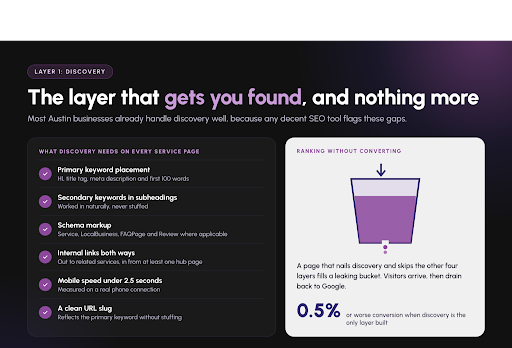
Discovery is the layer that gets the page found.
Keywords, headings, meta tags, schema, internal linking, and page speed all live here. This is the layer every generic SEO plan focuses on, and it is also the layer that matters least once the visitor has arrived.
A page that nails this and fails the other will rank. It will also convert at 0.5% or worse, because ranking without converting is the SEO equivalent of filling a leaking bucket.
What Layer 1 actually requires on an Austin service page:
- Primary keyword in H1, title tag, meta description, and the first 100 words.
- Secondary keywords worked naturally into subheadings.
- Schema markup for Service, LocalBusiness, FAQPage, and Review where applicable.
- Internal links out to related services and inbound from at least one hub page.
- Page speed under 2.5 seconds on mobile.
- A URL slug that reflects the primary keyword without stuffing.
Most Austin businesses buying SEO marketing services in Austin are already decent at Layer 1 because any competent SEO tool catches these gaps. The failure is in Layers 2 through 5.
Qualification (The Make-or-Break First 100 Words)
Qualification is the layer that answers “is this page for me?”
An Austin visitor who landed from a Google search for “commercial roofing contractor Austin” has about 10 seconds to decide whether this page describes their situation specifically or vaguely.
Vague loses.
A qualifying first 100 words name:
- Who the service is for (industry, business size, situation).
- What problem it solves specifically (not “all your marketing needs”).
- Where (Austin, which submarkets, which service areas).
- One disqualifying detail that proves you know the category (a specific permit, a specific vendor, a specific regulation).
Here is a before-and-after that shows the Layer 2 fix most Austin service pages need:
Before:
- We provide top-quality commercial roofing services to businesses throughout Austin.
- Our team of experienced professionals delivers results you can count on.
- Focus on customer satisfaction and competitive pricing.”
After:
- This page is for Austin commercial property owners (warehouses, retail, mid-rise office) in Travis County who need a TPO, EPDM, or standing seam metal replacement.
- Austin-based, pulls permits through the City of Austin Development Services Department, and has worked on buildings in East Austin, South Lamar, Round Rock, and Cedar Park. If you own a residential property, this is not the page you want.”
Service pages are not meant to retain every visitor; they are meant to qualify the right ones in and the wrong ones out.
Most Austin service pages read like the first version.
A credible SEO copywriter Austin businesses hire rewrites every Layer 2 to look like the second.
Mandatory Proof Section (The Layer Austin Buyers Scan For Hardest)
Austin buyers are proof-sensitive.
The city’s dense tech and professional services workforce has been pitched for a decade by every digital marketing agency within 100 miles, and the resulting default stance is skepticism.
Vague claims produce exits. Specific proof produces reads.
Proof lives in four forms on an Austin service page:
- Case studies with real numbers (how much lift, over what time, from what starting point).
- Named client logos with written permission to display.
- Review platform scores (Google, Clutch, Yelp, G2, or category-specific platforms).
- Documented methodology (what you actually do, step by step, with named tools and deliverables).
The weakest Austin service pages use adjectives: “proven,” “results-driven,” “trusted.” Austin buyers filter those words out before the paragraph finishes.
Mechanism (How The Work Actually Happens)
Mechanism is the layer most generic SEO content marketing in Austin skips entirely.
Mechanism answers “what will you actually do once I hire you, in what order, with what deliverables, and when.”
Austin buyers can compare SEO agencies in Austin before they fill out a form, because filling out a form to find out what the service actually is reads as a bait-and-switch.
A documented mechanism section signals that the service is defined, repeatable, and not improvised on each engagement.
A credible mechanism section on an Austin service page includes:
- Week-by-week or stage-by-stage breakdown.
- Named deliverables with each stage.
- Named tools used.
- Defined roles involved.
- An honest cadence of reporting and meetings.
For Austin service businesses with technical buyer bases (software, SaaS, professional services).
The mechanism section often drives more conversions than the proof section, because sophisticated buyers trust a documented process more than they trust a case study they cannot replicate.
Decision (The CTA Layer Almost Everyone Underwrites)
Decision is the layer that converts the qualified, convinced reader into a lead.
Most Austin service pages treat this as a formality: a “Contact Us” button at the bottom. Decision layer underwriting is why pages that ranked well, qualified well, proved well, and documented their mechanism well still convert at 1 to 2%.
A fully built Layer 5 Austin service page includes:
- A primary CTA with specific action language and specific first-step clarity (“Run a Free SEO Audit, three findings before you fill in your email” beats “Contact Us” by a measurable margin).
- Risk reduction (what the first interaction looks like, how long it takes, what the output is, what the follow-up commitment is).
- An honest statement of who should not fill out the form (Austin businesses too small, too large, outside service area, in categories you do not serve).
- A sticky CTA that stays visible as the visitor scrolls.
- Social proof directly adjacent to the CTA (one review, one client logo, one specific result).
What Separates Austin SEO Content Marketing From Generic SEO Content Writing
Three Austin-specific signals belong on every service page that credible SEO content marketing services in Austin produce:
- Named Austin submarkets you actually serve (Downtown, East Austin, South Lamar, South Congress, North Austin, Mueller, Riverside).
- Austin-specific context relevant to your category.
- Austin-credible proof sources when applicable.
Pages missing these three signals read as generic templates with “Austin” inserted. Austin buyers recognize the pattern immediately and bounce.
What ROILift Does for Austin SEO content marketing Retainers
ROILift builds every service page across all five pointers, not just the first one.
Each Austin service page gets a documented qualification paragraph specific to the client’s category and submarket coverage.
A proof section with real numbers (never adjectives), a documented mechanism section with named stages and deliverables, and a decision layer with risk reduction and a specific first-step CTA.
Austin-specific submarket signals, local publication references, and category-relevant seasonality (SXSW, ACL, hail season, UT calendar, City of Austin permit timelines) are built into every applicable page, not bolted on.
Every page ships with a 60-day post-publish review where conversion data is examined, and the weaker layers get rewritten based on actual visitor behavior.
Pricing is published. No service page work starts without a written scope that names which layers are being built, how many revision rounds are included, and what the specific deliverables look like per page.
Frequently Asked Questions
Why do keywords alone not produce leads from an Austin service page?
Because keywords only get the visitor to the page. The next seconds of reading decide whether they fill out a form or go back to Google, and keywords play almost no role in that 90-second window. Austin buyers specifically are proof-sensitive and skim quickly. Fixing the four conversion layers typically produces larger lead gains than fixing keywords alone.
How is SEO copywriting for Austin businesses different from blog content writing?
The copywriting approach is different because the reader intent is different. A service page visitor is deep in a buying decision; a blog visitor is researching. Treating the two the same, which many generic SEO content writing Austin plans do, produces blog posts that convert poorly and service pages that educate instead of selling.
How long should an Austin service page actually be?
Long enough to cover all 5 layers credibly, no longer. For most Austin service categories, that lands between 1,500 and 2,800 words. Shorter pages typically miss proof or mechanism. Longer pages often pad Layer 1 discovery with keyword variations that add nothing.
What proof points work hardest on an Austin service page?
Specific, replicable results from a client in a similar category and roughly the same business size, with the time period and starting baseline stated. “A South Austin HVAC company grew service bookings from 42 per month to 118 per month over 180 days through local SEO and Google Business Profile optimization” works far harder than “proven results for Austin HVAC companies.”
Should SEO copywriting services in Austin include ongoing optimization or one-time delivery?
A one-time service page delivery captures the launch moment, but Austin’s competitive landscape shifts quickly, buyer language changes, and new competitor pages appear every month. Pages that are reviewed and refined at a 60- or 90-day cadence outperform set-and-forget pages by consistent margins. The right structure is a one-time build with a quarterly optimization retainer that reviews conversion data, competitor movement, and language shifts.
What does Austin-specific SEO copywriting cost compared to a generic plan?
Austin-specific copywriting typically runs 15 to 30% higher than fully generic templated SEO content writing Austin plans. The cost delta pays back when the pages convert; a generic plan at $800 per page that converts at 1% costs more per lead than an Austin-specific plan at $1,100 per page that converts at 4%. The lead cost is what should be compared, not the page cost in isolation.