table of Content
- 1.How to Compare SEO Services in Austin Before You Hire an SEO Agency
- 2. SEO Agency in Austin That Offers True Local Search Results
- 3. Transparent SEO Services For Austin Businesses
- 4.Local Expertise Is What Separates Austin SEO Services
- 5. Additional Factors to Consider For Best Local SEO Services in Austin
- 6.Scorecard For Your Comparison to Choose the Best SEO Agency in Austin
- 7. Final Words: Now You Know What You Need to Ask in Discovery Call
- FAQs
Key Takeaways
- SEO lead generation services in Austin work only when every stage of the ranking-to-enquiry pipeline is fixed.
- The common mistake is treating rankings as the goal; a page ranked second with a 0.5% enquiry rate loses to a page ranked fifth with a 4% enquiry rate every time, and the fix is pipeline optimization, not ranking optimization.
- A credible SEO lead generation Austin provider measures each pipeline stage separately (SERP CTR, page landing, scroll depth, trust-check completion, form or call rate, qualified-lead rate) and rewrites the specific stage that is leaking, not the whole page.
The visitor searched, clicked, landed, scanned, left.
Somewhere between the Google result and the filled-out form, they dropped out. Real SEO lead generation work in Austin is to find exactly where that drop happens and fix the specific stage that is leaking, not to publish another page or add more keywords.
This article talks about stages between a Google ranking and a qualified enquiry, where Austin businesses lose the most leads, and how to fix each stage.
What Needs to Be Addressed by SEO Lead Generation Services in Austin?
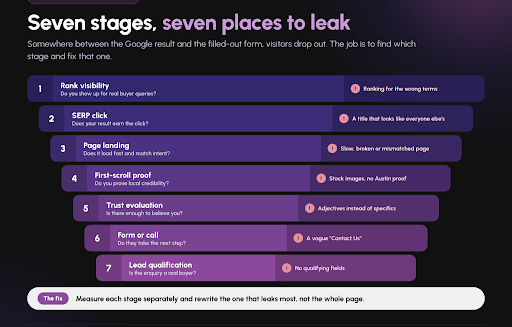
Austin is a competitive lead generation market because the buyer base is sophisticated and the service provider count is dense.
Think with Google’s 2026 research on local service search behavior shows that mobile local-service users typically make a visit, call, or form-fill decision within 2 minutes of their first search click, which means every stage of the pipeline has to work on the first attempt.
An effective SEO lead generation strategy doesn’t end when a visitor clicks on your website. It needs to guide that visitor through a series of connected stages, from discovering your business to becoming a qualified lead.
For Austin businesses, each stage needs to address a specific point of friction. Here’s how to structure the process:
Stage 1: Rank Visibility
The leak: The page does not rank for queries buyers actually use.
How Austin businesses lose here: Chasing head terms like “best SEO Austin” instead of the longer-tail, higher-intent queries.
Austin buyers actually type queries that are typically service plus submarket plus a modifier. Examples include ‘commercial roofer South Austin monsoon,” or “boutique PR firm East Austin SXSW”.
Head terms are rented with Google Ads; organic lead generation Austin wins come from mid-tail and long-tail queries.
The fix:
- Build pages for the specific submarket + service + qualifier combinations your buyers search for.
- Research the actual queries using Google Search Console, Google Business Profile Insights, and real customer interviews, not just a keyword tool.
- A typical Austin service business benefits from 8 to 15 submarket-specific pages with real differentiated content per page, not templates.
Stage 2: SERP Click
The leak: Page ranks but earns a low click-through rate from the search results.
How Austin businesses lose here: Generic title tags and meta descriptions that look identical to every other Austin result.
“Expert SEO Services in Austin, TX” is indistinguishable from four competitors on the same results page.
The fix:
- A title tag that names the specific service, specific submarket, and one differentiator.
- Meta description with a specific proof point and a specific action (“A South Lamar restaurant added 340 reservations in 90 days from local SEO. See the audit before you spend a dollar.”).
- Google Business Profile with current photos, reviews responded to within 24 hours, and category-matched posts.
Stage 3: Page Landing
The leak: Page loads too slowly, breaks on mobile, or does not match the click intent.
How Austin businesses lose here: Google Search Central’s page experience documentation is explicit that mobile Core Web Vitals affect both rank and user experience, and Austin’s mobile-first buyer base punishes slow pages harder than most metros.
Pages over 3 seconds on mobile Core Web Vitals, pages that redirect through tracking parameters that break on first load, or pages whose H1 does not match the title tag the visitor clicked.
- SEO lead generation service is all about optimizing pages to load under 2.5 seconds on mobile.
- H1 reads as the natural continuation of the title tag the visitor clicked.
- First meaningful content appears above the fold on mobile without scrolling. Images are compressed and lazy-loaded.
- No pop-ups, no interstitials, no “accept cookies” modal that covers the whole screen.
Stage 4: First Scroll Proof Check
The leak: Page loads but fails to prove local experience and category credibility in the first 30 seconds.
How Austin businesses lose here: This is the biggest leak that needs to be fixed by an SEO agency in Austin, and the one most generic plans ignore.
Pages that pass the headline scan but then show stock imagery, “trusted by hundreds” with no specific number, and “proudly serving Austin” without naming submarkets get closed before 30 seconds.
The fix:
- Name 5 to 8 specific Austin submarkets you serve. Include one Austin-specific context paragraph relevant to your category.
- Surface one specific Austin client proof point with a named submarket, named business type, and specific result in the first scroll.
- One Austin publication reference (Austin American-Statesman, Austin Business Journal, Austin Chronicle, Austonia, KUT) adds credibility weight.
Stage 5: Trust Evaluation
The leak: Visitor passes the first-scroll scan but fails to find enough credibility to justify filling the form.
How Austin businesses lose here: Adjective-heavy copy (“fair pricing,” “fully licensed,” “committed to quality”) without specific numbers, named platforms, or named credentials.
Austin buyers filter adjectives out and look for specifics; pages without specifics read as unprepared.
The fix:
- Replace adjectives with specifics. “Fully licensed and insured” becomes the actual Texas Department of Licensing and Regulation license number.
- Trusted by the community” becomes the real review score and review count from the specific platform (“4.8 stars across 240 Google reviews, response rate within 2 hours during business hours”).
- Fair pricing” becomes a price range or a what-drives-cost paragraph.
- Austin buyers who moved from higher-cost metros are specifically price-sensitive and reward transparency.
Stage 6: Form or Call Decision
The leak: Visitor passes the trust check and still does not fill the form or make the call.
How Austin businesses lose here: Generic CTAs (“Contact Us,” “Get a Quote,” “Request Information”) that make the visitor imagine what the first interaction will be instead of showing them.
Visitors who have to imagine the first interaction imagine the worst version (a long form, an aggressive sales call, a demand for budget before any value), and bail.
The fix:
- Run a SEO Audit, three findings before you fill in your email” beats “Contact Us” by a measurable margin.
- State the timing honestly (“90-second response during business hours, next-morning response outside business hours”).
- Add a visible phone number for the phone-first segment of Austin buyers, which skews higher than coastal tech metros because of the city’s established service economy and older homeowner segment. Place one specific proof point directly adjacent to the CTA.
Stage 7: Lead Qualification
The leak: Form fills come in, but most are unqualified (wrong budget, wrong service area, wrong category fit).
How Austin businesses lose here: Forms that ask for name and email only, with no qualifying fields.
Every submission becomes a sales team task; most are not real buyers, sales ignores or auto-replies, and real buyers never get called back.
The fix:
- Add 2 to 4 qualifying fields to the form without making it feel like an application.
- Budget range (if applicable), timeline, submarket, specific service needed. Include a one-line disqualifier above the form stating who should not fill it out (“Not accepting residential projects under $5,000; not serving outside Travis, Williamson, and Hays counties”).
- Qualifying fields raise form abandonment slightly but raise qualified lead rate significantly, and the net effect for Austin businesses is almost always more qualified enquiries per hour of sales time.
What Austin-Specific SEO Lead Generation Looks Like That Generic Plans Miss
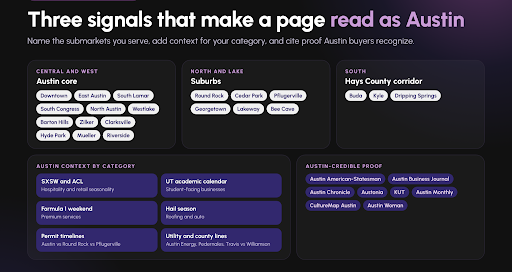
Three signals belong on every page a credible organic lead generation Austin provider produces:
- Named Austin submarkets with real content per submarket (Downtown, East Austin, South Lamar, South Congress, North Austin, Round Rock, Cedar Park, Pflugerville, Georgetown, Westlake, Barton Hills, Zilker, Clarksville, Hyde Park, Mueller, Riverside, Buda, Kyle, Dripping Springs, Lakeway, Bee Cave)
- Austin-specific context relevant to your category (SXSW seasonality for hospitality and retail, ACL weekend crowd dynamics, UT academic calendar for student-facing businesses, Formula 1 weekend for premium services, hail season for roofing and auto, City of Austin vs Round Rock vs Pflugerville permit timelines, Austin Energy and Pedernales Electric Cooperative service territories, Travis County vs Williamson County jurisdiction)
- Austin-credible proof sources (Austin American-Statesman, Austin Business Journal, Austin Chronicle, Austonia, KUT, Austin Monthly, Culture Map Austin, Austin Woman magazine) Pages without these three signals read as templates to Austin buyers. Pages built around them read as local.
What ROILift Does for Austin SEO Lead Generation Retainers
ROILift measures and reports on each of the seven pipeline stages separately for every SEO lead generation services in Austin retainer.
- Stage 1 (rank visibility): It is tracked via Google Search Console at the query-and-submarket level.
- Stage 2 (SERP click): Tracked via click-through rate per query.
- Stage 3 (page landing): Page landing is tracked via Core Web Vitals and bounce rate.
- Stage 4 (first scroll proof): It is measured via scroll depth and session heatmap data.
- Stage 5 (trust evaluation): The same tracking is followed, that is scroll depth and video engagement where applicable.
- Stage 6 (form or call decision): Tracked via form submission rate and call tracking data.
- Stage 7 (lead qualification): The detailed metrics can be identified via sales team feedback and closed-lost reasons.
Every month’s report names the stage that is leaking the most, the specific fix being made, and the expected impact.
Austin-specific submarket coverage, local proof sources, and category-relevant Austin context are built into every applicable page. Pricing is published.
No pipeline work begins without a written scope naming which stages are being targeted.
Frequently Asked Questions
Why does ranking first on Google not automatically produce more leads for Austin businesses?
the first-scroll proof check, the trust evaluation, the form decision, or the lead qualification. The common Austin failure is pages that rank well but convert at under 1%, which produces almost no leads despite strong rankings. The fix is pipeline optimization across all seven stages, not ranking improvement in isolation.
How is SEO lead generation for Austin businesses different from SEO lead generation in other large US metros?
Austin has three distinct dynamics: a sophisticated buyer base from the tech and professional services concentration, a strong submarket differentiation, and strong seasonality driven by SXSW, ACL, UT, Formula 1, and hail season. A generic plan misses these three dynamics. An Austin-specific plan builds around them, which raises the baseline performance of every pipeline stage.
What should local SEO leads Austin providers measure monthly to prove value?
At minimum: rankings per tracked query, SERP CTR per ranking position, pages per session, scroll depth, form submission rate, call tracking data, qualified lead rate per sales team feedback, and closed-won rate on sourced leads. Reports that show only rankings miss the pipeline stages below rank, which is where most Austin leads leak out.
How many submarket pages does an Austin service business actually need?
Enough to cover the submarkets you genuinely serve with distinct, differentiated content, not more. For most Austin service businesses, 8 to 15 submarket pages produce the best lead output. Template pages with one swapped submarket name are flagged by Google’s quality systems and often rank lower than the parent page.
How quickly does SEO lead generation produce qualified enquiries for a new Austin page?
xpect first measurable rank movement in 30 to 60 days after publication, first SERP clicks in 45 to 75 days, first form submissions in 60 to 90 days, and first closed deals in 90 to 180 days depending on sales cycle length. The pipeline compounds: each stage improvement multiplies against the stages above it, which means month 4 produces more leads than month 2, and month 8 produces more than month 4. Compound returns typically take 6 to 12 months to fully materialize for Austin service businesses.
Can an Austin business run SEO lead generation in-house without an outside provider?
The reasons most Austin businesses outsource it are (1) the time compounds against higher-value sales work, (2) pipeline-stage measurement requires experience with Google Search Console, Core Web Vitals, heatmap tools, and call tracking integrated together, (3) submarket content research takes category-specific knowledge, and (4) acting on monthly stage findings requires knowing which fixes actually move the needle. Most in-house efforts stall at stage one or stage four within three months.