table of Content
- 1.How to Compare SEO Services in Austin Before You Hire an SEO Agency
- 2. SEO Agency in Austin That Offers True Local Search Results
- 3. Transparent SEO Services For Austin Businesses
- 4.Local Expertise Is What Separates Austin SEO Services
- 5. Additional Factors to Consider For Best Local SEO Services in Austin
- 6.Scorecard For Your Comparison to Choose the Best SEO Agency in Austin
- 7. Final Words: Now You Know What You Need to Ask in Discovery Call
- FAQs
Key Takeaways
- SEO lead generation services in Phoenix work when the goal is leads, not rankings.
- The biggest lever is attribution tracing: knowing exactly which Google query, which lead channel, and which page element caused each received call.
- The common mistake is assuming every call comes from the same place.
- A credible SEO lead generation agency Phoenix businesses hire traces real calls backward every month and rebalances SEO investment based on which traces are producing the best cost per qualified call.
The most useful question in Phoenix SEO lead generation is not “how many leads did we get” or even “where did they come from.”
If your current SEO lead generation services provider in Phoenix cannot answer that for any call that landed last month, the retainer is paying for visibility, not calls.
And visibility without attribution is how Phoenix businesses end up ranked well and ringing less.
Here are three real Phoenix call traces, walked backward from the ring to the originating search, and what each one reveals about SEO lead generation Phoenix businesses need to actually invest in.
Why SEO Lead Generation Services in Phoenix Need to Be Measured
Ranking tells you where your page sits in the search results.
Measurement tells you whether that position is producing phone calls, form submissions, or direction requests.
These are two entirely different questions, and Phoenix SEO plans that answer only the first miss the one that pays for itself.
The practical reason is that Phoenix’s search behavior fractures by query type more than most metros. Google Search Central’s documentation on local search features confirms that the actions a mobile user takes from local results (call, directions, website visit, form submission) vary by query intent and surface type.
Phoenix amplifies the fracture because its household mix includes retirees, winter visitors, in-migrating professionals, and multi-generational households. Each with different default actions on the same query.
A single ranking number averaged across these behaviors tells you nothing useful. Measuring per-channel call volume and per-query action rates tells you where the retainer should invest next month.
The three call traces below do exactly that: each starts with a real phone call at a Phoenix business
Trace 1: The 2 PM July Emergency AC Call
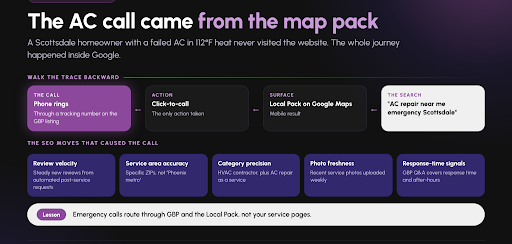
The call: Scottsdale homeowner, Tuesday afternoon in late July, outdoor temperature 112°F. Called an HVAC contractor’s direct line. Mentioned the AC system stopped cooling an hour earlier and the house was climbing past 85°F.
Walking the trace backward:
The call came through a tracking number assigned to the Google Business Profile listing.
Specifically, the click-to-call button on the mobile Google Maps result for the query “AC repair near me emergency Scottsdale.”
That listing appeared in the Local Pack (map pack) because the HVAC contractor had the category correctly set to “HVAC contractor” with “AC repair” as a service.
Additionally, the service area included Scottsdale with specific sub-ZIPs, 47 Google reviews from the last 90 days, and a 4.8 average.
The homeowner never visited the contractor’s website. The call originated entirely within Google’s Local Pack, with the click-to-call button the only action taken.
What this trace reveals:
Emergency Phoenix calls almost never route through traditional organic service pages.
They route through Google Business Profile, Local Pack visibility, and click-to-call. Phoenix businesses investing exclusively in website content for emergency categories (AC, plumbing, electrical, auto repair, urgent dental, 24-hour locksmith) leave most of this call volume unclaimed.
The SEO moves that caused the call:
- Review velocity: 47 reviews in 90 days, driven by a post-service automated review request.
- Service area accuracy: Specific sub-ZIPs instead of “Phoenix metro”
- Category precision: “HVAC contractor” primary, “AC repair” and “AC installation” as specific services
- Photo freshness: Recent summer service photos uploaded weekly
- Response-time signaling: GBP Q&A section included typical response time and after-hours availability
None of those are traditional SEO deliverables. All of them are what produces emergency call volume in Phoenix.
Trace 2: The September Planned Roof Replacement Call
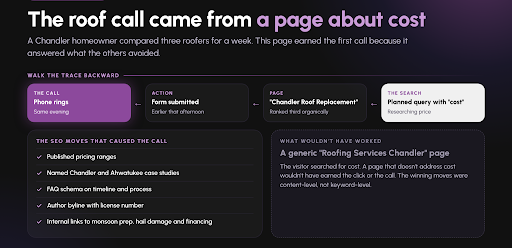
The call: Chandler homeowner, Wednesday evening in mid-September. Called a commercial-and-residential roofing contractor after submitting a form earlier that afternoon. Mentioned reviewing three contractors over the past week and choosing this one to speak with first.
Walking the trace backward:
The call followed a form submission from the contractor’s “Chandler Roof Replacement” page.
The form submission was triggered by a page visit. The page visit came from a Google click on the organic result by Roofing SEO.
The query itself was high-intent and planned, with “cost” as the qualifier indicating the visitor was researching pricing specifically.
The page ranked third because it had: published pricing ranges (most Chandler roofing pages did not), named case studies in specific Chandler submarkets.
Detailed FAQ schema answering “how long does a roof replacement take,” and an author byline with contractor license number.
What this trace reveals:
Planned Phoenix service calls route through traditional organic content, but only when the content answers the specific pricing, timeline, and process questions that other Phoenix pages avoid.
A generic “Roofing Services Chandler” page would not have produced this call because the visitor’s query had “cost” as the qualifier, and generic pages do not address cost.
The SEO moves that caused the call:
- Published pricing ranges on the page.
- Named Chandler and Ahwatukee case studies with specific details (addressing E-E-A-T).
- FAQ schema on roof-replacement timeline and process.
- Author byline with named license number.
- Internal linking from “Chandler Roof Replacement” to related pages (monsoon prep, hail damage, financing) that kept the visitor on the site.
A roofing page without those five elements would have ranked lower and converted worse even if it ranked. The specific moves that caused this call were content-level, not keyword-level.
Trace 3: The February Annual Pool Service Contract Call
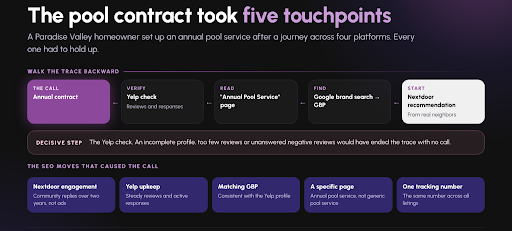
The call: Paradise Valley homeowner, Monday morning in early February. Called a pool service company to set up an annual maintenance contract ahead of the Phoenix pool season. Mentioned finding the company via Nextdoor Neighborhood Favorites, then double-checking reviews on Yelp before calling.
Walking the trace backward:
The call route was multi-touch.
Nextdoor neighborhood recommendations led to a Google search for the business name, which surfaced the Google Business Profile at the top of the results.
This linked to the website for a 4-minute visit to the “Annual Pool Service” page, which drove a cross-check on Yelp (4.7 stars, 180 reviews), which finally produced the call.
The initiating signal (Nextdoor recommendation) came from the pool service company’s two-year investment in Nextdoor presence.
Active responses on neighborhood threads about pool maintenance in Paradise Valley, Arcadia, Biltmore, and Scottsdale, a verified business profile, and a pattern of actual residents (not just the business) naming the company as their regular service.
The Yelp verification step was decisive.
If the Yelp profile had been incomplete, had fewer reviews, or had unresponded-to negative reviews, the trace would have ended there without a call.
What this trace reveals:
Routine Phoenix service calls often require 2 to 4 touchpoints across different channels, and each channel has to be tuned.
Organic leads Phoenix businesses produce for routine maintenance categories (pool, lawn, pest control, housekeeping, annual HVAC tune-up) require coordinated presence across neighborhood platforms, review platforms, Google Business Profile, and the website.
A single-channel plan misses the multi-touch dynamic entirely.
The SEO moves that caused the call:
- Nextdoor community engagement (not advertising) over 24 months.
- Yelp profile maintenance with 180 reviews and active response patterns.
- Google Business Profile matching the Yelp profile for consistency.
- Website page specifically for annual pool service (not generic pool service).
- Clear phone number in all three channel listings matching the same tracking number.
Four of those five are not what most SEO companies in Phoenix retainers include, but all five were required to produce this call.
What the Three Traces Teach About Phoenix SEO Lead Generation
Each call came from a different search, through a different channel, triggered by a different set of SEO moves.
The emergency trace required Local Pack and GBP investment. The planned trace required content depth and schema. The routine trace required multi-channel consistency and community platforms.
A Phoenix SEO lead generation agency Phoenix businesses hire should trace at least 10 calls every month this way.
Which calls came from the Local Pack. Which came from organic service pages. Which came from multi-touch journeys. Which were high-intent emergency. Which were planned. Which were routine. The trace pattern tells you where to invest next month.
A plan that cannot trace calls is a plan that is guessing. Guessing is expensive in Phoenix because the market is competitive enough that every month spent in the wrong channel costs real revenue.
Frequently Asked Questions
Why trace calls backward instead of just counting them?
Because the count tells you only one number, and the trace tells you where that number came from and how to grow it. Counting 30 calls tells you nothing about whether tomorrow’s SEO work should focus on Local Pack, organic pages, Nextdoor, or publication mentions. Tracing those 30 calls backward tells you exactly where next month’s investment produces the best return.
How is SEO lead generation in Phoenix different from other large Sunbelt metros?
Phoenix has three dynamics that reshape SEO lead generation. Seasonal urgency (monsoon, pool season, summer AC) that spikes emergency-call categories, an older homeowner segment that skews phone-first over form-first, and a service economy that over-indexes on home services where multi-touch journeys through neighborhood platforms carry heavier weight. A plan built for Dallas or Las Vegas misses the seasonal cycle timing and the multi-touch patterns.
How many calls should a Phoenix business trace monthly to get useful patterns?
At least 10, ideally 15 to 25. Fewer than 10 produces anecdotal patterns that can mislead. More than 25 adds diminishing returns relative to the hours required. The traces should span emergency, planned, and routine categories if the business serves more than one, so the plan can rebalance per category. If the business is single-category (say, strictly emergency plumbing), 10 traces from that category monthly is enough.
What specific tools or data are required to trace calls backward credibly?
Call tracking software with multiple numbers assigned per channel (CallRail, CallTrackingMetrics, WhatConverts, or similar), Google Business Profile Insights (direct and discovery searches, direction requests, calls), Google Analytics or GA4 with event tracking on form submissions and click-to-call, Google Search Console for organic query data, and sales team feedback on call quality per attribution.
How quickly do call traces produce enough data to reshape an SEO plan?
Expect usable pattern data within 60 to 90 days. The first 30 days typically produce too few calls to be statistically meaningful. By month 2, patterns start to emerge. By month 3, the retainer should have a documented trace breakdown driving month-4 investment priorities. For businesses with higher monthly call volume (20+ calls), useful patterns can emerge in 30 to 45 days.
How much does Phoenix SEO lead generation with call tracing cost compared to a standard plan?
Plans with full call tracing and multi-channel attribution typically run 15 to 25% higher than plans without tracing. The call tracking subscription and the monthly attribution work take real time. The cost delta pays back when investment gets rebalanced accurately: a $2,500 plan producing 18 qualified calls at $139 per call beats a $2,000 plan producing 8 qualified calls at $250 per call. The honest comparison is cost per qualified call with attribution, not retainer size in isolation.