table of Content
- 1.How to Compare SEO Services in Austin Before You Hire an SEO Agency
- 2. SEO Agency in Austin That Offers True Local Search Results
- 3. Transparent SEO Services For Austin Businesses
- 4.Local Expertise Is What Separates Austin SEO Services
- 5. Additional Factors to Consider For Best Local SEO Services in Austin
- 6.Scorecard For Your Comparison to Choose the Best SEO Agency in Austin
- 7. Final Words: Now You Know What You Need to Ask in Discovery Call
- FAQs
Key Takeaways
- WordPress SEO services in Los Angeles solve ranking problems by running three parallel audits (Core Web Vitals, Plugin Health, Indexing Health).
- The biggest lever for LA specifically is Core Web Vitals on mobile, because LA traffic skews mobile-first.
- The common mistake is tackling the three domains in sequence (fix speed, then plugins, then indexing); the three are interconnected, and work in one domain often surfaces problems in the others that get missed when the audits run separately.
Most Los Angeles WordPress sites that stopped ranking well this year are carrying technical debt no one person is tracking.
SEO team is auditing content when the actual ranking problem sits in Core Web Vitals, the plugin stack, and Google’s crawl behavior. WordPress SEO services in Los Angeles solve that specific compound problem by running parallel audits instead of the one generic SEO audit most providers deliver.
Here are the three parallel audits credible WordPress technical SEO Los Angeles work runs, the LA benchmark for each, and what failing any of them costs in rankings and leads.
Audit 1: Core Web Vitals Health With WordPress SEO services in Los Angeles
Mobile LCP (Largest Contentful Paint), INP (Interaction to Next Paint), and CLS (Cumulative Layout Shift) across your top traffic-generating pages.
Think with Google’s 2026 research on local service search shows LA buyer behavior skewing mobile-first, which means mobile Core Web Vitals failures cost measurably more in LA than in slower metros.
LA-Specific Benchmarks:
- Mobile LCP under 2.0 seconds on 4G and 5G connections. LA buyers on 5G networks in Westside submarkets actively compare page load times across competitors within the same search session, so a 2.4-second LCP that passes Google’s threshold still loses to a competitor at 1.6 seconds in real buyer behavior.
- Mobile INP under 150 ms on interaction-heavy pages (service pages with form fills, filterable listings, image galleries). Entertainment industry and professional services sites in Hollywood, Beverly Hills, and West LA frequently fail INP because of chat widgets, scheduling plugins, and third-party review embeds loading on page interaction.
- CLS under 0.05 on priority pages, which is tighter than Google’s 0.1 threshold. LA mobile buyers consistently bail from pages where content shifts during load, and ad-heavy or video-embed-heavy LA sites fail CLS at measurable rates.
What Failure Costs in LA?
Rankings drop specifically on mobile queries first.
Desktop rankings typically hold 30 to 60 days longer, which gives LA businesses false confidence that the site is fine before mobile ranking losses compound into total query drops.
Something that only profound technical SEO service agency will highlight.
The fixes:
- Image optimization.
- Audit third-party scripts (chat widgets, review widgets, call tracking, analytics).
- Theme audit for render-blocking resources; switch to a lightweight theme if the current theme loads unused CSS and JavaScript on every page.
- Font strategy: self-host fonts with font-display: swap, preload critical fonts, reduce font variants.
- Database optimization to reduce query time on complex pages; this often improves INP more than any front-end change.
Audit 2: Plugin Health
The full plugin stack, including active plugin count, abandoned plugin presence, overlapping functionality, update status, and plugin-specific security profile.
LA-specific benchmarks:
- LA sites consistently accumulate 35 to 50 active plugins because of the layered agency rotation pattern common in the metro, where each agency handoff adds plugins without removing legacy ones.
- Zero abandoned plugins (no updates in 12+ months). LA sites often have 3 to 7 abandoned plugins that have been forgotten but still load code and attack surface on every page.
- Single SEO plugin, not two. LA sites frequently have Yoast and Rank Math both active because a previous agency installed one, the current agency installed the other, and neither got cleaned up.
- At least 2 overlapping plugins per LA site in categories like security, caching, image optimization, and forms. These overlaps should be collapsed to a single plugin per category.
What Needs to Be Avoided With WordPress SEO in Los Angeles?
Page load time degrades, security risk increases, and plugin conflicts produce inconsistent SEO signals that confuse Google’s crawler.
The fixes:
- Plugin inventory with “last used” classification; deactivate and delete anything unused in the last 90 days.
- Replace any abandoned plugin (12+ months without update) with a maintained alternative.
- Consolidate overlapping plugins to one per category: one SEO plugin, one caching plugin, one image optimization plugin, one security plugin, one form plugin.
- Review plugins specifically interacting with Spanish, Mandarin, Korean, or Russian language markets if your LA business serves submarkets where those languages are prominent.
- Database cleanup for options and postmeta data left behind by deleted plugins
Audit 3: Indexing Health
Google Search Console coverage report, sitemap submission and validation, crawl stats, canonical tag integrity, schema markup validation, and internal linking depth.
LA-specific benchmarks:
- 5% of URLs in “Discovered but not indexed” or “Crawled but not indexed” status. Over 10% signals that the LA site is burning crawl budget on low-value URLs that should be noindexed or consolidated.
- The submitted sitemap matches the actual indexable URLs on the site. LA sites commonly have sitemaps that include deleted pages, redirected URLs, or pages with noindex tags, which confuses Google.
- Every page has exactly one canonical tag. LA sites with two SEO plugins, or a theme and a plugin both setting canonicals, produce duplicate canonical signals.
- Priority page validates cleanly in Google’s Rich Results Test. LA sites after plugin or theme updates frequently have schema that was valid last month and is not valid this month.
- LA sites with deep category structures or hidden service pages often have pages buried 5 to 7 clicks deep, which Google treats as low priority.
Cost of Failure
New content takes longer to index, existing content loses crawl budget share. Additionally, AI engine citations (ChatGPT, Perplexity, Claude, Google AI Overviews) become inconsistent because the entity signals the engines rely on are confused.
The fixes:
- Review every “Discovered but not indexed” URL, decide per URL whether to noindex, consolidate, or improve.
- Regenerate the sitemap from the correct source and resubmit in Google Search Console.
- Audit canonical tags using Screaming Frog or Sitebulb; disable duplicate canonical sources.
- Revalidate schema on every priority page; fix broken implementations.
- Flatten internal linking structure; ensure every revenue-producing page is linked from at least two hub pages.
When All Three Audits Converge
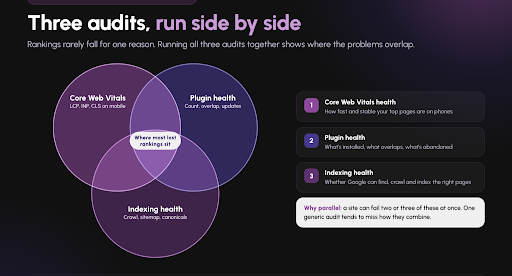
Most LA WordPress sites that have lost rankings in the last 12 months fail on 2 or 3 of these audits simultaneously.
The compound failure signal looks like this: mobile LCP is at 3.1 seconds, active plugin count is 34, and 14% of URLs are in “Crawled but not indexed” status.
No single one of those would cause ranking collapse on its own. The three together produce a 20 to 40% organic traffic decline over 6 to 12 months that gets diagnosed by generic SEO.
Everyone assumes the fact that “the content needs more work,” which is almost never the real cause.
The parallel audit with professional SEO service in Los Angeles catches the compound signal. Because it looks at all three simultaneously and prioritizes fixes by which domain’s failure is producing the largest ranking impact.
LA sites with heavy mobile traffic typically get Core Web Vitals prioritized first; sites with heavy indexing errors typically get the Coverage cleanup prioritized first; sites with 40+ plugins get plugin consolidation prioritized first.
What LA Specifics Matter in Every WordPress Audit
Three LA signals belong in every WordPress SEO service Los Angeles engagement:
- Named LA submarkets in the audit scope (Westside, Central LA, Hollywood area, Valley, Eastside, South Bay, Pasadena area) because submarket-specific pages frequently have different performance characteristics than city-level pages.
- LA-specific multilingual considerations because language-specific plugins and content affect both plugin health and indexing.
- LA-specific regulatory and infrastructure content (LADBS permits, LADWP service territory, Title 24 energy requirements, Mello-Roos districts, rent control status) preserved exactly through schema and content audits.
Frequently Asked Questions
Can an LA business run all three WordPress audits themselves in-house?
Yes, with roughly 12 to 20 hours of dedicated technical time and someone proficient with Google Search Console, PageSpeed Insights, Screaming Frog, WordPress admin tools, and database management. Most LA businesses outsource because the hours compound against higher-value work and because interpreting the three audits together requires experience diagnosing which combination of issues is producing the actual ranking impact.
Why does WordPress SEO Los Angeles work differently than WordPress SEO in other large US metros?
LA has three compounding dynamics: extreme submarket fragmentation that makes submarket-specific page performance matter more than city-level performance, high mobile traffic skew driven by the demographic and behavioral mix of the metro, and dense agency rotation history on most established business sites that produces layered plugin accumulation generic markets do not match.
Which of the three audits should an LA business prioritize if resources are limited?
Core Web Vitals first for most LA service businesses because mobile traffic is the dominant source of leads, and Google’s mobile ranking signal responds fastest to Core Web Vitals improvements. Plugin Health second because plugin consolidation often improves Core Web Vitals as a byproduct. Indexing Health third because indexing issues typically take 60 to 120 days to resolve after fixes, so the work benefits from starting in parallel with the others even if the first visible wins come from the other two.
Does hosting choice affect LA WordPress SEO outcomes?
Significantly. LA WordPress sites on shared hosting consistently fail mobile Core Web Vitals benchmarks regardless of plugin consolidation or image optimization
How do multilingual LA submarkets affect WordPress SEO work?
Significantly, if your business serves Spanish, Mandarin, Korean, or other non-English LA submarkets. Multilingual LA sites often add translation plugins (WPML, Polylang, TranslatePress) that can conflict with SEO plugins, caching plugins, and theme implementations, producing hidden performance and indexing issues. A WordPress SEO audit for an LA business serving multilingual submarkets must specifically test each language version for Core Web Vitals, indexing, and schema validity independently.
Do LA WordPress multisite installations need a different audit approach?
Yes, significantly. Multisite installations (one WordPress network with multiple sub-sites, common for LA businesses with multi-brand portfolios or multi-location setups) share a database, share plugin activations partially, and can have confusing canonical tag behavior across sub-sites.