Key Takeaways
- Content marketing services in Phoenix are usually judged by the wrong number: monthly blog traffic. The number that matters is monthly sales conversations sourced from that content.
- The gap between blog traffic and sales conversations is where most Phoenix SMB content programs leak. There are five specific leak points, and each one has a measurable fix that can be made in 2 to 6 weeks.
- A Phoenix content program with hundreds monthly blog visits and 3 sales conversations per month has a leak problem, not a traffic problem. Doubling traffic to 16,000 visits without fixing the leaks produces 6 conversations, not 60.
Content marketing services in Phoenix often get sold on the first half of the funnel and ignore the second half.
A program produces blog posts, the blog posts earn traffic, the traffic gets reported in monthly analytics screenshots, and the sales team sees almost none of it.
The gap between a visitor reading an article and a sales conversation starting is where most Phoenix small businesses never look. Traffic that does not produce conversations is a cost, not an asset.
The Gap: Why Traffic Without Conversations Is a Cost
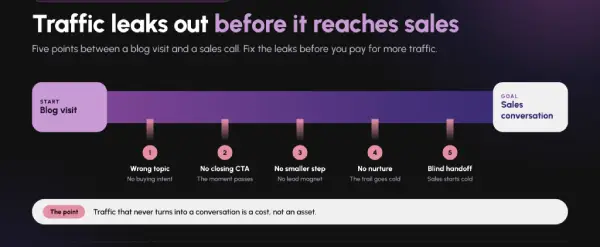
Blog traffic by itself produces no revenue.
The visitor lands, reads part of the article, and leaves. The business pays for the writing, the hosting, the SEO work, and the time spent planning.
If the visitor never returns, never fills a form, never joins a list, the full chain of investment produced by that signal has indirect value.
A functioning content program converts a measurable share of visits into next steps.
The next step can be small (newsletter subscription) or large (contact form, phone call, demo request).
What matters is that each visitor has a clearly offered next step tied to what they just read.
The Content Topic Does Not Match a Buying Intent
The first leak is where the visitor should never have arrived.
A piece titled “10 benefits” ranks for a query that produces casual browsers, not buyers.
Topic selection is the biggest leak because it affects every downstream metric.
A proficient content strategy services in Phoenix program doesn’t score topics by estimated search volume alone.
A program that scores topics by buyer intent plus volume ends up with fewer articles and meaningfully more sales conversations per piece.
The fix:
- Score each topic on two axes before writing.
- Volume (does enough search traffic exist to justify the piece) and intent (does the query signal a decision moment or just curiosity).
- Keep only the topics that pass both.
The Article Has No Bottom-of-Content CTA
The second leak sits at the end of the article.
The visitor finished reading.
They have your topic in their head and your brand in front of them. If the article ends with a generic footer and no clear next step, the moment passes.
Most Phoenix SMB blog articles have one of three endings.
- The first is no CTA at all: the article just stops.
- The second is a generic “contact us” link in the footer.
- The third is an aggressive “book a call” button the reader is not ready for.
All three leak visitors who would have taken a smaller step if it had been offered.
For an SEO audit tied to a Phoenix SEO article, the CTA fits because the article reader is researching the exact service the audit covers.
No Lead Magnet or Secondary Conversion Asset
The third leak catches the readers who are not ready for the primary CTA but are ready for something smaller.
Most Phoenix content programs have one conversion path: the main contact form. Without any form, the readers leave without a trace.
The fix:
- Build a lead magnet or secondary conversion asset tied to each content cluster.
- Each business in Phoenix gets a specified content list for email.
The email list that forms from lead magnet downloads becomes the asset the content program feeds for months or years.
Pair the content build with email marketing services in Phoenix so the subscribers who download a lead magnet move through a nurture sequence tied to the content cluster.
No Nurture Bridge Between Content and Sales
The fourth leak is the gap between email subscription and sales readiness.
Someone downloaded the lead magnet, and now they are on the list.
If the next email they receive is a monthly newsletter two weeks later, the connection to the original content moment is gone.
Most Phoenix content programs have strong production and weak nurture. The fix is a content-specific nurture sequence that fires immediately after each lead magnet download.
Pew Research Center’s 2026 tracking of older adults and technology shows the 65-plus cohort engaging with email at consistent but less frequent cadences than younger cohorts;
The content marketing Phoenix program that adjusts nurture cadence by audience age tends to produce substantially higher conversion rates from the same traffic.
Sales Has No Visibility Into Content-Sourced Leads
The nurture sequence worked. The subscriber clicked a decision-stage link, visited the pricing page, and then filled the main contact form.
The form submission arrives in the sales inbox with no context about what the lead read, downloaded, or opened in the previous 90 days.
Without the content history, the first sales call starts cold.
The salesperson asks questions the content already answered, repeats positioning the subscriber already read, and misses the specific objection.
The content marketing investment paid for the attribution signal, and the sales process threw it away.
The fix:
Tag every lead at every content touch and surface the full history in the sales handoff.
The salesperson opens the lead record and should see: downloaded the monsoon checklist, submitted the contact form, and additional queries.
This facilitates the call to start with the right question, the right positioning, and the right next step.
For Phoenix businesses using a CRM that supports lead scoring and content tagging, the fix is configuration work, not new platform cost.
For Phoenix businesses still running sales out of a shared inbox, the fix requires moving to a CRM first.
The Phoenix-Specific Layer Across All Five Leak Points

Three Phoenix market characteristics change how the five leak points should be addressed:
Phoenix seasonality shifts which content clusters leak hardest at which moments.
Weather-adjacent categories see a sharp traffic spike as the weather changes.
A content strategy with SEO services in Phoenix program should stress-test its conversion assets before the peak season starts.
Phoenix category economics favor fewer, better articles over high-volume publishing.
The leak fixes matter more than the article count. Pair the content build with coordinated Phoenix SEO services so the organic coverage strategy and content production strategy share the same keyword.
The 3 Hours That Fix Your Biggest Leak
Open your analytics.
Pull your top 20 blog articles by traffic from the last 90 days.
Open each one and look at the bottom of the content. Count how many have a clear, relevant next step offered. Add a specific next step to the remaining articles.
The Phoenix businesses producing sales conversations from content marketing are not the ones publishing the most articles.
They are the ones measuring each leak point and fixing the biggest one first, then compounding across the full funnel. A SEO audit covers the organic traffic side of the same question with three specific findings before it asks for an email.
For Phoenix businesses running multiple channels, ROILift prioritizes fix list weighted by the biggest leak first. Monthly reporting carries both traffic and conversation numbers so the owner sees whether the content is moving the metric that matters.
Frequently Asked Questions
Is it better to refresh old content or publish new content?
Refresh first, then publish new. Most Phoenix SMB blogs have 10 to 30 articles already indexed; a content refresh on the top 5 traffic-earning pieces usually produces faster lift than a new article because Google already trusts the URLs.
Which leak should a Phoenix business fix first?
Start with bottom-of-content CTA because it is the cheapest to fix and often the biggest single lift. Most Phoenix SMB blog articles end with no next step at all.
What should content marketing services in Phoenix cost?
Setup fees for the initial 30-day leak audit and infrastructure build run $2,500 to $8,000 depending on the state of the current program and the number of lead magnets built in the first 90 days.
How is this different from standard content marketing that every agency pitches?
Standard content marketing pitches start and end with publishing volume. The leak-point approach starts with where traffic stops converting and fixes those specific points before adding more traffic. The outputs include articles but also lead magnets, nurture sequences, CTA infrastructure, and sales handoff configuration.
How long before the fixes produce measurable sales conversation increases?
Bottom CTAs)typically produce measurable lift within 14 to 30 days because they act on existing traffic. Lead magnets produce lift within 30 to 60 days as the opt-in list grows. Nurture produce lift within 45 to 90 days as subscribers move through sequences. Sales handoff produce lift within 30 to 45 days once the CRM visibility is configured.
Can the five-leak approach work for Phoenix businesses with low current blog traffic?
Yes, with adjustments. Phoenix businesses with under 500 monthly blog visits should prioritize topic intent and lead magnet before, because the article count is too small to measure CTA lift reliably. The focus becomes building the first 10 to 15 high-intent articles with lead magnet infrastructure in place from day one, rather than retrofitting existing low-traffic content.