table of Content
- 1. How Subscriber Count Determines Which Automation for Email Marketing in Austin to Build First?
- 2.Milestone 1: Under 500 Subscribers = Build the Welcome Series
- 3.Milestone 2: Add Cart Abandonment Recovery
- 4.Milestone 4: Add Win-Back and Sunset Flow
- 5.Milestone 5: 10,000+ Subscribers → Add Segmented Lifecycle and Behavioral Triggers
- 6. What ROILift Does for Austin Email Marketing Engagements
- FAQs
Key Takeaways
- Email marketing services in Austin produce the biggest return when automations get built in the order your subscriber count unlocks.
- The first automation to build is the welcome series, and each later automation (browse recovery, cart recovery, post-purchase, win-back, segmented lifecycle) earns its place at a specific list-size threshold where the math starts working.
- A credible Austin email marketing agency sequences the build in milestones, not in a six-month rollout, and reports revenue by automation so the reader sees which ones are carrying the account.
Email marketing services in Austin get pitched as “set up all the automations and watch the revenue roll in.”
The reality looks different. An Austin business with 400 subscribers needs one specific automation turned on, not seven.
An Austin food outlet with 8,000 subscribers needs a different one, and the automation that makes sense at 8,000 would produce almost nothing at 400.
The question of which email automation to build first has a sharper answer than most Austin business owners realize: build the one your current subscriber count can actually feed.
How Subscriber Count Determines Which Automation for Email Marketing in Austin to Build First?
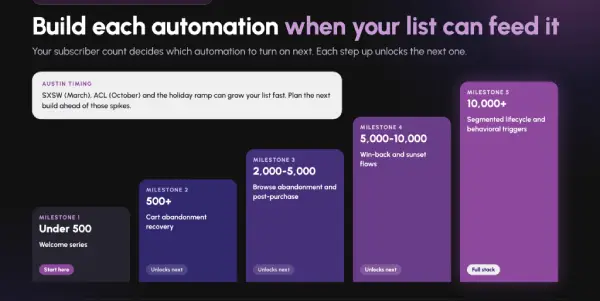
This piece walks through five subscriber milestones and the automation each one unlocks.
The thresholds are not rigid, and some businesses move faster or slower based on category and transaction frequency.
Austin seasonal spikes (SXSW in March, ACL in October, the holiday retail ramp from November to late December) accelerate list growth for some categories and should influence the timing.
Across most Austin small businesses, the order below reflects where the math actually starts working, drawn from aggregate behavior in Pew Research’s 2026 survey on consumer email engagement and category benchmarks published by Google’s small business marketing guidance.
Milestone 1: Under 500 Subscribers = Build the Welcome Series
At under 500 subscribers, exactly one email automation deserves the time to build and maintain. Every other automation produces too little volume at this stage to earn the attention.
The welcome series is three to five emails sent to someone who just joined your list.
For an Austin coffee shop, this might be:
- Email 1 (immediate) confirms the signup and shares the free code.
- 2nd email (day 2) tells the origin story of the roastery.
- Day 4 features a flagship blend; email 4 (day 7) invites the subscriber to an upcoming cupping event at the East Austin location.
For an Austin boutique, the same five-email structure might cover welcome plus code, brand founder story, bestseller edit, styling guide, and a quiet upsell to the newest collection.
Why it belongs first at any list size: a new subscriber is at their highest engagement point in the first 72 hours after signing up.
Pew Research data indicates email open rates from new subscribers run 45 to 70 percent in the first week and drop by half after 30 days.
The welcome series captures the window that will not come back.
If the business has one, it converts meaningfully better than a universal percentage discount.
For e-commerce brands, segmenting the welcome series by signup source (homepage popup versus SXSW event signup versus loyalty program) often produces 15 to 25 percent higher first-purchase conversion than a single universal welcome track.
Milestone 2: Add Cart Abandonment Recovery
Once an Austin business crosses 500 subscribers and starts seeing even modest weekly purchase volume, cart abandonment recovery becomes the second automation to build.
It sits on live purchase intent and produces revenue that would otherwise disappear.
The flow is typically three emails:
- Email 1 at one hour after abandonment (gentle reminder, cart preview, no discount).
- Email 2 at 24 hours (social proof, review snippets, value framing).
- 3rd email at 72 hours (a modest incentive, usually free shipping before a percentage discount).
Under 500 subscribers, most Austin e-commerce businesses see fewer than 10 abandons per week, which is not enough signal to optimize the flow or confirm its impact.
Above 500 subscribers with regular purchase traffic, abandons typically run 20 to 100 per week, which is enough to measure and improve.
Austin businesses with physical locations, cart abandonment emails can route the subscriber to local pickup rather than only online checkout.
Milestone 3: Add Browse Abandonment and Post-Purchase
At the 2,000 to 5,000 subscriber range, two automations deserve attention together, because they catch the subscriber at the two moments adjacent to a purchase that most Austin businesses leave completely ignored.
Browse abandonment recovery triggers when a subscriber viewed specific product pages but did not add to cart.
The flow is usually two emails: one at four to six hours (product reminder, similar items), one at 48 hours (limited time framing or social proof).
The email automation service for this phase only earns its place at this list size because it needs enough product-page traffic from identified subscribers to generate measurable triggers.
Post-purchase sequences trigger immediately after a purchase and continue for 60 to 90 days.
Why both belong at this list size: at under 2,000 subscribers, post-purchase volume is not enough to produce meaningful second-purchase or cross-sell revenue, and browse abandonment produces too few triggers to measure.
Above 2,000 subscribers for most Austin categories, both start producing revenue worth the setup time.
Austin-specific build notes: post-purchase sequences for Austin brands can incorporate the local community angle. For SEO audit, the post-purchase email can be paired with an organic coverage check so the reader sees whether Google search is also feeding the same customer segment.
Milestone 4: Add Win-Back and Sunset Flow
Between 5,000 and 10,000 subscribers, list hygiene becomes a measurable revenue issue.
The automations that solve this are the win-back flow and the sunset flow.
The win-back flow targets subscribers who have not opened or clicked in 60 to 120 days. A typical flow is three emails over 14 days:
- Email 1 (question-framed re-engagement, “still want this?”).
- 2nd email (reminder of benefits plus a modest offer)
- Email 3 (final attempt plus unsubscribe option).
Subscribers who do not re-engage move to the sunset flow, which removes them from the active list after a final warning.
Why both belong at this list size:
Under 5,000 subscribers, most Austin businesses have not yet accumulated enough dormant subscribers to see deliverability drag.
Above 5,000, dormant subscribers typically make up 20 to 40 percent of the list, and their non-engagement starts pulling inbox placement rates down for active subscribers, which reduces revenue from every other automation.
Milestone 5: 10,000+ Subscribers → Add Segmented Lifecycle and Behavioral Triggers
At 10,000 subscribers and above, segmentation and behavioral triggers become the next frontier.
By this list size, every subscriber has already accumulated enough behavior data to warrant automations built on those specific signals.
The segmented lifecycle of email marketing services from a reputable agency delivers different content paths to different subscriber segments.
Each segment gets its own cadence, content mix, and offer structure.
The behavioral trigger automation fires on specific actions: a subscriber visited the high-ticket product page three times in two weeks, a subscriber opened six promotional emails in a month but never purchased, a subscriber has not browsed in 45 days but is historically a monthly buyer. Each specific behavior triggers its own small flow.
Austin businesses with strong tourist and conference audiences should maintain a separate behavioral segment for subscribers who signed up during SXSW or ACL.
Their purchase and engagement patterns differ meaningfully from local Austin subscribers, and treating them as one segment dilutes both.
Pair the segmentation work with paid search support so retargeting and email segments feed each other rather than running as isolated silos.
What ROILift Does for Austin Email Marketing Engagements
ROILift builds the automation stack for an Austin business in the order the subscriber count unlocks, not in the order a template suggests.
The first engagement always starts with a 30-day audit of the current list health, deliverability, and existing automations.
This is followed by a written sequence plan tied to the current subscriber count and projected growth.
Revenue is reported per automation monthly, so the reader can see which ones are carrying the account and which ones are not pulling their weight.
No other email marketing agency Austin engagement begins without a written list-health audit. A 90-day build roadmap and specific revenue targets by automation. Pair the email build with coordinated Austin SEO services so organic search and email share the same customer segment definitions.
Frequently Asked Questions
How long does each automation take to build before it starts producing revenue?
Welcome series: 1 to 2 weeks to build, 2 to 4 weeks to produce measurable revenue. Browse abandonment and post-purchase: 2 to 3 weeks to build, 4 to 6 weeks to produce revenue. Win-back and sunset: 1 week to build, 30 to 60 days to see deliverability lift. Segmentation and behavioral: 3 to 6 weeks to build, 60 to 90 days to see revenue lift. A realistic Austin SMB roadmap stacks automations across 4 to 6 months.
What email platform do you need to run all of this?
Any major platform supports the full automation stack: Klaviyo (strongest for Austin e-commerce brands), Mailchimp (fits smaller lists and professional services), ActiveCampaign (fits service businesses with CRM integration needs), HubSpot (fits businesses already using the CRM). The platform matters less than the sequencing.
How much should email marketing services in Austin cost?
Published fees for Austin email marketing retainers typically run $1,500 to $5,000 per month depending on list size, automation count, and campaign cadence. Setup fees for building a full automation stack run $3,000 to $12,000 depending on complexity and number of integrations.
How do I know email marketing is the right next investment and not paid ads or SEO?
Email marketing produces the highest return when there is already traffic to convert. If your Austin business has 10,000 monthly website visitors but only 300 subscribers, invest in email first because the lift is immediate. If your Austin business has 500 subscribers and 400 monthly visitors, invest in traffic acquisition first (SEO or paid search) before email, because email needs a feed to grow.
What email automation Austin businesses skip but should not?
Most Austin SMBs leave dormant subscribers on the list indefinitely, which drags inbox placement down for active subscribers. Removing 2,000 dormant subscribers from a 10,000-subscriber list can lift open rates by 5 to 15 percentage points across every other automation, which produces meaningful revenue lift without any new content. This is the single highest-ROI email project many Austin businesses are not doing.
Can email marketing work for Austin businesses that do not sell online?
Yes, but the milestones and automations shift. For Austin home services, professional services, and brick-and-mortar retail without e-commerce, replace cart abandonment and browse abandonment with appointment reminder, service reminder, and in-store visit follow-up flows. The welcome series, win-back, and post-service flows all still apply.