table of Content
- 1.How to Compare SEO Services in Austin Before You Hire an SEO Agency
- 2. SEO Agency in Austin That Offers True Local Search Results
- 3. Transparent SEO Services For Austin Businesses
- 4.Local Expertise Is What Separates Austin SEO Services
- 5. Additional Factors to Consider For Best Local SEO Services in Austin
- 6.Scorecard For Your Comparison to Choose the Best SEO Agency in Austin
- 7. Final Words: Now You Know What You Need to Ask in Discovery Call
- FAQs
Key Takeaways
- Email marketing services in Los Angeles get judged by campaigns sent per month. The number that matters is revenue contribution per program component, measured monthly.
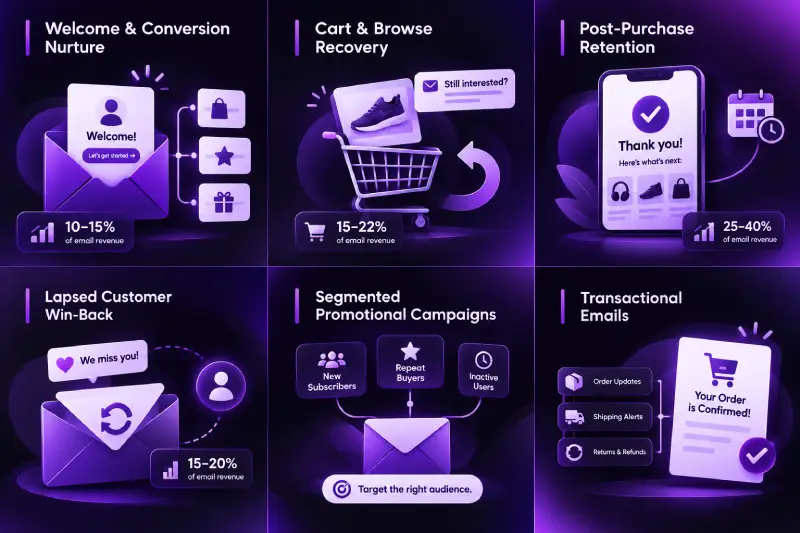
- A complete revenue-focused LA email program has six components: welcome and conversion nurture, cart and browse recovery, post-purchase retention, lapsed customer win-back, segmented promotional campaigns, and transactional email revenue.
- The highest-contribution component is almost never the newsletter; it is post-purchase retention plus win-back.
Email marketing services in Los Angeles usually get packaged as “two newsletters a month plus a promo calendar.”
That packaging produces campaigns that look busy and revenue that looks thin. The LA small businesses getting real returns from email treat the program as a portfolio of revenue components, each one measured separately and built to contribute its own share.
The question is not how many emails go out. The question is what each component contributes to monthly revenue.
LA is a market where the components behave slightly differently than the national average. The U.S. Bureau of Labor Statistics data for the Los Angeles-Long Beach-Anaheim MSA shows an economy weighted toward entertainment, direct-to-consumer retail, wellness, hospitality, professional services, and a growing tech sector in Silicon Beach (Santa Monica, This facts matter for how a revenue-focused program should be built.
Why Revenue Contribution Is the Right Lens
A revenue-focused email program is a portfolio.
Each component plays a different role, carries a different build cost, and produces a different share of monthly revenue.
Judging the program by campaign count is like judging a stock portfolio by how many trades happened last week.
The output that matters is attributable revenue per component per month, reviewed in the same place.
The six components below cover the full span of what a LA SMB email program should include.
Each section walks through what the component does, what signals it needs, and what it typically contributes.
The table after the third component shows all six side by side with typical revenue contribution ranges for LA businesses, so you can compare where your program is weighted today against where it should be.
Component 1: Welcome and Conversion Nurture
The welcome series meets a new subscriber at the moment their engagement is highest.
A revenue-focused welcome series runs 4 to 6 emails over 10 to 21 days, split by signup source.
An LA DTC fashion brand gives Beverly Hills-adjacent signups a different welcome than Venice-adjacent signups because the purchase patterns differ.
The split is not cosmetic; it changes conversion rate in the first 30 days by 10 to 25 percent for most LA categories.
Conversion nurture extends the welcome for subscribers who did not buy. Three to five additional emails, each addressing one specific objection (price, timing, trust, service scope), spaced over the following 21 to 30 days.
Combined, welcome plus conversion nurture typically contributes 10 to 15 percent of total email revenue for an LA SMB.
Component 2: Cart and Browse Recovery
Cart recovery catches live purchase intent and converts a portion of it that would otherwise disappear.
Browse recovery fires on product-page views that did not become cart adds. Two emails over 48 hours: one product reminder with similar items at 4 to 6 hours, one social proof or limited-time framing at 48 hours.
For LA DTC e-commerce brands, these two components typically produce 15 to 22 percent of total email revenue once optimized. The LA mobile-first consumer skew raises the stakes on load speed and mobile-friendly cart pages; a cart recovery email that routes to a slow mobile checkout wastes most of the live intent.
Pair the recovery flows with a coordinated paid search layer.
For LA accounts also running paid retargeting, the economics of channel splits matter, and the broader paid search management decisions for LA accounts directly affect how much of the cart recovery credit email captures versus other channels.
Component 3: Post-Purchase Retention
Post-purchase sequences are where the compounding revenue sits. A 6-email flow over 60 to 90 days from the first purchase moves a new customer toward a second purchase. For LA businesses with any repeat-purchase potential, this component is the biggest single lever in the program.
The flow structure: order confirmation enhancement with brand story, shipping confirmation with usage tips, delivery confirmation with review request, cross-sell based on purchase, loyalty or referral invitation, repurchase or subscription prompt.
Each email is small and focused; the compounding effect is in the full sequence, not in any single send.
For LA wellness, beauty, food, and subscription-fit categories, post-purchase sequences commonly contribute 25 to 40 percent of total email revenue.
Component 4: Lapsed Customer Win-Back
Win-back targets customers who have bought at least once but have gone dormant for 90 days or more. They stopped buying for a specific reason that the campaign asks about before offering a solution.
For LA home services, win-back typically contributes 15 to 20 percent of email revenue because the customer lifetime is long and the economics of returning a lapsed buyer beat acquiring a new one by a wide margin.
For higher-frequency LA categories, the share is 10 to 15 percent because the window from active to lapsed is shorter and the recovery arc tighter.
The Federal Trade Commission’s CAN-SPAM Act compliance guide requires a clear, working unsubscribe in every commercial send. The sunset flow makes that compliance visible and improves deliverability for the other five components.
Component 5: Segmented Promotional Campaigns
Promotional campaigns are where most LA SMB email programs over-index and most revenue-focused programs weight carefully.
The difference is segmentation.
A generic monthly newsletter to the full list typically produces 5 to 10 percent of total email revenue.
The same monthly send segmented by purchase behavior, engagement tier, and life-stage signal typically produces 20 to 25 percent. The absolute volume is similar; the revenue difference comes from relevance.
For LA fashion, beauty, hospitality, and seasonal retail businesses, promotional segmentation matters most.
The LA buyer cycle is tied to awards season, summer tourism , and the holiday retail ramp. Each cycle supports a different segmented campaign structure.
For a complete picture of how organic traffic should also feed the segmented campaigns with fresh subscribers, SEO audit covers the audit side with three specific findings before it asks for an email.
Component 6: Transactional Email Revenue
Transactional emails are the most under-monetized component in almost every LA SMB program.
Order confirmations, shipping confirmations, delivery confirmations, booking reminders, appointment confirmations. Each one is opened at 60 to 85 percent rates, far above any marketing send, and most carry no revenue component at all.
A revenue-focused program treats every transactional email as a secondary conversion opportunity.
The primary content stays, but a small, relevant cross-sell or referral invitation sits below it.
Uplift is modest per send, 3 to 8 percent of total email revenue, but it compounds for free because the sends happen regardless.
LA SMBs with high transaction volume leave meaningful revenue on the table when transactional emails stay plain. Adding a single relevant post-receipt module typically adds 2 to 4 percent of total revenue within 60 days.
What ROILift Does for LA Email Marketing Engagements
ROILift reports revenue by component every month for LA email marketing agency engagements.
The first 30 days produce a current-state revenue attribution across the six components. A gap analysis showing which components are underbuilt, and a 90-day build roadmap starting with the component that produces revenue soonest for the specific business model.
Monthly reporting carries the per-component revenue line so the owner sees where the program is working and where it still has room.
For LA businesses that run multiple digital channels, coordinated paid search management pairs with the email build so the channels share buyer segments and CPQL targets.
The Revenue Contribution Breakdown
The table below shows the full revenue contribution breakdown for a mature revenue-focused LA email program.
The ranges span different LA business categories; e-commerce leans toward the top of the retention and promotional ranges, service businesses lean toward the top of the welcome and transactional ranges.
Component | What It Does | Typical Revenue Contribution | LA Category Weighting |
Welcome and conversion nurture | Converts new subscribers into first purchase | 10 to 15 percent | Higher for LA DTC and wellness brands with strong brand pull |
Cart and browse recovery | Captures live purchase intent that would otherwise disappear | 15 to 22 percent | Higher for LA e-commerce; near zero for pure-service businesses |
Post-purchase retention | Moves first-time buyers toward repeat purchase | 25 to 40 percent | Highest for LA wellness, beauty, food, subscription categories |
Lapsed customer win-back | Returns former customers who went dormant | 10 to 20 percent | Higher for LA home services, legal, dental; annual-cycle businesses |
Segmented promotional campaigns | Drives revenue from targeted content and offer sends | 15 to 25 percent | Higher for LA fashion, beauty, hospitality with seasonal cycles |
Transactional email revenue | Monetizes already-triggered confirmation emails | 3 to 8 percent | Consistent across LA categories; underbuilt in most programs |
A program with revenue skewed heavily toward promotional campaigns and almost nothing in the other five components is a revenue-focused program; it is a newsletter habit.
A program where post-purchase retention plus win-back together make up at least 40 percent of attributable revenue is the shape to aim for when the business model supports repeat purchase.
Frequently Asked Questions
How do I pull current revenue contribution by component for my LA business?
Export the last 90 days of email-attributable revenue from your platform and segment it by automation or campaign type. Most email platforms tag revenue by flow versus campaign and allow the breakdown in a single report. If your platform does not track revenue per automation, fix that first before running the gap analysis. Clean per-component attribution is the baseline for every decision that follows.
Which component should an LA business build first?
Start with the component that produces revenue soonest for your business model. For LA DTC e-commerce, start with cart and browse recovery because the triggers are already happening and the build time is shortest. For LA wellness, beauty, and subscription categories, start with post-purchase retention because the repeat-purchase arc compounds fastest. The second component to build is usually the one with the next-highest typical revenue contribution for your category.
What should email marketing services in Los Angeles cost?
Published fees for LA email engagements typically run $1,500 to $5,500 per month for ongoing retainers depending on list size, component count, and campaign cadence. Setup fees for building the full six-component program run $4,000 to $15,000 depending on complexity, number of segments, and integrations with the e-commerce or booking platform.
How is revenue contribution different from standard open and click reporting?
Open and click rates measure engagement; revenue contribution measures attributable dollars. The two often disagree. A newsletter with 35 percent open rates may contribute 6 percent of revenue, while a post-purchase sequence with 22 percent open rates may contribute 30 percent of revenue. Revenue contribution is the number tied to outcomes; opens and clicks are intermediate signals. A credible program reports both but prioritizes revenue contribution for strategy decisions.
How long before all six components are producing revenue?
Cart and browse recovery produces revenue within 2 to 4 weeks of launch. Post-purchase retention produces revenue within 4 to 8 weeks. Welcome and conversion nurture produces revenue within 4 to 6 weeks. Win-back produces revenue within 6 to 12 weeks. Segmented promotional campaigns produce revenue within 4 to 8 weeks of segmentation launch. A realistic LA SMB roadmap sees all six components contributing by day 90 to 120 of a focused engagement.
What email platform does a revenue-focused LA program need?
Any major platform supports the six-component structure: Klaviyo works especially well for LA DTC e-commerce, ActiveCampaign fits LA service businesses with CRM integration needs, HubSpot fits LA businesses already using the broader HubSpot ecosystem, Mailchimp fits smaller LA lists and starting programs. The platform choice matters less than the per-component revenue attribution capability; verify that the platform can report revenue by flow before committing.