Key Takeaways
- Email marketing services in Phoenix produce the fastest return when the work starts with the existing lead database, not with new list growth.
- The database splits cleanly into four quadrants based on two signals.
- Each quadrant gets a different reactivation play: conversion nurture, cold wake-up, repeat and upsell, lapsed win-back. Treating all four with one blast campaign leaves 60 to 80 percent of the possible revenue on the table.
- A credible Phoenix email marketing agency maps your database into the quadrants in the first 14 days of the engagement.
Email marketing services in Phoenix usually get framed as a growth problem.
For most Phoenix small businesses, the bigger problem sits on the other side of the ledger.
Email is the channel that monetizes them. Not with one reactivation blast, which teaches the inbox provider to filter the next one.
The right approach walks the 2×2 quadrant framework a Phoenix email marketing agency should use, defines what each quadrant holds, and shares the specific email play that produces revenue from it.
The quadrant lines are drawn on two signals your CRM already tracks: has this contact bought at least once, and has this contact engaged with email, visited the website, or responded to any outreach in the last 90 days.
The Quadrant Map
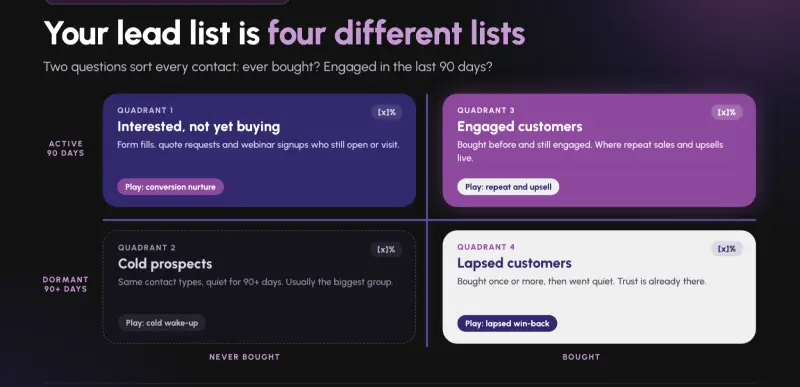
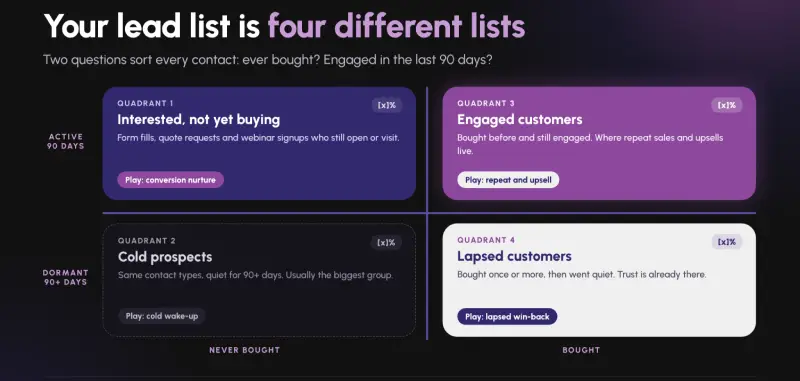
Your lead database maps onto four quadrants
Quadrant 1 (Never Bought + Active): Form-fill leads, webinar registrants, free consultation signups, download leads, or quote requests who opened an email, visited a page, or responded in the last 90 days.
Quadrant 2 (Never Bought + Dormant): Same contact types as Quadrant 1, but no engagement in 90+ days. Cold prospects, still in the database, mostly ignored.
Quadrant 3 (Bought + Active): Past customers who have made at least one purchase and show recent engagement. Active repeat-buy opportunities and upsell targets.
Quadrant 4 (Bought + Dormant): Past customers who bought once or more but have gone quiet for 90+ days. Lapsed customers with the highest reactivation value of any quadrant.
Pull each quadrant’s count from your CRM before reading the next sections. A typical Phoenix SMB with 18 months of operating history shows 15 to 30 percent in Quadrant 1, 35 to 55 percent in Quadrant 2, 10 to 20 percent in Quadrant 3, and 15 to 30 percent in Quadrant 4.
The quadrant with the biggest count rarely matches the quadrant with the biggest revenue opportunity.
Quadrant 1 Play: Conversion Nurture
Quadrant 1 holds your highest-intent non-customers. These are people who have raised their hand (filled a form, started a quote, attended a webinar) and still show engagement signals.
The email play is not a discount blast; it is a focused conversion nurture that addresses the specific objection or decision gap.
A typical Phoenix conversion nurture runs 5 to 7 emails over 21 to 30 days.
For a Phoenix HVAC business, Quadrant 1 reactivation might run over the 30 days before monsoon season and address the specific concern (timing of install before storms, financing, warranty terms) that prevented the first conversion. For a Phoenix dental practice, Quadrant 1 might address insurance coverage questions and specific procedure fears that stop first-time patients.
Pairing this with SEO services in Phoenix covers the organic side of why some of these leads may be searching your brand name and still not converting.
Typical revenue lift from Quadrant 1 reactivation: 8 to 15 percent of Quadrant 1 contacts convert within 60 days when the nurture matches their objection, compared to 1 to 3 percent for the same contacts receiving generic campaigns.
Quadrant 2 Play: Cold Wake-Up
These are contacts who gave you their email at some point but have shown no activity in 90+ days.
The Federal Communications Commission’s 2026 Broadband Deployment Report confirms broadband access is near-universal across Phoenix, which means dormant contacts are almost always still checking email, just not yours. The silence is an attention problem, not an availability one.
These are contacts who gave you their email at some point but have shown no activity in 90+ days.
The common assumption is that they are worthless.
The play is a 3-email wake-up sequence that leads with new value, not a sales message.
- Email 1 delivers a specific new piece of information relevant to their original interest: new content, new service line, new pricing structure, new Phoenix location, new seasonal offering.
- Email 2 asks one short question to re-engage (survey format with 2 to 4 options, not open-ended).
- Email 3 shares what they can expect going forward if they stay on the list, and a clear unsubscribe option if they do not.
- A credible Phoenix email marketing agency maps your database into the quadrants in the first 14 days of the engagement.
Phoenix-specific wake-up angles: winter visitor Phoenix contacts who signed up in a previous November-March window are worth pinging in the first week of November with a season-opening message.
Monsoon-adjacent categories (HVAC, roofing, pool, landscaping) can run their wake-up campaigns in late May, before the June monsoon ramp, framed around preparation.
Quadrant 3 Play: Repeat and Upsell
Quadrant 3 is where the margin lives. Existing customers who are still engaged have the highest lifetime value potential of any quadrant, because the trust is already established and the economics of selling one more thing to them beat the economics of acquiring a new customer by roughly 5 to 7 times.
The play splits by purchase cadence:
For transaction-frequency businesses (restaurants, fitness, services), the play is a cadence-matching campaign.
If your typical customer buys every 45 days, the email cadence should prompt them around day 35, with a value-first message, not a discount. Over-frequency teaches customers to wait for the next email; matching their natural cadence feels helpful.
For higher-ticket businesses (home services, healthcare, legal, financial), the play is a scheduled-review campaign. An annual check-in email tied to the service they bought, inviting them to review their situation or book a recurring service.
Typical revenue lift from Quadrant 3 reactivation: 20 to 40 percent of Quadrant 3 contacts respond to a cadence-matching campaign, with revenue per contact running 2 to 4 times higher than new customer acquisition.
Quadrant 4 Play: Lapsed Win-Back
These are people who bought at least once but have gone quiet for 90+ days.
They already crossed the trust line. They stopped buying for a specific reason.
The win-back play runs 4 emails over 21 days.
- Email 1 acknowledges the gap and asks what happened, with 3 or 4 multiple-choice reasons they can tap (service issue, price, no longer need, forgot).
- 2nd email responds to the most common reasons with a specific answer and a soft offer to reconnect.
- The third one offers a meaningful incentive to return (a discount, a free service add-on, or a complimentary consultation), coded with a 14-day expiration.
- Email 4 is the final exit, thanking them if they choose to leave and offering the door for a return anytime.
Phoenix-specific win-back considerations: retiree customers who become dormant often have moved or passed away rather than switched providers.
For higher-ticket Phoenix categories (HVAC, home services, legal, dental), the revenue per returned customer often exceeds the annual revenue per new customer, because the lifetime value is multi-year.
The Phoenix Layer Across All Four Quadrants
Three Phoenix-specific characteristics change how all four quadrants should be approached:
Phoenix seasonality matters more than most metros.
- The June-September monsoon season drives different engagement patterns than the November-March winter visitor season.
- For home services, legal, and health categories serving year-round Phoenix residents, the natural engagement cycles should inform when each quadrant’s campaign fires.
- A Quadrant 2 wake-up sent in mid-August (peak monsoon) behaves differently than the same email sent in mid-October (pre-winter visitor).
The Phoenix retiree audience in the established corridors has distinct email behavior.
Phoenix email automation sent to Sun City, Sun City West, Fountain Hills, or Scottsdale-established-neighborhood lists should target the earlier window.
Pair the quadrant work with coordinated SEO services so organic visibility feeds Quadrant 1 with fresh warm leads while the four plays work the existing database.
The 60 Minutes That Set the Reactivation Order
Open your CRM. Pull the list with two columns beside each contact: did they ever buy, and when was their last activity.
Sort into the four quadrants and count each. The quadrant with the biggest revenue opportunity for your business model is where the work starts; the quadrant with the biggest contact count may not be the same, and both numbers matter when prioritizing.
The Phoenix businesses getting the most out of email marketing are not the ones sending the most campaigns. They are the ones treating the existing database as four distinct assets.
Each with its own play, and measuring the revenue lift per quadrant so the work compounds instead of diluting.
A SEO audit covers the organic side of the same question with three specific findings before it asks for an email. So you can see whether the right next move is email reactivation or traffic acquisition.
Frequently Asked Questions
How do I pull the four-quadrant counts from my CRM?
Export your full contact list with two columns: purchase status and last activity date. Sort each contact into Active (any activity in the last 90 days) or Dormant (nothing in 90+ days). The crosstab of purchase status by activity status gives you the four quadrant counts. Most CRMs export this in 10 minutes. If your CRM does not track email engagement, fix that first with your current email platform before running the reactivation work.
Which quadrant should a Phoenix business start with?
Start with the quadrant that produces revenue soonest for your business model. For Phoenix home services, start with Quadrant 4 (lapsed win-back) because annual-cycle customers represent concentrated revenue. For Phoenix professional services, start with Quadrant 3 because the business depends on ongoing relationships.
What does the quadrant audit actually cost and how much time does it take?
Published fees for the 14-day quadrant audit run $1,500 to $3,500 depending on CRM complexity and list size. Monthly retainers for ongoing email marketing services in Phoenix typically run $1,500 to $5,000 depending on quadrant count, campaign cadence, and list size. A published rate card is a reasonable screening signal when choosing an email marketing agency Phoenix partner.
How is this different from “email marketing” that every agency pitches?
The difference is treating the existing database as a four-part asset rather than one undifferentiated list. Most Phoenix email engagements run one or two monthly newsletters to the entire list, which averages the signal across all four quadrants and leaves most of the quadrant-specific revenue unclaimed. The quadrant approach assigns a specific play to each segment, with its own goals, cadence, and measurement, so the work compounds instead of diluting.
What if my CRM has fewer than 500 total contacts across all four quadrants?
Under 500 total contacts, the quadrant framework still applies, but the primary focus shifts to Quadrant 1 (conversion nurture) and list growth. Below 500 contacts, Quadrants 2, 3, and 4 are usually too small to produce measurable revenue separately, so they can be worked as a single reactivation segment.
How long before the four-quadrant work shows revenue?
Quadrant 1 conversion nurture produces revenue within 30 to 45 days of launch. Quadrant 3 cadence-matching produces revenue within 30 to 60 days. Quadrant 4 win-back produces revenue within 45 to 90 days. Quadrant 2 cold wake-up is the slowest, with meaningful revenue appearing at 60 to 120 days and deliverability improvement visible at 30 to 60 days. A realistic Phoenix SMB roadmap sees combined revenue lift across all four quadrants by day 90 to 120 of the engagement.