Key Takeaways
- Microsoft Ads management in New York is not a budget question; it is an audience question. The CPC savings matter only if the Bing audience in the New York DMA matches the customer your business actually closes.
- The audit runs across four specific dimensions: the age and life stage of your customers, the device and work environment they search from, the borough and submarket they live or work in, and the professional decision authority Microsoft Ads lets you target.
- A New York business that passes all four dimensions typically sees 15 to 40 percent lower blended cost per qualified lead after adding Microsoft Ads to Google Ads.
Microsoft Ads management in New York gets pitched as “Bing is cheaper.” That pitch skips the question that actually decides what a New York customer looks like.
In the five boroughs plus the Westchester, Nassau, and Northern New Jersey commuter rings, the Bing audience looks very specific.
It skews older, more desktop, more financial services, insurance, and legal, more enterprise-employee, and more suburban-commuter than the Google audience.
When that profile matches your customer, Microsoft Ads produces leads at 15 to 40 percent below Google’s blended cost per qualified lead. When it does not, the lower CPCs disappear into lower conversion rates and the account dilutes your overall results.
The audit below runs four tests. Microsoft’s advertising platform documentation confirms the demographic skew of the Bing network across Yahoo, DuckDuckGo, AOL, and LinkedIn professional targeting. This data produces a clear verdict for most New York businesses once the audit runs end to end.
Dimension 1: The Age and Life Stage of Your Customers
The first test is the one most New York Microsoft PPC conversations get wrong.
The question is not whether your customer is on Bing; the question is whether the age and life stage of your qualified buyers matches the Bing audience skew.
Green flag signal:
- 40 percent or more of your qualified New York leads over the last 90 days are over age 45.
- Your customer base includes meaningful numbers of Upper East Side, Upper West Side, Westchester County, Nassau County, and Northern New Jersey residents.
- Your service category serves established careers, estate planning, retirement readiness, succession, elder care, or senior-focused healthcare.
Red flag signal:
- Your qualified leads skew under 40, concentrated in Brooklyn, Queens, Lower Manhattan residential, Hoboken, and Jersey City Downtown.
- Your service category targets millennial and Gen Z buyers: direct-to-consumer brands, young-professional wellness, startup-adjacent services, creative industries, ASU-age education, or mobile-first consumer apps.
- Your service category serves established careers, estate planning, retirement readiness, succession, elder care, or senior-focused healthcare.
Pull your last 90 days of qualified leads from your CRM and filter by age where it is tracked. A New York business with 45 percent of qualified leads over age 45 passes this dimension cleanly. Below 20 percent, this dimension fails.
Dimension 2: Device and Work Environment of Your Customers
The New York Bing audience does more than skew older; it skews desktop, workplace, and enterprise-managed.
Green flag signal:
- Your customers typically search from work desktops at large firms. Think the Midtown financial district corridor from Bryant Park to 57th Street, the Financial District in Lower Manhattan, the law firm cluster in Times Square South and Midtown East.
- The healthcare cluster around NYU Langone on First Avenue, the Mount Sinai area on the Upper East Side, and the Hospital for Special Surgery corridor.
- These employees sit on enterprise Windows machines with Microsoft Edge as the default or policy-mandated browser, which means their Google searches route through Bing without them choosing.
Red flag signal:
- Your customers search primarily from iPhones on consumer plans in residential zip codes.
- Your traffic shows 75 percent or higher mobile share on Google Ads.
- And your buyers make decisions while commuting, between meetings, or at home in the evenings rather than during the workday.
Pull your device breakdown in Google Ads over the last 90 days. A business with 45 percent or higher desktop share on qualified lead-generating sessions passes this dimension. Below 25 percent desktop, this dimension fails.
Both passing on dimensions one and two usually indicate the account is worth pairing with an SEO audit to see whether the organic and paid search strategies share enough audience that running both on Bing makes sense.
Dimension 3: The Borough and Submarket of Your Customers
The third test is specifically New York. The five-borough and commuter geography of this DMA is not uniform in how the Bing audience performs.
Submarkets where Bing math usually works:
- Manhattan Upper East Side and Upper West Side above 72nd Street, where resident demographics skew toward older established households.
- Manhattan Financial District and Midtown corporate buildings, where the enterprise-desktop Bing audience concentrates during business hours.
- Westchester County established neighborhoods.
- Nassau County established neighborhoods.
- Northern New Jersey established neighborhoods (Short Hills, Summit, Chatham, Ridgewood, Montclair, Upper Montclair, Glen Rock).
- Staten Island middle and south shore established neighborhoods.
Submarkets where Bing Maps usually fails:
- Brooklyn (most of Williamsburg, Bushwick, Greenpoint, Bedford-Stuyvesant, Crown Heights, Prospect Heights, Park Slope sub-40 demographics).
- Queens (Long Island City, Astoria below Ditmars, Sunnyside, Woodside).
- Lower Manhattan residential buildings south of Canal Street.
- Hoboken and Jersey City Downtown.
- Any submarket with a median resident age under 35.
Green flag signal:
40 percent or more of your qualified leads come from the top list above.
Red flag signal:
50 percent or more of your qualified leads come from the bottom list.
Businesses that serve Westchester estate planning, Nassau County healthcare for older patients, Upper East Side legal and financial services, or Manhattan enterprise B2B services typically pass this dimension strongly.
Businesses serving Williamsburg restaurants, Long Island City coworking, Downtown Jersey City fitness, or Lower Manhattan startup-adjacent services typically fail it.
Dimension 4: Decision Authority Through LinkedIn Targeting
The fourth test applies specifically to New York B2B businesses and is the one that most dramatically changes the Microsoft Ads conversation when it applies.
Microsoft Ads is the only major paid search platform that lets you layer LinkedIn professional data on top of search campaigns.
Green flag signal:
- Your sales team closes deals at defined decision-maker profiles. For New York businesses, this means specific titles in specific industries at specific company sizes.
- SVP of Operations at Manhattan financial services firms with 500-plus employees, managing partners at Midtown law firms.
- CMOs at Flatiron SaaS companies, CFOs at Connecticut-based manufacturing companies, practice administrators at NYU Langone affiliate practices, HR directors at NJ pharmaceutical companies.
If your sales team can list the exact titles and company types that close, Microsoft Ads lets you put your bid in front of only those people.
Red flag signal:
Your sales team closes deals across a wide range of titles and company types, or your ideal customer profile is defined by consumer attributes (life event, income, interests) rather than professional role.
Green flag signal:
A defined ICP gets Microsoft Ads doing work Google Ads cannot match for New York B2B accounts. This single capability justifies the Microsoft Advertising New York investment for many Manhattan and Westchester professional services businesses even when their customer age skew is mixed.
The Composite Verdict
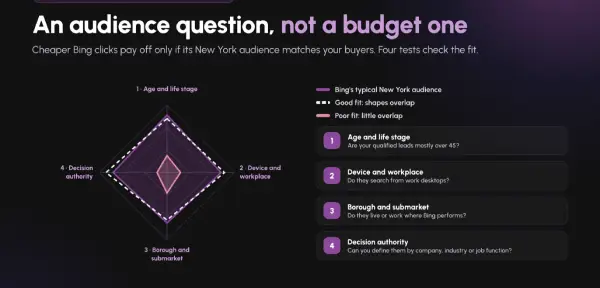
Score your business across all four dimensions.
Three or four green flags mean Microsoft Ads management in New York almost always makes sense.
A 60-day Bing Ads management New York test with 20 to 30 percent of your total paid search budget typically produces a blended cost per qualified lead 15 to 40 percent below your Google-only baseline.
The management overhead, ongoing optimization time, and attention cost exceed the probable return. Concentrate your paid search budget on Google Ads optimization and pair it with audit findings with SEO services in New York to build organic coverage.
Frequently Asked Questions
How do I pull the data to run the four-dimension audit on my own business?
Pull three reports: your Google Ads device breakdown by qualified conversion over the last 90 days, your CRM qualified lead geography by zip code or borough over 90 days, and your won-deal buyer profile analysis from your sales team. The audit takes about one hour if the data is clean. If your tracking is not pulling qualified leads correctly, fix that with your current PPC management partner before running the Microsoft Ads decision.
What minimum Microsoft Ads budget is needed for a meaningful New York test?
$1,500 to $3,500 per month in media spend over 60 days, scaled to total paid search budget. Below $1,500, the account does not accumulate enough daily data for a clean signal within 60 days given New York’s higher competitive density. Management fee runs separately, typically $750 to $2,000 depending on account complexity.
How is New York different from other metros for the Microsoft Ads decision?
Three differences matter. First, New York’s financial services, legal services, and insurance concentration creates the largest enterprise-desktop Bing audience of any US metro, which strongly favors certain B2B categories. Second, New York’s submarket geography is more extreme than most metros, so audience fit varies more by zip code than in other metros. Third, New York’s higher Google Ads CPCs mean the proportional CPC savings from Bing often produce larger dollar savings per qualified lead than the same percentage savings would in Phoenix or Austin.
How do I handle the LinkedIn targeting layer through Microsoft Ads for New York B2B?
Start with tight ICP definition: specific titles, specific industries, specific company size bands, specific company locations within the New York DMA. Test the LinkedIn layer on one campaign segment first before rolling it across the account. New York B2B accounts targeting Manhattan financial services decision-makers, Westchester healthcare administrators, or Northern NJ pharma HR often see this single feature justify the Microsoft Ads investment within 45 days.
How should the four-dimension audit influence campaign structure?
Build the Bing campaigns around the green-flag segments specifically. Separate campaigns for the submarket geographies that passed Dimension 3, separate landing page variants for the age and life-stage signal from Dimension 1, separate bid adjustments for the device patterns from Dimension 2, separate ad groups for the LinkedIn-targeted segments from Dimension 4.
What should Bing Ads management in New York cost compared to Google Ads management?
Management fees typically run 15 to 25 percent of Bing media spend or $750 to $2,000 flat per month for Bing accounts added to an existing Google retainer. Since Bing spend typically runs 15 to 30 percent of total paid search spend, the absolute dollar fee stays proportionally smaller. Published fee schedules are a reasonable screening signal when selecting a New York Microsoft Ads partner.