table of Content
- 1.How to Compare SEO Services in Austin Before You Hire an SEO Agency
- 2. SEO Agency in Austin That Offers True Local Search Results
- 3. Transparent SEO Services For Austin Businesses
- 4.Local Expertise Is What Separates Austin SEO Services
- 5. Additional Factors to Consider For Best Local SEO Services in Austin
- 6.Scorecard For Your Comparison to Choose the Best SEO Agency in Austin
- 7. Final Words: Now You Know What You Need to Ask in Discovery Call
- FAQs
Microsoft Ads management in Phoenix becomes a financial decision the moment you look past the CPC headline and ask what your blended cost per qualified lead actually becomes after adding Bing to the mix.
Some Phoenix businesses answer that question with a confident yes. Others answer with a clear no. The point of this piece is to walk the math with you instead of handing you a generic recommendation.
Microsoft’s advertising platform documentation confirms its network (Bing, Yahoo, DuckDuckGo, AOL, LinkedIn for professional targeting) reaches an audience that skews older, more desktop, and higher-income than Google’s average.
Here is the math laid out as a walkthrough you can run on your own account.
Start With Your Google Ads CPQL Right Now
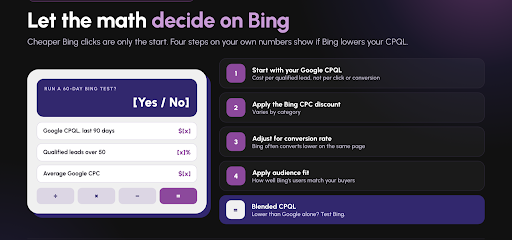
Before any Bing math makes sense, write down your current Google Ads cost per qualified lead.
Not cost per click. Not cost per conversion. Cost per qualified lead, meaning conversions your sales team has tagged as real buyers within 48 hours of arriving.
If your monthly Google Ads spend is $8,000 and your sales team marked 32 leads as qualified last month, your Google CPQL is $250.
If your spend is $4,500 and qualified lead count is 18, your Google CPQL is $250 too. The absolute budget number does not matter for this decision; the per-qualified-lead number is what travels into the Bing calculation.
If you cannot answer this question, pause the Microsoft Ads decision. You are not measuring the current account well enough to measure a second account. Fix the Google Ads tracking first with your current Google Ads management services team, then come back to this.
Apply the Phoenix Bing CPC Discount
Microsoft Ads CPCs in Phoenix run roughly 25 to 45 percent cheaper than Google Ads CPCs for most service categories. Legal and insurance tend to see the biggest discount (closer to 45 percent).
Home services and B2B tend to see 25 to 35 percent. Highly specialized medical and dental run closer to 20 to 30 percent.
If your Google Ads CPC averages $12, your expected Bing CPC in Phoenix lands somewhere between $6.60 and $9. If your Google CPC is $25, your Bing CPC is likely $13.75 to $18.75.
This part of the math is the easy part. The discount is real. The question is what happens after the click.
Adjust for the Conversion Rate Difference
Here is where many Phoenix Microsoft Ads service conversations go wrong.
Bing clicks are cheaper, but Bing landing page conversion rates are often lower than Google rates by 10 to 30 percent for the same page.
The reasons are mostly audience-related: Bing users skew older, which sometimes means slower form completion, more phone-first behavior, and different trust signals needed.
If your Google Ads account converts at 6 percent (6 of every 100 clicks become a conversion), expect Bing to convert at 4.5 to 5.4 percent on the same pages without any optimization.
Apply that to your CPC math. A $9 Bing CPC at 5 percent conversion produces a cost per conversion of $180.
A $12 Google CPC at 6 percent conversion produces a cost per conversion of $200. Bing is ahead, but less decisively than the raw CPC gap suggested.
Layer In the Phoenix Audience Fit Multiplier
Now apply the piece of the math most templates skip: how well does the Bing audience match your actual Phoenix buyer?
This is where the answer becomes category-specific.
Phoenix HVAC, roofing, and plumbing businesses serving the established homeowner segments in Scottsdale, Paradise Valley, Sun City, Sun City West, Fountain Hills, Carefree, Cave Creek, and the older parts of Mesa, Chandler, and Glendale find that Bing’s older audience converts at or above Google’s rate for their specific customer profile.
The multiplier is 1.0 to 1.2 in their favor: Bing not only costs less per click, but it also converts qualified leads at a rate equal to or better than Google for that submarket.
Phoenix direct-to-consumer e-commerce, SXSW-adjacent creative services, young-skewing retail, and most ASU-adjacent services see the opposite.
The multiplier is 0.6 to 0.8 against Bing: the audience is on Google, the Bing users who search the same keywords convert worse, and the math does not work even with the CPC discount.
If you do not know where your buyer profile sits on this spectrum, pull the age demographic breakdown of your qualified Google Ads leads over the last 90 days. If more than 40 percent of qualified leads are over age 50, the multiplier likely favors Bing.
If less than 20 percent, it likely does not.
Calculate Your Blended CPQL
Now stack all four pieces together:
Add Bing with a $1,500 monthly test budget.
Your Bing CPC runs 30 percent cheaper: $8.40 vs $12.
Your Bing conversion rate runs 15 percent lower than Google: 5.1 percent vs 6 percent.
Your qualified lead rate on Bing matches Google for this Phoenix audience: 60 percent. Your Bing CPQL comes out to around $275 if the audience fit is neutral, $180 if the audience fit is strong, and $360 if the audience fit is weak.
Blended across both platforms, the account looks different in each scenario:
- Strong fit: $9,500 total spend, 44 qualified leads, blended CPQL $216 (down from $250 Google-only)
- Neutral fit: $9,500 total spend, 37 qualified leads, blended CPQL $257 (basically unchanged)
- Weak fit: $9,500 total spend, 36 qualified leads, blended CPQL $264 (slightly worse)
Find Your Decision Threshold
Here is a shortcut for Phoenix businesses that do not want to run the full math.
There is a minimum Google CPQL below which Microsoft Ads almost never pays back the setup and management cost, and a threshold above which it almost always does.
Below $80 CPQL on Google:
Bing rarely helps because the account is already efficient, and the added management overhead costs more than it saves.
$80 to $200 CPQL:
Bing helps selectively, mostly in categories where audience fit is strong (home services for older homeowners, financial and legal for retirees, specialized medical for over-55 populations).
$200 to $500 CPQL:
Bing usually helps meaningfully if the audience fit is at least neutral. Phoenix accounts in this range see the biggest proportional lift from adding Bing because the CPC discount compounds.
Above $500 CPQL:
Bing almost always helps because the Google CPQL is high enough that even a weak audience fit produces meaningful dollar savings. Phoenix legal, high-ticket healthcare, and B2B accounts often live in this range.
Pair this threshold with SEO audit to see whether organic coverage could reduce your dependency on paid search altogether; sometimes the right answer is less paid spend rather than more platforms.
The Specific Phoenix Categories Where Bing Math Works
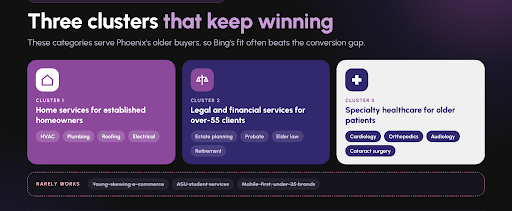
Three Phoenix category clusters show up repeatedly on the winning side of the math:
HVAC, plumbing, roofing, and electrical serving the established Phoenix retiree corridors commonly see Bing CPQL run 20 to 40 percent below Google CPQL on the same keywords.
The audience fit is strong enough to overcome the conversion rate gap.
Legal and financial services serving over-55 Phoenix clients (estate planning, probate, Medicare, retirement planning, elder law, revocable trusts) consistently find Bing produces competitive or better CPQL. Microsoft Ads’ LinkedIn integration adds another lever for B2B subcategories (commercial law, business succession planning, nonprofit financial services).
Specialty healthcare targeting older Phoenix patients (cardiology, orthopedics, audiology, cataract surgery, hearing aids, hip and knee replacement, Medicare-focused primary care) tends to see audience fit multipliers in the 1.1 to 1.3 range, which typically makes the Bing math work even when conversion rates lag Google by 20 percent.
The Phoenix categories where the math rarely works include young-skewing direct-to-consumer brands, ASU student-facing services, creative and entertainment-adjacent businesses, and mobile-first consumer services targeting under-35 audiences.
What a Credible Phoenix Microsoft Ads Setup Does With the Math
A credible PPC services in Phoenix engagement starts the math conversation during the discovery call, not after signing.
The agency pulls your Google Ads CPQL, your qualified lead demographic breakdown, and your current spend tier, then walks the exact calculation above with your numbers before pitching a budget.
When the math produces a weak case, the agency declines the engagement rather than running Bing anyway.
When the math works, setup involves importing your proven Google Ads campaigns via Microsoft’s Google Ads Import tool, layering Microsoft-specific audience features, and tracking Bing CPQL side-by-side with Google CPQL in a single monthly report.
Phoenix seasonal cycles still apply to Bing. Monsoon season (June to September) drives spikes in emergency HVAC, roofing, and water damage queries where Bing’s retiree audience responds well.
Winter visitor season (November to March) brings a measurable share of established out-of-state Bing users searching for Phoenix services.
Spring Training window (February to March) matters for hospitality and retail that overlap older Bing demographics.
Pair the Microsoft Ads rollout with coordinated Phoenix SEO services so paid and organic share landing pages and converging CPQL targets across both engines.
The 10 Minutes That Decide Your Bing Budget
Open Google Ads.
Open your CRM.
Calculate three numbers:
Your current Google Ads cost per qualified lead over the last 90 days, the percentage of your qualified leads that are over age 50, and your typical Google Ads CPC.
Those three numbers run through the math above in ten minutes and tell you whether a 60-day Bing test is worth starting.
The Phoenix businesses that get the most from paid search are not the ones running every platform.
They are the ones running the platforms where their math works, with discipline to close platforms that do not earn their keep.
Microsoft Ads is one of those platforms for Phoenix businesses in home services for older homeowners, legal and financial services for retirees, and specialty healthcare for over-55 patients.
Frequently Asked Questions
What is the minimum Microsoft Ads budget to run a meaningful Phoenix test?
$1,000 to $2,500 per month in media spend over 60 days. Below $1,000 the account does not accumulate enough daily data to produce a signal within 60 days. Above $2,500 at the test stage is premature until you have confirmed the math works. The agency management fee for the test runs separately, typically $500 to $1,500 depending on complexity.
How long does the 60-day test usually take to produce usable numbers?
First meaningful Bing CPQL data appears around day 35 to 45 for Phoenix accounts spending $1,500 to $2,500 per month on Bing. Full confidence in whether to keep or cut the account usually comes at day 60 to 75. Phoenix accounts with heavier seasonality should time the test so the 60-day window includes at least part of the peak season, not entirely in an off-season window.
Can an existing Microsoft Advertising Phoenix campaign be rebuilt if the first 60 days failed?
Yes, in specific cases. A failed test often fails for one of three fixable reasons: wrong audience targeting, wrong landing page for Bing demographics, or wrong campaign structure imported too literally from Google. Rebuilding with proper Bing-specific audience layering, a landing page variant for older users, and tighter match types often turns a failed 60-day test into a profitable account within another 60 to 90 days. Accounts that fail for category-fit reasons (wrong demographic for Bing) rarely recover regardless of rebuild.
How much should Bing Ads management Phoenix cost compared to Google Ads management?
Fees typically run 15 to 25 percent of Bing media spend or $500 to $1,500 flat per month for small Bing accounts added to an existing Google retainer. Since Bing spend usually runs 15 to 25 percent of Google spend, the absolute dollar fee is proportionally smaller. Published fee schedules are a reasonable screening signal when choosing a provider.
How should the CPQL math be rechecked during the 60-day test?
Pull the numbers weekly for the first 4 weeks, then every 2 weeks. Track these specific items: Bing CPC, Bing conversion rate, qualified lead rate on Bing leads tagged by sales team (should settle by week 5), and blended CPQL across both platforms (the real decision metric by week 6). Any of these settling significantly outside the predicted ranges is a signal to either rebuild the campaign or close it out.
How does the LinkedIn targeting through Microsoft Ads work for Phoenix B2B accounts?
Microsoft Ads lets Phoenix B2B advertisers layer LinkedIn professional data on top of Bing search campaigns. For Phoenix accounts serving well-defined decision-maker profiles, this unlocks targeting precision Google Ads cannot match. This single feature often justifies the Microsoft Ads investment for Phoenix B2B service businesses with defined ICPs.