table of Content
- 1. Key Takeaways
- 2.Why Creative Quality Matters in Paid Social Services in Austin?
- 3. The Shift: Spending More Without Better Creative Produces Diminishing Returns
- 4.Layer 1: The Hook
- 5.Layer 2: The Context
- 6 . Layer 3: The Proof
- 7. Layer 4: The Action
- 8.The Layer-Alignment Test
- 9.How to Request a Quote That Actually Means Something
- FAQs
Key Takeaways
- Paid social services in Austin produce leads when four creative layers work together: a hook that stops the scroll, a context line that earns the read, a proof signal that passes the credibility check, and an action step that gives the viewer a reason to click now.
- When an Austin paid social campaign stalls, the problem is almost always a specific broken layer, not the audience.
- Austin audiences on Meta Ads respond to different creative tuning than national audiences. SXSW and ACL cycles, the mix of transplant and native populations, and the Austin food, fitness, and DTC scenes all change which hook styles earn the scroll.
Paid social services in Austin fail most often because the creative does not carry the viewer.
An alluring video with a weak hook gets scrolled past in the first second.
A strong hook with no context leaves the viewer confused about what the offer is.
Clear context with no proof signal fails the Austin buyer’s credibility check. Every layer has to land, and every layer has to agree with the next one.
This article walks you through the four creative layers and the Austin-specific tuning that changes the stack.
Why Creative Quality Matters in Paid Social Services in Austin?
Austin is a market where this discipline shows up quickly.
U.S. Bureau of Labor Statistics data for the Austin-Round Rock-Georgetown MSA tracks a city with concentrated DTC retail, food service, fitness, wellness, technology, and professional services small businesses, categories where paid social is often the primary lead channel.
Meta’s own advertising documentation describes the Advantage+ and Advantage audience features that automate much of the targeting work, which means the creative layer carries more weight than ever.
When targeting is automated, the creative is the differentiator.
The Shift: Spending More Without Better Creative Produces Diminishing Returns
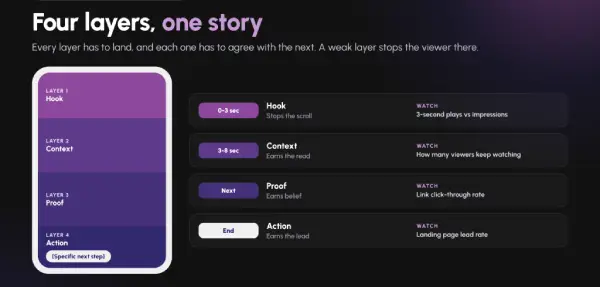
The old paid social playbook treated creative as production and audience as strategy.
The 2026 paid social playbook treats the two in the opposite order. Meta’s automated audience systems now handle targeting better than most agencies ever did manually, which means the manual lever that moves cost per qualified lead has shifted to creative.
Three ads of similar production quality running in the same campaign can produce cost per qualified lead gaps of 3 to 8 times based on which creative layers are working.
This matters for Austin budgets especially. Austin SMB paid social retainers typically run between $3,000 and $20,000 per month in media spend, which puts a premium on each creative producing qualified leads rather than on broad reach.
The four-layer anatomy below is the diagnostic that decides which creative to scale and which to retire.
Layer 1: The Hook
The hook is the first one to three seconds of the ad. Its only job is to stop the scroll. Nothing else matters if the hook fails because no viewer sees Layer 2.
What works as a hook has shifted in the last 18 months. Pattern-interrupt motion still works.
What pulls the biggest proportional lift in Austin audiences is specificity: a hook that names a specific Austin neighborhood, a specific Austin service category, a specific dollar amount, or a specific outcome.
Generic hooks (“boost your business,” “grow your sales”) get scrolled past. Specific hooks (“the exact Austin HVAC quote that cost me $3,400,” “I watched 12 East Austin boutiques raise prices last quarter, here is what they did”) earn the scroll.
Pair your hook library with coordinated Austin SEO services so the paid social hooks and organic landing pages share the same language and buyer context.
Layer 2: The Context
The context layer runs from roughly 3 seconds to 8 seconds in a video ad, or the body copy and secondary visual in a static or carousel ad.
Its job is to earn the read after the hook has already earned the scroll.
The viewer has paused; now they need to understand what the ad is actually about and why it matters to them.
Context fails when the ad jumps straight from hook to sales pitch.
Context works when it names the specific problem, situation, or question the viewer brought to the platform.
“Three things most Austin dentists get wrong about their first-year patient communication” names a problem.
“Why Austin restaurants with strong Yelp reviews still struggle to fill Tuesday nights” names a question.
The test for whether your context is working: the hold rate, which is the percentage of 3-second viewers who make it to 10 seconds in the video, or the engagement rate on static and carousel ads.
A hold rate below 25 percent of 3-second viewers signals weak context. Above 40 percent signals strong context.
Context that acknowledges Austin cost-of-living pressures, Austin growth-related change, or Austin-specific industry dynamics (tech transplant waves, the music scene economy, the food truck ecosystem) builds credibility that national-template context cannot match.
Layer 3: The Proof
The proof layer is where Austin paid social campaigns live or die.
The viewer has stopped scrolling and understood the context; now they need to believe the business can actually deliver what the ad implies.
Proof in 2026 takes four main forms:
- Specific numbers (not vague adjectives).
- Real customer language (quotes from real conversations, not polished testimonials).
- Visible process (behind-the-scenes clips, screen recordings, actual deliverables).
- Named credentials (specific certifications, named clients where permitted, specific years of experience).
For Austin audiences, the pattern holds across categories.
The test for whether your proof is working: the click-through rate from the view to the landing page. A CTR below 1 percent on cold traffic signals weak proof.
Above 2.5 percent signals strong proof.
Between 1 and 2.5 percent is the common range for most Austin SMB creative, with room to improve through better proof signals.
Layer 4: The Action
This is the weakest layer in most Austin paid social creative because most ads default to generic calls to action that give the viewer no reason to act today versus three weeks from now.
First, they name the specific next step in concrete terms.
Second, they give a reason the step matters now (“we close the Austin cohort on March 15,” “the first 50 qualified callers get a free 30-minute strategy session”).
Third, they lower the friction of the step. An action layer that does all three produces 2 to 4 times the click-through rate of a generic action layer on otherwise identical creative.
The test for whether your action is working:
A lead rate under 10 percent on cold traffic suggests the action language was weak or the landing page did not match the action promise.
Between 15 and 25 percent indicates a strong action layer matched to a well-aligned landing page.
Above 25 percent is unusual outside highly optimized Meta ads Austin campaigns.
The Layer-Alignment Test
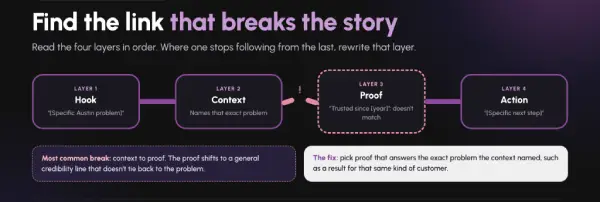
he four layers work together.
An ad can have a strong hook and a strong action but weak context and proof, and the lead rate will stall at 30 to 50 percent of its potential.
If the four layers tell one coherent story, the ad is aligned. If any layer feels disconnected from the one before it, that is the layer to rewrite.
For most Austin paid social services campaigns, the alignment problem shows up most often between Layer 2 (context) and Layer 3 (proof).
The hook pulls attention, the context names the problem, but the proof shifts to a generic credibility signal that does not tie back to the specific context.
Fixing that single transition commonly produces a 20 to 40 percent lift in cost per qualified lead within 2 to 3 weeks.
The Austin-Specific Layer Across All Four Creative Layers
Three Austin market characteristics change how the four-layer anatomy should be tuned:
Austin audience diversity shifts creative tuning by submarket.
Downtown and Second Street District audiences skew toward professional services, legal, financial, and tech buyers who respond to data-rich proof and specific credentials.
East Austin audiences skew toward creative-adjacent buyers who respond to stronger visual production and community signals. These are the signs of what lead-focused PPC management in Austin looks like, someone who take care of such strategy in Austin
A content strategy for Austin that runs the same creative across all submarkets leaves measurable lift on the table.
Austin seasonal cycles shift hook and context timing.
A paid social services in Austin program timed to the specific cycle of its category typically produces 20 to 35 percent higher lead rates during peak windows than one running all year evenly.
Austin tech corridor audiences break the consumer pattern.
B2B creative targeting Austin startup, SaaS, and enterprise buyers (Domain area, Northwest Austin, and the broader Silicon Hills audience) runs longer-form, requires heavier proof, and converts on demos and consultations rather than lead magnets.
The four-layer anatomy still applies, but the specific test thresholds shift: thumbstop rates run lower, hold rates run higher, click-through rates run lower, and lead rates run higher than consumer-facing Austin campaigns.
Pair the paid social build with coordinated email marketing services in Austin so leads from paid social enter a nurture sequence tuned to the context and promise of the ad that captured them, which is where the compound return on paid social actually lives.
How to Request a Quote That Actually Means Something
Most agency quotes come back vague because the brief going in was not something that might have satisfied the service.
If you give the agency these five inputs up front, you will get a quote you can compare.
1.Your average customer value and close rate. This lets the agency reverse-engineer a realistic retainer size.
2.Downtown Indianapolis, Carmel, Fishers, Noblesville, Greenwood, and Avon are different search markets. Ask which ones matter for the industry.
3.Read-only Google Search Console and Google Analytics so the agency can scope from your real data, not a cold audit.
4.Ask for the three biggest Indianapolis competitors by name. This lets the agency price against the real link and content gap, not a theoretical one.
5.Not “more leads.” A specific number. Even if it is wrong, it forces the quote to match the ambition.
With those five inputs, the quote should come back with a monthly number, a specific deliverable list, and a 12-month lead projection with milestones. Without them, you will get a boilerplate.
Frequently Asked Questions
How do I measure the four creative layers on my own paid social account?
Open Meta Ads Manager and pull the breakdown by creative for the last 30 to 60 days. The four metrics that map: thumbstop rate, hold rate for the context, click-through rate for the proof, and lead rate on the landing page for the action.
Which creative layer should an Austin business test first?
Start with the hook if your thumbstop rate is under 20 percent, because it is the fastest to test and the biggest upstream lever.
What should paid social services in Austin cost?
Published fees for Austin paid social retainers typically run $1,500 to $5,500 per month in management plus the media spend itself.
How is this different from "paid social" that every agency pitches?
Most paid social engagements report on surface metrics (impressions, reach, CPC, cost per thousand impressions) without diagnosing where creative fails to produce leads. The outputs look similar on the surface (ads, audiences, campaigns), but the creative decisions compound differently because each new test is targeted at a known weakness rather than a general improvement.
How long before the four-layer changes produce measurable cost per qualified lead decreases?
Hook tests produce visible thumbstop rate changes within 72 hours of launch for most Austin audiences. Context tests show hold rate changes within 5 to 10 days. A realistic Austin SMB roadmap sees combined cost per qualified lead lift of 20 to 40 percent by day 60 to 90 of a focused engagement.
Can the four-layer anatomy work for Austin businesses with small ad budgets?
Yes, with scope adjustments. Austin businesses under $2,000 monthly media spend run fewer simultaneous tests but still apply the four-layer diagnostic to every creative. The pacing shifts to one-layer tests every 10 to 14 days rather than multiple in parallel, and the creative library stays smaller (3 to 5 active creatives at any time rather than 10 to 15). The compound returns take longer (120 to 180 days) but the per-dollar lift is often higher because every creative must earn its place.