table of Content
- 1.How to Compare SEO Services in Austin Before You Hire an SEO Agency
- 2. SEO Agency in Austin That Offers True Local Search Results
- 3. Transparent SEO Services For Austin Businesses
- 4.Local Expertise Is What Separates Austin SEO Services
- 5. Additional Factors to Consider For Best Local SEO Services in Austin
- 6.Scorecard For Your Comparison to Choose the Best SEO Agency in Austin
- 7. Final Words: Now You Know What You Need to Ask in Discovery Call
- FAQs
Key Takeaways
- PPC management services in Austin produce qualified leads only when the retainer delivers specific monthly artifacts (search term reports, qualified lead rate reports, landing page experiment logs, budget pacing reports, competitor briefs, attribution maps).
- The biggest lever is the qualified lead rate report (not the conversion count report).
- The common mistake is accepting a monthly PPC report that shows impressions, clicks, and conversions without showing search term quality, landing page experiment results, or qualified lead rate tied to sales team feedback.
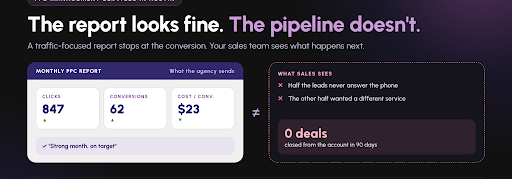
Here’s what typical PPC management services in Austin look like: 847 clicks, 62 conversions, a $23 cost per conversion.
The report looks fine.
The sales team says half the leads never answer the phone, the other half were looking for a different service, and the business has not closed a single deal from the account in 90 days.
This is the ground reality in Austin.
Why This Happens With PPC Services in Austin?
The report is measuring the wrong things.
The point of lead-focused PPC services for Austin businesses actually should be the measurement of what happens after the click, not just how many clicks happened.
Google Ads Help Center documentation on quality score and conversion tracking also makes clear that lead quality signals (conversion value, offline conversions, enhanced conversions) matter more than raw conversions.
Which is why a traffic-focused report systematically misses the account’s actual performance picture.
Austin is a particularly demanding PPC market because the metro has one of the densest advertiser concentrations per capita in the US.
Instead of clicks and traffic acquisition, what should be focused on and included with the monthly retainer are these factors.
Search Term and Negative Keyword Report
A weekly export of every search term that triggered your ads.
With annotations for which terms produced qualified leads, which produced junk, and which new negative keywords got added that week.
What It Reveals?
- Whether the account is being actively curated or left on autopilot.
- Negative keywords.
- A retainer that is not adding negative keywords per week in the first quarter is burning spend on terms a 10-minute review would eliminate.
Search term list with qualified lead attribution per term, named negative keywords added that week, and a running count of refined match-type coverage.
Qualified Lead Rate Report
The share of conversions that your sales team marked as qualified. A report that truly converts the traffic junk of interested into buyers.
What It Reveals?
- Whether the expenditure by PPC service is producing real pipeline or inflated form-fill counts.
- Audience refinement.
Search term list with qualified lead attribution per term, named negative keywords added that week, and a running count of refined match-type coverage.
Qualified Lead Rate Report
The share of conversions that your sales team marked as qualified. A report that truly converts the traffic junk of interested into buyers.
What It Reveals?
Integrated with your CRM (HubSpot, Salesforce, Pipedrive, or a simpler system), showing per-lead qualification tags, closed-lost reasons, and month-over-month qualified rate trend per ad group.
If the agency is not asking your sales team monthly which leads panned out, they cannot report lead quality honestly.
Landing Page Experiment Log
A monthly log of landing page tests run on the account, with the hypothesis, the variant tested, the result, and what gets rolled out versus rolled back.
What It Reveals?
- Whether the retainer treats landing pages as a dynamic variable (where most PPC gains actually sit) or as static assets.
- Landing page conversion rate.
- Keyword optimization work.
Named tests with specific variants (headline rewrite, form field reduction, trust signal placement, image swap), statistical significance thresholds, and clear roll-out decisions. At least 1 to 2 tests running continuously on priority landing pages.
Budget Pacing and Cost-Per-Lead Trajectory Report
Weekly view of spend against monthly budget, cost per lead tracked over time, and projected end-of-month spend and lead volume.
What It Reveals?
- The account is being managed to a cost per lead target or just spending the available budget.
- Cost per qualified lead.
- Traffic-focused retainers show flat or rising cost per qualified lead.
Reporting looks at month-over-month cost per qualified lead trajectory, segmented by campaign and ad group, with named drivers behind any direction change.
Austin Competitor and Auction Insights Brief
A monthly brief covering which Austin competitors are bidding on your core terms. How auction share has shifted, which new entrants have appeared in your SERP, and what positioning competitors are using that you are not.
What it reveals?
- Whether the retainer is monitoring the Austin competitive environment continuously or ignoring it.
- New or departing advertisers per quarter.
- CPL spikes after the fact instead of adjusting ahead of them.
Austin competitors appearing in auction insights, submarket-specific competitive intensity, and documented ad copy changes from competitors that affect your click-through rate.
Attribution and Customer Journey Map
Monthly view of which touchpoints (paid search, organic, direct, referral, email, offline) contribute to closed deals, and what the paid search role actually is in the path to purchase.
What It Reveals?
- PPC is deserving credit or borrowing it.
- Whether business paid search accounts produce incremental revenue or not.
- A credible attribution map shows multi-touch contribution and incrementality, not just last-click.
Multi-touch attribution tied to CRM close data, with per-channel contribution scores and documented methodology. Additionally, occasional incrementality testing (paused campaigns on specific segments to measure true lift).
What Austin Specifics Matter in Every PPC Retainer
Three Austin signals belong in every lead-focused PPC management services in Austin engagement:
- Named Austin submarkets in geo-targeting and bid adjustments (Downtown, East Austin, South Lamar, South Congress, North Austin, Round Rock, Cedar Park, Bee Cave)
- Austin seasonal demand cycles accounted for in budget pacing.
- Austin-specific Spanish-language ad coverage for applicable categories serving East Austin, South Austin, and specific neighborhoods with Spanish-speaking populations.
The One Artifact That Tells You Everything
If you can only ask your current PPC agency Austin businesses hire for, go for qualified lead rate.
Not the conversion count, not the cost per conversion.
The qualified lead rate, tied to sales team feedback, segmented by campaign and ad group, trended over time.
If the agency can deliver that report within 48 hours, the account is probably being managed to leads.
If they cannot, they offer substitutes; if they explain why that specific data is “too complex to track,” the account is being managed to conversions, and the gap between conversions and leads is where the budget is going.
Frequently Asked Questions
How is lead-focused PPC management for Austin businesses different from traffic-focused PPC?
The practical difference is in what gets measured: lead-focused retainers tie every conversion to sales team feedback and optimize bids and keywords toward the ones producing closed deals. Traffic-focused retainers optimize toward raw conversion count regardless of lead quality. In dense Austin markets like HVAC, legal, medical, and home services, the gap between the two approaches typically produces 2 to 4 times the closed revenue per dollar spent over 12 months.
What should PPC services Austin businesses budget monthly to see meaningful results?
Minimum useful budgets typically start at $2,000 to $5,000 per month in media spend for competitive Austin service categories, with agency management fees separate. Below $2,000 in media spend, Austin auction density prevents enough daily data accumulation to run meaningful tests or compete for premium positions.
How quickly should a new Austin PPC account produce measurable results?
Austin competitive categories often require 90 to 150 days to reach the account’s natural cost per qualified lead floor as negative keywords accumulate and audiences refine. Accounts promising sub-30-day full optimization in Austin are typically overpromising.
Should a PPC agency Austin businesses hire use Performance Max or stick to standard search campaigns?
Both have use cases, with limitations. Performance Max can drive incremental volume for established Austin accounts with strong conversion signals, but gives less transparency into search term quality. For lead-focused, standard search campaigns with careful match type management, negative keywords, and audience signals typically produce better qualified lead rates than Performance Max alone.
How much does PPC management cost in Austin compared to other metros?
Typical Austin PPC management fees sit at 15 to 25% of media spend on percentage-based retainers, or $1,500 to $5,000 per month on flat-fee retainers for mid-market accounts. The cost delta pays back when qualified lead rate improvements exceed the fee difference, which they usually do on accounts over $5,000 in monthly media spend.
Can an Austin business run PPC in-house without hiring a PPC agency Austin providers offer?
Most Austin businesses outsource because the hours compound against sales and operational work, and because producing the 6 artifacts consistently each month typically requires experience running multiple accounts across industries.