table of Content
- 1.How to Compare SEO Services in Austin Before You Hire an SEO Agency
- 2. SEO Agency in Austin That Offers True Local Search Results
- 3. Transparent SEO Services For Austin Businesses
- 4.Local Expertise Is What Separates Austin SEO Services
- 5. Additional Factors to Consider For Best Local SEO Services in Austin
- 6.Scorecard For Your Comparison to Choose the Best SEO Agency in Austin
- 7. Final Words: Now You Know What You Need to Ask in Discovery Call
- FAQs
Key Takeaways
- AI SEO services in Austin focus on five specific ingredients.
- Schema markup, named author credentials, and third-party brand mentions matter more for AI citations than they do for traditional Google rankings.
- The biggest mistake Austin businesses make is treating AI SEO as “better regular SEO.”
Open ChatGPT right now and ask it to recommend a plumber, lawyer, SaaS tool, or restaurant in Austin.
Businesses showing up are the ones winning AI SEO services in Austin, whether they bought the service or not.
Those citations are not random; AI engines combine specific ingredients to decide which businesses get named in their answers.
Reverse-engineer those ingredients, and you can systematically earn mentions. Ignore them and your competitor earns the mention instead, every time.
Why AI SEO is as Important as Traditional SEO?
Austin is a city where this matters sooner than most.
Austin has one of the highest concentrations of early AI tool adopters in the country, driven by the city’s tech workforce.
The Pew Research Center’s data on AI tool adoption shows faster uptake among college-educated and professional audiences, which maps directly to Austin’s buyer base. Winning AI mentions here is not a 2027 problem. It is a right-now problem.
The Citation Formula
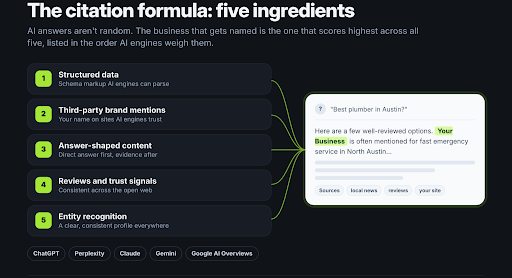
AI engines (ChatGPT, Perplexity, Claude, Gemini, Google AI Overviews) do not use one simple ranking signal.
They combine five specific ingredients, and the business that gets cited is the one that scores highest across all five.
Here is the formula, in the order AI engines weigh it.
- LocalBusiness schema on your homepage and location pages.
- Service schema on every service page, with specific service names.
- FAQPage schema on your FAQ sections and FAQ-shaped content.
- Author schema with real credentials on content pages.
- Review schema where legitimate (never fabricated).
- Product schema on ecommerce or SaaS pricing pages.
Your business is invisible to the layer AI engines parse before they decide what to quote. With it, you become machine-readable in a way most Austin competitors still are not.
Brand Mentions on Trusted Third-Party Sites
This is the biggest difference between AI SEO and GEO services and traditional SEO.
AI engines heavily weight your brand name appearing on sites they consider authoritative, even without a backlink. A mention of your business on Austin Monitor, the Austin American-Statesman, KXAN, Community Impact, or an industry publication counts, even if the mention is not linked.
For GEO services Austin to work, your plan has to include:
- Digital PR to Austin publications (Austin American-Statesman, Austin Monitor, Austin Business Journal, Community Impact Austin, Austonia, KXAN, KUT, KVUE)
- Industry publication mentions in your vertical
- Podcast appearances where your founder or domain expert is named
- Guest contributions and bylines in trade press
- Being quoted in news articles about your industry (reactive PR)
Traditional link building gets you half credit here. Named brand mentions in editorial content, linked or unlinked, get full credit.
Answer-Shaped Content on Your Own Site
AI engines prefer content that is written in answer form.
A direct answer in the first sentence, with evidence after. Content built for 2015-era SEO (introduction, context, history, then the answer buried in paragraph seven) rarely gets quoted.
What answer-shaped content looks like:
- H2 headings written as questions a buyer actually types
- The first sentence of each section answers the heading directly
- Short declarative sentences, not meandering explanatory ones
- Named author with credentials visible at the top of the content
- A “last updated” date that is recent (AI engines favor fresh content for time-sensitive topics)
If your current Austin SEO content opens with “In today’s fast-paced digital landscape,” no AI engine will ever quote you.
Review Signals and Trust Signals Across the Open Web
AI engines sample reviews from multiple platforms before describing a business, not just Google.
What matters:
- Consistency of your business name, address, and phone across platforms.
- Review sentiment that holds up across platforms, not just on Google.
- Reddit mentions of your brand in subreddits relevant to your category and city.
- Reddit comments carry disproportionate weight for AI engines right now.
Entity Recognition and Knowledge Graph Presence
AI engines map businesses as entities with relationships, not as isolated web pages. The clearer and more specific your entity profile is across the web, the more confidently an AI engine will quote you.
Where entity signals live:
- Your Google Business Profile (completeness, categories, services, Q&A).
- Wikipedia or Wikidata entries where you qualify (for larger businesses).
- Crunchbase, LinkedIn Company Page, Facebook Business Page, Bing Places.
- Industry-specific entity databases.
- Press release services with persistent URLs.
Gaps, inconsistencies, or duplicate entries weaken your entity signal, which weakens your citation odds.
How to Test Your Current AI Visibility Yourself
You do not need expensive software to run a first-pass audit. In 20 minutes, you can score your business across the four main AI engines.
Open each of these engines in a private browser window (so personalization does not skew the result):
- ChatGPT
- Perplexity
- Claude
- Google AI Overviews (search a query that triggers one)
Run three types of queries:
- Best [your category] in Austin.” Note whether your business appears. Note which competitors do.
- [Your category] in [your submarket]” (e.g., “coffee roasters in East Austin,” “immigration lawyers in Downtown Austin”). More specific queries sometimes surface different businesses than citywide queries.
- [Your business name] reviews” or “is [your business name] good.” Note how each AI engine describes you. The description tells you what sources it is pulling from.
Record the results in a spreadsheet. If you appear in zero to one engine, your AI visibility is at zero, and the retainer should start there.
If you appear in two to three, you have partial coverage and the plan should fill gaps. If you appear in all four, your AI SEO services in Austin plan is already working, and the question is maintenance versus expansion.
Why Some Austin Businesses Get Cited and Others Do Not
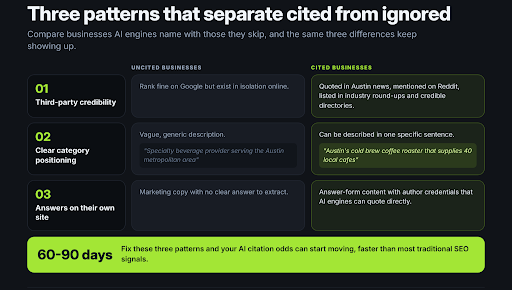
Three patterns show up consistently when you compare cited and uncited Austin businesses:
Businesses Have Third-Party Credibility Signals
They have been quoted in Austin news coverage, mentioned on Reddit, listed in industry round-ups, or named on a credible directory. Uncited businesses often rank fine on Google but exist in isolation online.
Cited Businesses Have Clear Category Positioning
AI engines prefer businesses that can be described in one sentence. “Austin’s cold brew coffee roaster that supplies 40 local cafes” is quotable. “Specialty beverage provider serving the Austin metropolitan area” is not. If your website cannot describe your business in one specific sentence, AI engines will not either.
Businesses Answer Specific Questions On Their Own Site
They have content written in answer form, with author credentials, that AI engines can quote directly. Uncited businesses have marketing copy written for humans with no clear answer to extract.
Fix those three patterns and your AI citation odds move inside 60 to 90 days, which is faster than most traditional SEO signals.
How ROILift Builds AI SEO Services in Austin Campaigns
ROILift’s ChatGPT SEO Austin work maps every retainer to the five-ingredient formula, not to a generic SEO checklist.
- Structured data is implemented on every money page in week one, with the markup type matched to the page’s purpose.
- Digital PR targets Austin’s actual editorial outlets and the industry publications your buyers read, with brand mention tracking across linked and unlinked mentions.
- Content is rewritten in answer-first form, with named authors and credentials visible, not generic “team” bylines.
- Monthly reporting tracks your business’s mentions and position across ChatGPT, Perplexity, Claude, and Google AI Overviews, with the specific queries that triggered each citation.
Within 10 business days of any major AI engine update, ROILift sends a plain-language impact note: what changed, which citations moved, and the correction plan.
Frequently Asked Questions
What is the actual difference between AEO, GEO, and SEO?
SEO targets traditional search engine results pages. AEO (Answer Engine Optimization) targets featured snippets and direct answers across any engine. GEO (Generative Engine Optimization) targets AI-generated answers from ChatGPT, Perplexity, Claude, and Google AI Overviews. GEO services Austin providers should be able to explain which one your current campaign targets and which measurement surface they report against, because the three use different signals and different reporting setups.
How often do AI engines update their training data about my Austin business?
It varies by engine. Perplexity and ChatGPT’s search feature pull live web results, so new mentions can show up within days. ChatGPT without search uses cached training data that updates in waves measured in months. Claude also uses mixed sources depending on the mode. Google AI Overviews pulls close to live.
Does Reddit really matter that much for AI SEO services in Austin?
Yes, significantly. ChatGPT, Perplexity, and Google AI Overviews all cite Reddit threads as sources for consumer and professional recommendations. For Austin businesses, mentions in r/Austin, r/AustinFood, r/UTAustin, r/startups, and industry-specific subs can produce AI citations.
How do I know if my Austin business is actually losing leads to AI answers right now?
Three signals suggest you are. First, your Google Analytics shows organic traffic flat or declining while direct and branded traffic rise, meaning buyers are finding you through a different surface. Second, new-customer intake calls mention “ChatGPT suggested you” or “I asked AI.” Third, your zero-click rate (impressions without clicks in Search Console) is climbing, often because an AI Overview answered the query without the user ever visiting your site. Any two of these three is enough to prioritize AI SEO.
Can I use ChatGPT itself to help me get mentioned in ChatGPT?
No, it doesn’t work like this. ChatGPT can draft answer-shaped content for you, but it does not have persistent memory of what gets cited by its own model, and it cannot create third-party credibility signals from nothing. ChatGPT SEO Austin requires real digital PR, real author credentials, and real third-party mentions. The AI can help with the content layer, but the trust and entity layers are earned off the model, not through it.
Do I need to pay for a separate AI visibility tracking tool?
For a small Austin business running one to five target queries, you can track manually in a spreadsheet, free, in 20 minutes a week. For a mid-sized operation with 20+ target queries across multiple AI engines, dedicated tools like Peec, Profound, Otterly, or AthenaHQ become worth their cost. A credible AI search optimization Austin provider should offer tracking either way, so you are not left to self-audit when you are paying for the service.