table of Content
- 1.How to Compare SEO Services in Austin Before You Hire an SEO Agency
- 2. SEO Agency in Austin That Offers True Local Search Results
- 3. Transparent SEO Services For Austin Businesses
- 4.Local Expertise Is What Separates Austin SEO Services
- 5. Additional Factors to Consider For Best Local SEO Services in Austin
- 6.Scorecard For Your Comparison to Choose the Best SEO Agency in Austin
- 7. Final Words: Now You Know What You Need to Ask in Discovery Call
- FAQs
Key Takeaways
- A monthly audit says a lot about how your AI campaign is running through the competitive market of New York.
- The reporting should consist of how much of our target we have achieved and whether the queries have been met or not.
- Credible AI search visibility New York tracker records 15 to 25 queries per month across ChatGPT, Perplexity, Claude, and Google AI Overviews; logs mention rank.
Knowing how many AI mentions my business earned last month compared to the month before is an essential evaluation for businesses in New York.
New York has the densest, fastest-cycling AI query ecosystem in the US. AI engines refresh their NY result sets faster than other metros, and tracking has to run on a tighter cadence to catch what moved.
Here is the exact monthly tracking protocol a NY business should run, or a credible GEO services New York provider should run for them.
The Monthly AI SEO Services in New York Mention Audit: What To Actually Record
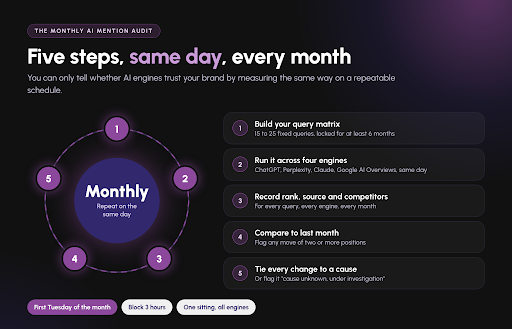
While partnering with an AI SEO and GEO service agency, keeping track becomes essential. The campaign is either producing citations that AI engines are trusting, or it is not.
And the only way to know is to measure it on a repeatable schedule using queries that reflect how NY buyers actually search.
A credible monthly audit is not a vague “did we show up more.” It is a documented table that answers five questions on the same day each month.
Step 1: Build Your Query Matrix
Google Search Central documentation on structured data confirms that properly implemented schema (LocalBusiness, Service, FAQPage, Author, Review) is a direct input into how Google’s AI surfaces, including AI Overviews.
Your query matrix is a fixed list of 15 to 25 queries that reflect how NY buyers search for your category.
- Generic category queries.
- Borough or submarket queries: “best commercial real estate attorney in Brooklyn,” “SoHo real estate lawyer,” “Williamsburg family dentist.”
- Price-point queries.
- Trust-signal queries.
Pick 15 to 25 queries that cover your top 3 service lines and your top 3 geographic submarkets, lock the list, and run them unchanged for at least 6 months.
Step 2: Run the Matrix Across Four Engines on the Same Day
Run every query on your matrix across ChatGPT, Perplexity, Claude, and Google AI Overviews on the same calendar day each month.
AI engines refresh their indexes on different cycles, and comparing results pulled across different days introduces noise that masks real signal.
Pick the first Tuesday of each month, block three hours on your calendar, and run the full matrix in one sitting.
Step 3: Record Mention Rank, Citation Source, Competitor Position
For every query, every engine, every month, record:
- Did your business get mentioned?
- Rank in the response.
- The citation source the engine pulled from (your site, Yelp, Google, a press mention, a Reddit thread).
- Top three competitors mentioned and their rank order.
- Any new business mentioned this month that was not in last month’s result.
The last line is the one most tracking tools miss.
New entrants to the AI result set are the leading indicator of a competitor doing effective AI SEO work.
Catching them early tells you where to pay attention.
Step 4: Compare to Last Month and Flag Deltas
Every monthly audit produces a report that fetches the entire citation report; it should include which queries gained a mention.
Which lost one and which saw rank changes of two or more positions.
A delta of two or more positions in either direction is actionable.
Positive deltas mean recent optimization work is compounding, and you double down.
Negative deltas mean something broke in your citation ecosystem (a review platform update, a lost press mention, a competitor’s new content), and you investigate within 10 business days.
Step 5: Tie Every Delta to a Specific Cause
The hardest part of credible AI tracking is attribution, and this is what sets a benchmark for choosing the SEO agency in New York when the market is competitive.
When a mention appears or disappears, you need to know why.
The documented causes that produce most NY mention changes:
- A press mention published in credible sources like NYT, Village Voice, Curbed NY, StreetEasy, or an industry trade.
- A review velocity spike or drop on Google, Yelp, or a vertical-specific platform.
- A Reddit thread on r/NYC, r/AskNYC, r/newyorkcity, r/brooklyn, r/manhattan, r/queens, or r/bronx that gained engagement.
- A structured data change on your site.
- A new competitor landing page that captured citation share.
- An AI engine update that reshuffled result sets.
Your monthly report should name the cause for every delta, or flag it as “cause unknown, under investigation.”
NY-Specific Query Types Most Businesses Miss
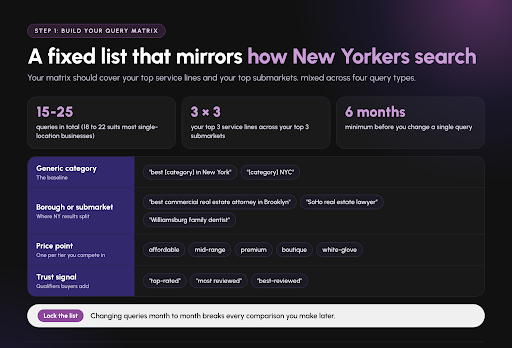
The query matrix most generic SEO agencies in New York plan to build for a NY business tracks only generic category queries.
That misses the four query types that actually produce most of NY’s AI mention volume.
Borough And Submarket Queries
NY buyers specify geography far more granularly than buyers in any other US metro.
“Best coffee shop” produces one result set; “best coffee shop Williamsburg” produces an entirely different set with almost no overlap.
Track submarket queries for every submarket you serve: Manhattan submarkets (SoHo, Tribeca, Chelsea, West Village, East Village, Upper East Side, Upper West Side, Harlem, Washington Heights, Financial District, Midtown East, Midtown West) and the Bronx and Staten Island submarkets you serve.
Price-Point Queries
NY buyers price-stratify more aggressively than most metros. “Affordable” produces a different AI result set than “mid-range” or “premium” or “boutique” or “white-glove.” Track at least one query per price point you compete at.
Language-Specific Queries
NY’s language diversity produces measurable AI query volume in Spanish, Mandarin, Cantonese, Russian, Yiddish, Korean, Arabic, French, and Haitian Creole, among others.
If you serve a submarket where another language is prominent (Spanish in Washington Heights or parts of Queens, Mandarin in Flushing or Sunset Park, Russian in Brighton Beach, Yiddish in Borough Park or Williamsburg), track at least two queries per month in that language.
Trust-signal queries
NY buyers often add trust qualifiers to their AI queries that other metros use less often.
Those queries include “most reviewed,” “top-rated,” “best-reviewed,” “Michelin-rated” (for restaurants), “Super Lawyers” (for legal), “Castle Connolly top doctor” (for medical).
These queries pull from different source sets than generic queries, and they often reveal citation gaps your generic tracking misses.
What a Credible NY AI SEO Tracking Report Looks Like
To truly determine whether you have partnered with the profound SEO company in New York, a report has eight sections:
- Executive summary with the three biggest wins and three biggest losses of the month.
- Full matrix results table with every query, every engine, mention Y/N, rank, source.
- Delta table versus previous month.
- Competitor movement summary (who gained ground, who lost ground).
- Attribution notes for every delta.
- Recommended actions for the next month with specific owners and deadlines.
- The exact queries, engines, and date the audit ran so the work is reproducible.
If your current AI SEO services provider in New York sends a “we got mentioned 12 times this month” summary with no matrix, no deltas, no attribution, you are not getting tracking.
You are getting marketing copy about tracking.
Common NY AI Tracking Mistakes
- Running the matrix on different days for each engine, which introduces timing noise.
- Changing queries month over month, which breaks comparison.
- English queries in multilingual submarkets.
- Tracking only generic queries and missing borough, price-point, and trust-signal queries.
- Ignoring competitor movement, which is the leading indicator of a market shift.
- No attribution column, so deltas have no cause and no action.
- Monthly audit cadence drifting to quarterly, which misses NY’s 4-to-8-week result reshuffling cycle.
What Should the Number Look Like?
What you need from your agency is how many numbers we achieved, not the leads that went unfruitful.
Frequently Asked Questions
How many queries should a NY tracking matrix cover for a single-location business?
Between 15 and 25 queries total, covering 3 to 5 service lines, and at least one query in each applicable language if you serve multilingual submarkets. More than 25 becomes unmanageable to run monthly; fewer than 15 produces too thin a signal to detect real deltas. The right number for most NY single-location businesses is 18 to 22.
Why do borough-specific queries matter so much more in NY than in other metros?
Because NY buyers specify geography more granularly, and because AI engines treat each borough and submarket as a nearly separate result set with low cross-contamination. A business ranked first for “best bakery in Manhattan” might not appear at all for “best bakery in Park Slope,” even though Park Slope is one subway ride away.
Should GEO services New York tracking include Spanish, Mandarin, and other non-English queries?
Yes, when your business serves a submarket where another language is prominent. Washington Heights and parts of the South Bronx and Queens produce measurable Spanish AI query volume. The queries return different winners than their English equivalents, and businesses that do not track them do not know what their non-English AI visibility actually is. Native speakers should run the queries, not machine-translated versions.
What citation sources matter most for AI search visibility New York campaigns?
NYT, Village Voice, Gothamist, Time Out NY, Eater NY, Grub Street, Curbed NY, StreetEasy, and the relevant industry trade publications for your category (The Real Deal for real estate, Crain’s for business, Law360 for legal, Modern Healthcare for medical). Reddit threads on r/NYC, r/AskNYC, r/newyorkcity, and borough-specific subreddits carry heavier weight than most metros.
How quickly can a NY business expect new AI mentions after starting ChatGPT SEO New York work?
Expect first measurable mentions in Perplexity and Google AI Overviews within 45 to 90 days of structured data implementation and digital PR work; ChatGPT and Claude typically lag by 2 to 4 months because their training cycles are slower. For NY mention gains compound faster than other metros once the baseline is set because NY has higher raw query volume. Full stable gains across all four engines typically take 6 to 12 months.
What AI engine update frequency should NY tracking plan for?
ChatGPT, Perplexity, Claude, and Google AI Overviews each run their own update cycles. But NY-focused result sets tend to reshuffle more frequently than other metros because of higher query volume and higher citation turnover. Monthly tracking catches these shifts; quarterly tracking misses roughly two reshuffling cycles per quarter and loses the attribution thread.