table of Content
- 1.How to Compare SEO Services in Austin Before You Hire an SEO Agency
- 2. SEO Agency in Austin That Offers True Local Search Results
- 3. Transparent SEO Services For Austin Businesses
- 4.Local Expertise Is What Separates Austin SEO Services
- 5. Additional Factors to Consider For Best Local SEO Services in Austin
- 6.Scorecard For Your Comparison to Choose the Best SEO Agency in Austin
- 7. Final Words: Now You Know What You Need to Ask in Discovery Call
- FAQs
Key Takeaways
- HVAC SEO services in Phoenix win or lose at the Google Business Profile and map pack level, not the website level, because the search is almost always urgent and almost always on mobile.
- Review velocity is the single biggest lever most Phoenix HVAC companies underfund, and it moves the local pack faster than content or links.
- Content for HVAC marketing Phoenix should answer specific service questions a homeowner types during an outage, not generic “benefits of a tune-up” articles.
- A credible HVAC SEO Phoenix retainer connects every monthly report to booked service calls, not traffic. If calls are not in the dashboard, the campaign is not being measured against the thing that matters.
Phoenix is the hottest part of the US.
The National Weather Service Phoenix Forecast Office records regular stretches of 115°F-plus temperatures across the Phoenix-Mesa-Chandler metro.
And each summer, the query for “AC not working” rises, which is the opportunity for HVAC contractors in this city.
Every HVAC search in July or August is a buyer standing in a hot house, phone in hand, scrolling the map pack for the first business that looks competent and reachable. That is the real buyer behavior behind HVAC SEO services in Phoenix. This piece is about building for it.
What a Phoenix HVAC Search Actually Looks Like
The buyer behavior in HVAC search is not like other local services. Three patterns show up consistently:
- Mobile-first and urgent: Most searches happen from a phone, in a hot house, at a hot time of day. Page speed matters at the physical device level, not just as a Google ranking signal.
- Map pack dominant: The three local pack results take the vast majority of clicks for emergency HVAC queries. If you are not in the top three, you are competing for scraps.
- Call-driven, not form-driven: HVAC buyers call, they do not fill out forms. GBP “call” taps and tracked phone numbers on your site are the real conversion metric, not form submissions.
This changes what SEO for HVAC companies in Phoenix actually has to deliver. Rankings and traffic are secondary. Phone rings are the real scoreboard.
The Phoenix HVAC Call Funnel
Think of the campaign as a four-stage funnel. Every stage has a specific lever, and every stage has to be measured.
Stage 1: Query to Impression
The homeowner types “AC repair near me,” “emergency AC Chandler,” or “HVAC Scottsdale open now.” Your job is to appear in that result set.
What makes you appear:
- Google Business Profile completeness and category accuracy
- Service area pages that match submarkets (Tempe, Mesa, Scottsdale, Chandler, Gilbert, Glendale, Peoria, Surprise, Avondale, Goodyear)
- Business hours accurately marked as “open now” when relevant
- Proximity to the searcher, which you cannot control but can influence through location pages
What to track: impressions in Search Console for emergency and submarket queries, and GBP Insights for views by category of query.
Stage 2: Impression to Click
The homeowner types “AC repair near me,” “emergency AC Chandler,” or “HVAC Scottsdale open now.” Your job is to appear in that result set.
What makes you appear:
- Rating above 4.5 stars.
- Review count that is competitive with your top three local competitors.
- At least 10 photos on the GBP, including team and equipment shots.
- A GBP description that names your service area and specialties plainly.
- Open” status when the search happens, especially on weekends and evenings.
What to track: GBP calls, direction requests, and website clicks against impressions.
Stage 3: Click to Call
Once they click, the homeowner lands on your GBP card or a service page. Your job is to get them to tap the call button.
What drives the call:
- A prominent, tracked phone number above the fold on mobile.
- A clear “we serve your area” signal.
- Social proof (reviews, badges, service years) within the first scroll.
- A page that loads in under 2 seconds on mobile per Google’s Core Web Vitals thresholds, documented in Google Search Central’s page experience guidance.
What to track: tracked phone calls from organic and from GBP, call duration (shorts calls that disconnect fast often indicate a mismatch), and bounce rate on service pages.
Stage 4: Call to Service
If calls are coming in but not converting to booked work, that is a dispatcher problem, not an SEO problem, and your HVAC marketing Phoenix campaign cannot fix it. But the agency should still measure it.
What to track: booked calls divided by total calls from organic. If that number drops below 50%, run a call-audit week before changing the SEO agency in Phoenix.
Why GBP Beats Your Website for Phoenix HVAC
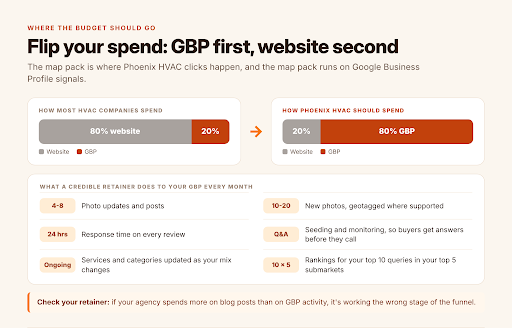
Most HVAC companies spend 80% of their SEO budget on their website and 20% on GBP.
HVAC businesses in Phoenix should flip that.
The local SEO service pack is where the clicks live, and the local pack is driven by Google Business Profile signals, not your website.
What a credible HVAC SEO Phoenix retainer does to your GBP every month:
Posts 4 to 8 updates with photos (truck photos, team photos, service completions where legitimate).
*Monitors and responds to every review within 24 hours.
*Updates services and categories as your service mix changes.
*Adds 10 to 20 new photos monthly, geotagged where supported.
*Runs Q&A seeding and monitoring, so buyers see answers before they call.
*Tracks category rankings for your top 10 queries in your top 5 submarkets.
If your current agency is spending more on blog posts than on GBP activity, your retainer is pointed at the wrong stage of the call funnel.
Review Velocity Is the Lever Phoenix HVAC Companies Underfund
Google’s local ranking factors documentation names three signals: relevance, distance, and prominence. Reviews drive prominence directly.
The pattern in Phoenix HVAC is consistent. The top three local pack results in most service queries carry hundreds of reviews.
New entrants need a review-generation workflow that produces 5 to 15 new reviews a month, every month, not a one-time push.
What a credible review workflow looks like:
*A post-service text or email asking for a review, sent within 24 hours of the completed job
*A simple instruction with the direct Google review link, no login friction
*A response plan for both positive and negative reviews, within 24 hours
*Monthly tracking of review volume, velocity, and star rating against your top three local competitors
Buy software for the workflow or build it yourself. Either way, if your retainer does not fund it, your HVAC marketing Phoenix campaign is leaving the most movable lever on the table.
Content That Converts for Phoenix HVAC Buyers
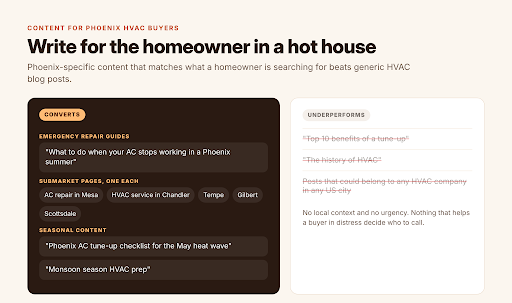
Generic HVAC content underperforms. Phoenix-specific, intent-matched content converts.
What works:
*Emergency repair guides: “What to do when your AC stops working in a Phoenix summer”
*Submarket pages: “AC repair in Mesa,” “HVAC service in Chandler,” one page per submarket with real local content
*Seasonal content: “Phoenix AC tune-up checklist for the May heat wave,” “Monsoon season HVAC prep”
What underperforms:
*“Top 10 benefits of a tune-up” without local context
*“The history of HVAC” and other filler
Generic blog posts that could belong to any HVAC company in any US metro
Content with Phoenix-specific context, written to a buyer in distress, outranks generic HVAC blog content every quarter.
The Only Scoreboard That Matters Is the Phone
Your Phoenix HVAC campaign has one job. Make the phone ring with qualified calls from the submarkets you actually serve.
Rankings, traffic, impressions, backlinks, content velocity, and dashboard screenshots are all intermediate signals, not the conversion.
Three steps to run before you commit to any Phoenix HVAC SEO provider:
Pull last quarter’s tracked phone calls from organic and GBP. If you do not have tracked numbers, that is step zero; fix tracking before you fix anything else.
Furthermore, open your profile side by side with your top three local competitors in your submarket. If your review count, review velocity, photo count, and completeness lag theirs, that is where the retainer should point first.
The HVAC SEO services in Phoenix that produce real returns are not the ones with the glossiest pitch.
They are the ones where every line of the retainer connects back to the number of booked service calls your phone shows this quarter.
Frequently Asked Questions
How much do HVAC SEO services in Phoenix cost?
Most Phoenix HVAC companies spend $1,500 to $4,000 a month on SEO retainers, with multi-location operators clearing $5,000. The spend scales with service area count and review workflow intensity, not just content volume.
How long before HVAC SEO Phoenix starts producing service calls?
Expect first measurable call lift in 60 to 120 days from GBP optimization and review velocity, well before organic rankings move. Full compound returns from a Phoenix HVAC campaign typically show up between months six and twelve.
What is the single most important metric for an HVAC SEO Phoenix campaign?
Tracked phone calls attributed to organic and GBP, broken down by submarket. Rankings and traffic are leading indicators. Calls are the lagging indicator that pays your business. Any Phoenix HVAC retainer that reports on rankings but not on calls is measuring the wrong thing.
Do I need separate landing pages for every Phoenix suburb I serve?
Yes, if you want to compete in the local pack across submarkets. One page for “Phoenix” is insufficient for an HVAC company that serves Chandler, Gilbert, Mesa, Tempe, Scottsdale, and the West Valley.
How do I beat an HVAC company that already has 500 reviews in my Phoenix submarket?
Not head-on. Compete on review velocity, not review count, because Google weighs recent review activity heavily. Add 10 to 15 new reviews a month consistently, respond to every one within 24 hours, and you will often outrank a competitor with twice your review count.
Should I run HVAC SEO Phoenix alongside Google Ads?
Yes, especially in peak summer months when every search is urgent. Google Local Services Ads and Google Ads cover the window from search to call while your SEO compounds in the background.