SEO Lead Generation Services in Los Angeles: Which Pages Should Be Built to Convert?
SEO Lead Generation Services in Los Angeles: Which Pages Should Be Built to Convert? November 16, 2026 fogvibrant Instagram Facebook Linkedin X-twitter table of Content 1.How to Compare SEO Services in Austin Before You Hire an SEO Agency 2. SEO Agency in Austin That Offers True Local Search Results 3. Transparent SEO Services For Austin Businesses 4.Local Expertise Is What Separates Austin SEO Services 5. Additional Factors to Consider For Best Local SEO Services in Austin 6.Scorecard For Your Comparison to Choose the Best SEO Agency in Austin 7. Final Words: Now You Know What You Need to Ask in Discovery Call FAQs Key Takeaways SEO lead generation services in Los Angeles work when the page portfolio is deliberate; most LA businesses build 20 to 40 pages that convert at under 1% instead. A submarket service page, a price-transparent service page, a problem-first diagnostic page, a comparison page, and a local authority page together capture most of the LA query intents that actually convert. The common mistake is building generic service pages first and specialized pages never. As an existing business in Los Angeles who hired SEO retainer gets 3-40 content pieces that ranks well but convert poorly. Sounds familiar? The problem is rarely any one page. The problem is that no one picked the right five pages to build and build them well. Here are the five pages that produce most organic lead generation Los Angeles businesses actually earn, what each one captures, and the order to build them in. The Submarket Service Page: Crucial for SEO Lead Generation Services in Los Angeles A page built for one specific LA submarket, covering one specific service, with real content about that submarket. The intent it should capture is “service + submarket” (“HVAC West LA,” “commercial roofer Santa Monica,” “family dentist Culver City,” “personal injury lawyer Hollywood”), “submarket + near me” queries, and submarket-specific comparison queries. Who converts from it? LA buyers who have already decided their submarket and are comparing providers. It is called mid-funnel buyers, ready to engage, and the submarket signal in their query means a generic citywide page loses to a submarket-specific one every time. Build cost and time 1,500 to 2,500 words of genuinely differentiated content per submarket, including named streets, named neighborhoods, submarket-specific context (parking in Beverly Hills, permits in Santa Monica, HOA rules in Palos Verdes). Expect 4 to 6 weeks to publish per page, 30 to 60 days to rank. How many to build first? 5 to 8 submarkets where you have real work history. Westside, Central, Hollywood area, Valley, Eastside, and Pasadena area. Pick the 5 to 8 that match your actual service area. The Price-Transparent Service Page Page that publishes real pricing ranges or a clear what-drives-cost explanation for a specific service. “service + cost,” “service + price,” “how much does + service + cost in LA,” “service + pricing + submarket.” These are high-intent queries where the LA buyer has already decided to spend money and is now researching how much. Who converts from it? LA buyers moving from research to shortlist. The price-transparent page shortcuts a comparison process that usually takes the buyer across 4 or 5 competitor pages. Positioning your business as the shortlist entry point rather than one of several options. Build cost and time Moderate to high. Writing requires real pricing data from your sales team, documented cost drivers, and legal review for any guarantees or ranges. Expect 6 to 8 weeks to publish, 30 to 60 days to rank, and immediate conversion lift in the LA market specifically because price opacity is the LA competitive norm. Why LA especially? LA has absorbed in-migration from higher-cost metros where price transparency is more common, and the incoming buyer segment punishes LA’s price-opacity default. A price-transparent page captures the newcomer segment reliably. The Problem-First Diagnostic Page for Organic Lead Generation Los Angeles A page built around the specific problem the buyer is trying to solve, not the service your business offers. Example: “Why Is My Roof Leaking in a Light LA Rain” (not “Roof Repair Services”). Problem-first queries, which are higher volume and lower competition than service-name queries. It signals a buyer who is diagnosing a symptom and has not yet decided which category of provider to call. Who converts from it? LA buyers at the top of the funnel who read the diagnostic page, recognize their problem, and then click through to your service page because you already proved category expertise. Build cost and time Moderate. 1,500 to 2,500 words answering the problem specifically, with photos or diagrams where applicable. Named LA-specific triggers (monsoon pattern changes, Santa Ana wind damage, El Niño cycles, LA-specific pest species, LA-specific building code quirks). Expect 4 to 6 weeks to publish, 60 to 90 days to rank because problem-first queries have less competition. Why most LA plans skip this Generic SEO service agencies in Los Angeles build plans around service keywords. Problem-first content requires category expertise and willingness to invest in content that does not immediately mention your service, which generic plans consistently avoid. Comparison and Alternatives Page Page that addresses “X vs Y” and “alternatives to X” queries. Comparing your approach to common alternatives without disparaging competitors. Alternatives to X or comparison of which is better for. These queries signal a buyer deep in evaluation mode, often comparing options rather than providers. Who converts from it? LA buyers at the evaluation stage, usually the second or third page they visit in a buying cycle. These visitors convert at higher rates because they arrived already pre-sold on the category and just need a credible provider. Build cost and time Comparatively high. Comparison pages require honest, defensible claims about both options, with sources where applicable. Legal review for any specific-brand comparisons. 2,000 to 3,500 words. Expect 6 to 10 weeks to publish, 60 to 120 days to rank because comparison content earns backlinks over time and compounds. LA-specific note Comparison pages work especially well in LA because the buyer sophistication produces
Link Building Services in Austin: What Makes a Local Backlink Worth Pursuing?
Link Building Services in Austin: What Makes a Local Backlink Worth Pursuing? November 12, 2026 fogvibrant InstagramFacebookLinkedinX-twitter table of Content 1.How to Compare SEO Services in Austin Before You Hire an SEO Agency 2. SEO Agency in Austin That Offers True Local Search Results 3. Transparent SEO Services For Austin Businesses 4.Local Expertise Is What Separates Austin SEO Services 5. Additional Factors to Consider For Best Local SEO Services in Austin 6.Scorecard For Your Comparison to Choose the Best SEO Agency in Austin 7. Final Words: Now You Know What You Need to Ask in Discovery Call FAQs Key Takeaways Link building services in Austin produce ranking lift only when every proposed backlink passes all pre-checks. An Austin link from a site that ranks for Austin category queries compounds authority faster than a higher-DR link from a generic national blog that has no local or topical signal. The common mistake is chasing links by Domain Rating alone, ignoring editorial independence, placement context, and durability. A credible SEO link building Austin provider runs the pre-flight before proposing a target, documents the pass or fail on each check, and declines low-passing opportunities even when they count toward monthly link quota. Businesses in Austin hiring link building services regularly end up with 20 to 50 links per quarter. However, a link from a Domain Rating 60 site that is topically unrelated is worth less to your Austin rankings than a dofollow editorial mention from a Domain Rating 32. The job of credible local link building Austin work is to filter aggressively before outreach, not to maximize volume. Here are the 7 pre-flight checks any Austin business can run on any proposed link in 10 minutes. Topical Relevance to Your Austin Category Google Search Central’s link best practices also make clear that link quality signals (topical relevance, editorial placement, site trust) determine whether a link passes authority or gets ignored by the algorithm. How To Test It? Open the site, scan the last 10 to 15 posts. Count how many address topics relevant to your service category. Check whether the site ranks organically for queries in your category using Ahrefs, Semrush, or a simple Google site: operator. At least 40% of recent posts cover your category or an adjacent topic, and the site ranks on page 1 for at least 5 category-relevant queries. The link building service is a failure if the site covers 10+ unrelated categories with no topical focus, or ranks for zero queries in your space. How To Test It? Check Domain Rating (Ahrefs) or Domain Authority (Semrush) as a starting signal, then look at referring domain trend over the last 12 months. A site with DR 50 that has lost 20% of its referring domains over the year is a declining asset; a site with DR 32 that has gained 30% is a rising one. DR or DA above your current site’s own DR (to pass authority upward rather than sideways). The link-building strategy fails if DR is significantly below your own, the referring domain trend, or visible spam signals in the backlink profile. Editorial Independence Would this site exist, publish, and link to your business if SEO were not a factor? The answer separates editorial links (valuable) from paid link schemes (risky). How To Test It? Read the site’s “write for us” or “contribute” page. Check whether they publicly solicit guest posts with a payment or exchange arrangement. Look at the outbound link pattern on 5 recent posts; natural editorial sites link to varied sources based on topic, while paid link sites link to many unrelated commercial sites in repetitive patterns. You have partnered with the right link-building agency services in Austin if the site exists primarily to serve a real audience. Outbound linking is varied and editorial, and there is no public “pay for placement” solicitation. Placement Context Where on the page does the link sit? An editorial in-content link passes authority; a footer link, sidebar link, or “sponsored” block link often does not. How To Test It? Look at example posts where the site has linked to businesses. Note whether links sit inside the article body, in author bylines, in editorial resource recommendations, or in sidebar widgets and footer rolls. In-content editorial placement, with the link surrounded by relevant discussion that explains why your business is being referenced. Footer link blocks, sidebar “partners” or “sponsors” widgets, author bio boxes (unless the author is a named expert at your business), or any pattern that signals a bulk commercial placement. Durability Will this link still exist in 24 months, or is it a short-term placement that disappears when the content archives, the site redesigns, or a payment lapses? How To Test It? Does content from 3 years ago still have the same URL and content, or has the site redesigned recently with URL changes? Check whether the site uses date-based URLs (which can be deprecated) or evergreen URLs. For paid placements, confirm whether the “sponsorship” is monthly, annual, or permanent. Sites that have preserved 3+ year-old content at stable URLs and use evergreen URL structures are the ones that truly cater to the durability factor. Site has redesigned twice in the last 3 years with mass URL changes, uses date-based URLs that tend to deprecate, or the placement is month-to-month paid. Signal For Best Link Building Services In Austin Does the link carry a specific Austin or Texas geographic signal that Google can use to associate your site with the Austin market? How To Test It? Look at the linking page’s content, the site’s primary focus, and whether Austin or Texas appears in the domain, the editorial policy, or the topic of the linking piece. The site is explicitly Austin-focused (Austin in the domain or primary editorial focus), or the linking piece specifically covers Austin topics. Fail: the link comes from a site with no Austin signal and from a piece that does not mention Austin or Texas. These links can still pass category authority but do not
Link Building Services in Phoenix: Where Local Authority Links Actually Come From?
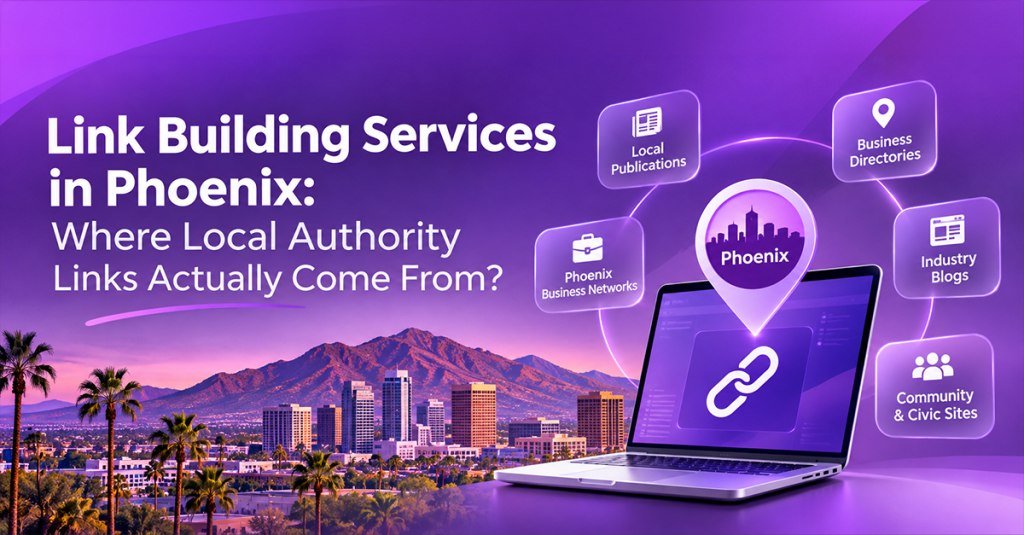
Link Building Services in Phoenix: Where Local Authority Links Actually Come From? November 12, 2026 fogvibrant InstagramFacebookLinkedinX-twitter table of Content 1.How to Compare SEO Services in Austin Before You Hire an SEO Agency 2. SEO Agency in Austin That Offers True Local Search Results 3. Transparent SEO Services For Austin Businesses 4.Local Expertise Is What Separates Austin SEO Services 5. Additional Factors to Consider For Best Local SEO Services in Austin 6.Scorecard For Your Comparison to Choose the Best SEO Agency in Austin 7. Final Words: Now You Know What You Need to Ask in Discovery Call FAQs Key Takeaways Link building services in Phoenix work when the link profile is built from concentric of sources (direct relationships, local community, Phoenix media, industry trades, national authority). The common mistake is paying for paid directory listings or guest post farms that promise fast Phoenix links; most of these sit outside. A credible SEO link building Phoenix provider documents which ring each proposed link source belongs to, projects the compound authority value, and reports monthly on links earned per ring, not just raw link counts. Phoenix businesses that pay for link building services in Phoenix often end up with numbers that look impressive on a report but produce no measurable ranking lift. Google Search Central’s link best practices documentation also makes clear that link quality matters far more than link quantity. This is why a thoughtful ring-by-ring approach beats volume-based outreach consistently. Here are the prominent link sources, from closest to farthest, with the specific Phoenix examples, acquisition methods, and authority weights for each. Direct Relationship Links Links from businesses, vendors, and partners you already work with. The people who would mention your business in natural conversation. The links came from recycled guest post networks, pay-to-play directories, or outreach services that targeted every US metro the same way. They did not come from anywhere in Phoenix. The point of credible local link-building services in Phoenix is to earn links from specific sources. Those sources actually produce authority within the Phoenix search ecosystem, which means thinking about link sources in concentric rings around your business rather than in raw volume. Phoenix-specific examples: Your suppliers’ “customers we serve” or “partners” pages. Clients’ resource pages, especially if you have named Phoenix clients in verticals like real estate, healthcare, hospitality, or professional services. Local Phoenix podcasts, newsletters, and small publications run by people in your network. Phoenix business groups you participate in (mastermind groups, referral networks, BNI chapters). Authority weight Moderate per link, but these links compound quickly because the sources are often niche-relevant to your Phoenix service category. The common mistake Phoenix businesses often forget that their existing network is a link source. They chase cold outreach for 6 months before doing the 20-minute ask to the three vendors they have paid invoices to for 2 years. Local Community and Association Links From Link Building Service in Phoenix SEO services in Phoenix that offer links from Phoenix-area chambers of commerce, trade associations, nonprofit partnerships, and community organizations. Phoenix-specific examples: Phoenix Chamber of Commerce member directory. Scottsdale Area Chamber of Commerce member listings. Mesa Chamber of Commerce, Chandler Chamber of Commerce, Gilbert Chamber of Commerce, and submarket-specific chambers for your service area. Arizona Small Business Association (ASBA). Industry-specific Arizona associations (Arizona Builders Alliance for construction, Arizona Medical Association for medical, State Bar of Arizona for legal, Arizona Technology Council for tech). Phoenix-area Rotary Clubs, Kiwanis, Lions Clubs. Better Business Bureau Arizona serving the Phoenix metro. Local nonprofit sponsorships (United Way of Central Arizona, Arizona Humane Society, St. Mary’s Food Bank Alliance) where your sponsorship produces a “thank you” link. Authority Weight Moderate to high per link, with significant local relevance signal. These are the links that most directly lift rankings for submarket and “best X in Phoenix” queries. The Common Mistake Phoenix businesses join a chamber and never request the member profile update or verify the link is correctly implemented. Many chamber directories use nofollow tags by default. Chamber dues ($200 to $1,500 per year) are a legitimate SEO line item when the link ends up dofollow, and a credible breakdown of how much SEO services in Phoenix cost for a local business treats them exactly that way instead of hiding them in a separate marketing budget. Phoenix Media Links Links earned through press mentions, features, interviews, and expert commentary in Phoenix-area publications. Phoenix-specific examples: Phoenix Business Journal. Phoenix New Times. Phoenix Magazine. AZ Big Media properties (AZ Business Magazine, Ranking Arizona, People & Projects to Know). Trade and local publications (Downtown Phoenix Journal, Scottsdale Progress, Ahwatukee Foothills News, East Valley Tribune, West Valley View). Arizona PBS and local public radio coverage Authority Weight A single Phoenix Business Journal feature can produce more ranking lift than 50 generic links combined, because the source carries documented authority with Google and the surrounding editorial context signals topical relevance. The Common Mistake Phoenix businesses pitch generic company news (new hire, new office) and wonder why no one covers it. Reporters cover specific angles tied to current Phoenix trends (seasonal demand shifts, submarket development, industry disruption). And pitches tied to those angles produce 10 to 20 times the response rate of generic pitches. Industry and Trade Links From Local Link Building in Phoenix Links from publications, associations, and resources specific to your industry category, with Arizona or national scope. Phoenix-specific and category-specific examples: Arizona Attorney magazine (for legal). Arizona Medicine and Arizona Physician (for medical). Arizona Builder Exchange and Arizona Builders Alliance publications (for construction). Arizona Food and Lifestyle Magazine (for hospitality and food service). Trade conference speaking engagements that produce organizer link coverage. Authority Weight High per link, with strong topical relevance to your specific service category. These are the links that lift rankings on category-specific queries nationally, not just locally. The Common Mistake Phoenix businesses chase these links through paid guest post services instead of earning them through actual industry participation. Paid guest post farms have been largely devalued by Google’s spam policies, and the risk of
SEO Migration Services in Austin: What to Protect Before a Website Rebuild
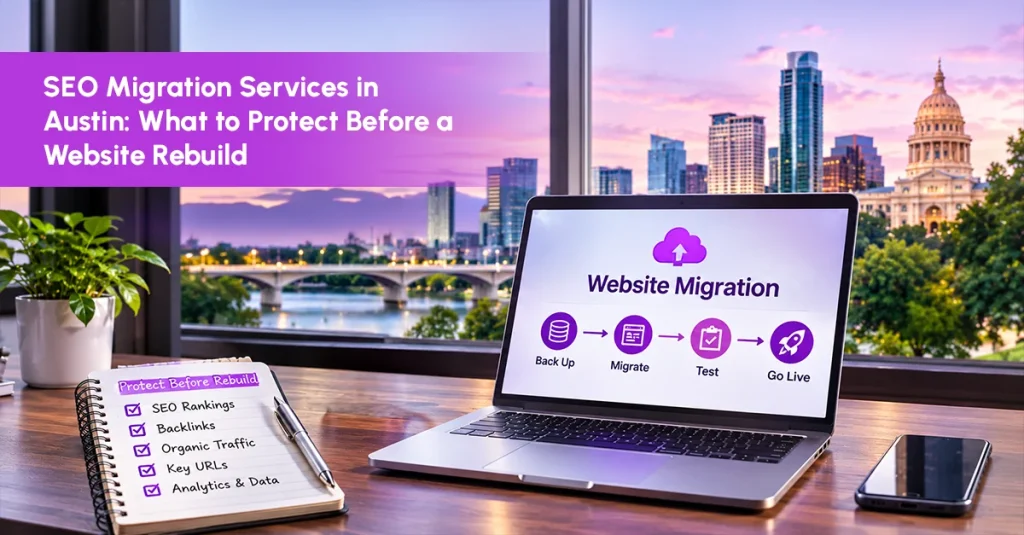
SEO Migration Services in Austin: What to Protect Before a Website Rebuild November 16, 2026 fogvibrant Instagram Facebook Linkedin X-twitter table of Content 1.How to Compare SEO Services in Austin Before You Hire an SEO Agency 2. SEO Agency in Austin That Offers True Local Search Results 3. Transparent SEO Services For Austin Businesses 4.Local Expertise Is What Separates Austin SEO Services 5. Additional Factors to Consider For Best Local SEO Services in Austin 6.Scorecard For Your Comparison to Choose the Best SEO Agency in Austin 7. Final Words: Now You Know What You Need to Ask in Discovery Call FAQs Key Takeaways SEO migration services in Austin exist because website rebuilds routinely destroy 30 to 70% of organic traffic. The biggest lever is pre-migration asset inventory: catalog every ranking page, every high-value backlink, every schema block, every internal link path, and every tracked keyword before the first wireframe gets drawn. The common mistake is letting the design team or development team lead the migration; they optimize for aesthetics and code quality, which are different problems from preserving the SEO equity that took years to build. Austin businesses that pay for a website redesign and then watch their rankings collapse are usually not victims of bad luck. They are victims of a poorly mapped, predictable sequence. The design agency promised a modern site, the developer rebuilt from scratch, nobody mapped the old URLs to the new ones, nobody preserved the schema, and the first month after launch produced a 40% traffic drop that took 9 months to recover. The significance of SEO migration is to exactly tackle this problem and tackle the quarterly loss. Here are five migration failure modes that destroy Austin website rankings. Why SEO Migration Services in Austin Make Sense? Because an Austin service business that loses organic traffic does not come back automatically once rankings recover. Austin is a rebuild-heavy market because the metro has a high tech-adjacent business concentration. The U.S. Bureau of Labor Statistics data for the Austin-Round Rock-Georgetown MSA shows above-average professional services, creative, and tech employment, which produces a constant flow of agencies pitching Austin businesses on redesigns. The Austin competitive environment punishes slow recovery harder than most metros because competitors move in quickly on any ranking drop. And the real symptom each one produces, what actually causes it, and the specific protection a credible SEO migration services plan builds before any rebuild work begins. Failure Mode 1: The 301 Redirect Gap 30 to 60 days after launch, Google Search Console shows a surge of 404 errors, rankings drop across multiple priority pages, and organic traffic falls between 30 and 50%. This happens because old URLs did not get 301-redirected to new URLs. Either the redirects were never built, were built incorrectly, chained through multiple hops, or missed specific URL patterns like category pages, parameter URLs, or legacy blog archives. What to protect before the rebuild? Export every URL from the current site that has earned either organic traffic or a backlink in the last 24 months. Data from Google Search Console, Google Analytics, or GA4 helps you with deciding the which URLs to focus on. Any URL without a direct equivalent gets a decision: redirect to the closest topical match, redirect to the parent category, or 410 (gone) for truly obsolete pages. The map becomes a 301 redirect file the developer implements before launch, verified with a test crawl before DNS changes over. Failure Mode 2: The Content Depth Downgrade Rankings hold for the first 30 days (because 301s were done correctly), then start declining gradually over months 2 through 6 across pages that lost content substance in the rebuild. The design team shortened pages to fit the new aesthetic. A page that used to have 2,400 words of substantive content became a 600-word version just to follow a “modern, clean” version. Google’s helpful content system eventually notices the drop in topical depth, and rankings erode on queries where the longer version used to be the comprehensive answer. What to protect before the rebuild? Redesign the website based on the content and not vice versa. For each page, document: word count, the H2 and H3 structure, any tables or lists, any FAQ schema, and any specific examples or case studies the page contains. The new design must accommodate this content density, not require it to be cut. If specific sections genuinely need to move elsewhere, those destinations also need to be mapped. Failure Mode 3: The Schema and Structured Data Loss AI Overview citations and featured snippet appearances disappear within 60 days of launch, even when traditional rankings hold. Mobile click-through rate drops. Specific page types (FAQ pages, review pages, service pages) lose rich results in Google. The rebuild used a new CMS, theme, or framework that did not carry over the structured data markup from the old site. LocalBusiness, Service, FAQPage, Review, Author, Article, and Organization schema either never got reimplemented, got implemented incorrectly, or got implemented with stripped-down properties missing from the original. AI engines that were citing the old site cannot extract the same entity signals from the new site. What to protect before the rebuild? Export every schema block from the old site using Google’s Rich Results Test on each ranking page. This is what a credible SEO partner would do and one of the finest benchmarks to compare SEO companies in Austin. The rebuild spec must include a schema implementation checklist naming the exact schema types and properties per page template. Validation happens before launch using the Rich Results Test again, confirming every schema block the old site had, the new site has. What Separates Austin SEO Migration From Generic Plans Three specifics belong on every Austin migration project a credible website redesign SEO Austin provider runs: Named Austin submarket pages get specific migration priority because submarket pages typically produce the highest lead volume per URL. Austin-specific trust signals get preserved exactly (Austin Business Journal mentions, Texas Department of Licensing and Regulation license numbers, specific
WordPress SEO Services in Los Angeles: Core Web Vitals, Plugins, and Indexing Issues to Watch
WordPress SEO Services in Los Angeles: Core Web Vitals, Plugins, and Indexing Issues to Watch November 12, 2026 Dushyant InstagramFacebookLinkedinX-twitter table of Content 1.How to Compare SEO Services in Austin Before You Hire an SEO Agency 2. SEO Agency in Austin That Offers True Local Search Results 3. Transparent SEO Services For Austin Businesses 4.Local Expertise Is What Separates Austin SEO Services 5. Additional Factors to Consider For Best Local SEO Services in Austin 6.Scorecard For Your Comparison to Choose the Best SEO Agency in Austin 7. Final Words: Now You Know What You Need to Ask in Discovery Call FAQs Key Takeaways WordPress SEO services in Los Angeles solve ranking problems by running three parallel audits (Core Web Vitals, Plugin Health, Indexing Health). The biggest lever for LA specifically is Core Web Vitals on mobile, because LA traffic skews mobile-first. The common mistake is tackling the three domains in sequence (fix speed, then plugins, then indexing); the three are interconnected, and work in one domain often surfaces problems in the others that get missed when the audits run separately. Most Los Angeles WordPress sites that stopped ranking well this year are carrying technical debt no one person is tracking. SEO team is auditing content when the actual ranking problem sits in Core Web Vitals, the plugin stack, and Google’s crawl behavior. WordPress SEO services in Los Angeles solve that specific compound problem by running parallel audits instead of the one generic SEO audit most providers deliver. Here are the three parallel audits credible WordPress technical SEO Los Angeles work runs, the LA benchmark for each, and what failing any of them costs in rankings and leads. Audit 1: Core Web Vitals Health With WordPress SEO services in Los Angeles Mobile LCP (Largest Contentful Paint), INP (Interaction to Next Paint), and CLS (Cumulative Layout Shift) across your top traffic-generating pages. Think with Google’s 2026 research on local service search shows LA buyer behavior skewing mobile-first, which means mobile Core Web Vitals failures cost measurably more in LA than in slower metros. LA-Specific Benchmarks: Mobile LCP under 2.0 seconds on 4G and 5G connections. LA buyers on 5G networks in Westside submarkets actively compare page load times across competitors within the same search session, so a 2.4-second LCP that passes Google’s threshold still loses to a competitor at 1.6 seconds in real buyer behavior. Mobile INP under 150 ms on interaction-heavy pages (service pages with form fills, filterable listings, image galleries). Entertainment industry and professional services sites in Hollywood, Beverly Hills, and West LA frequently fail INP because of chat widgets, scheduling plugins, and third-party review embeds loading on page interaction. CLS under 0.05 on priority pages, which is tighter than Google’s 0.1 threshold. LA mobile buyers consistently bail from pages where content shifts during load, and ad-heavy or video-embed-heavy LA sites fail CLS at measurable rates. What Failure Costs in LA? Rankings drop specifically on mobile queries first. Desktop rankings typically hold 30 to 60 days longer, which gives LA businesses false confidence that the site is fine before mobile ranking losses compound into total query drops. Something that only profound technical SEO service agency will highlight. The fixes: Image optimization. Audit third-party scripts (chat widgets, review widgets, call tracking, analytics). Theme audit for render-blocking resources; switch to a lightweight theme if the current theme loads unused CSS and JavaScript on every page. Font strategy: self-host fonts with font-display: swap, preload critical fonts, reduce font variants. Database optimization to reduce query time on complex pages; this often improves INP more than any front-end change. Audit 2: Plugin Health The full plugin stack, including active plugin count, abandoned plugin presence, overlapping functionality, update status, and plugin-specific security profile. LA-specific benchmarks: LA sites consistently accumulate 35 to 50 active plugins because of the layered agency rotation pattern common in the metro, where each agency handoff adds plugins without removing legacy ones. Zero abandoned plugins (no updates in 12+ months). LA sites often have 3 to 7 abandoned plugins that have been forgotten but still load code and attack surface on every page. Single SEO plugin, not two. LA sites frequently have Yoast and Rank Math both active because a previous agency installed one, the current agency installed the other, and neither got cleaned up. At least 2 overlapping plugins per LA site in categories like security, caching, image optimization, and forms. These overlaps should be collapsed to a single plugin per category. What Needs to Be Avoided With WordPress SEO in Los Angeles? Page load time degrades, security risk increases, and plugin conflicts produce inconsistent SEO signals that confuse Google’s crawler. The fixes: Plugin inventory with “last used” classification; deactivate and delete anything unused in the last 90 days. Replace any abandoned plugin (12+ months without update) with a maintained alternative. Consolidate overlapping plugins to one per category: one SEO plugin, one caching plugin, one image optimization plugin, one security plugin, one form plugin. Review plugins specifically interacting with Spanish, Mandarin, Korean, or Russian language markets if your LA business serves submarkets where those languages are prominent. Database cleanup for options and postmeta data left behind by deleted plugins Audit 3: Indexing Health Google Search Console coverage report, sitemap submission and validation, crawl stats, canonical tag integrity, schema markup validation, and internal linking depth. LA-specific benchmarks: 5% of URLs in “Discovered but not indexed” or “Crawled but not indexed” status. Over 10% signals that the LA site is burning crawl budget on low-value URLs that should be noindexed or consolidated. The submitted sitemap matches the actual indexable URLs on the site. LA sites commonly have sitemaps that include deleted pages, redirected URLs, or pages with noindex tags, which confuses Google. Every page has exactly one canonical tag. LA sites with two SEO plugins, or a theme and a plugin both setting canonicals, produce duplicate canonical signals. Priority page validates cleanly in Google’s Rich Results Test. LA sites after plugin or theme updates frequently have schema that was valid last month and
What to Check With WordPress SEO Services in Phoenix Before Blaming the Content
What to Check With WordPress SEO Services in Phoenix Before Blaming the Content November 12, 2026 Dushyant InstagramFacebookLinkedinX-twitter table of Content 1.How to Compare SEO Services in Austin Before You Hire an SEO Agency 2. SEO Agency in Austin That Offers True Local Search Results 3. Transparent SEO Services For Austin Businesses 4.Local Expertise Is What Separates Austin SEO Services 5. Additional Factors to Consider For Best Local SEO Services in Austin 6.Scorecard For Your Comparison to Choose the Best SEO Agency in Austin 7. Final Words: Now You Know What You Need to Ask in Discovery Call FAQs Key Takeaways WordPress SEO services in Phoenix fix ranking drops that get misdiagnosed as content issues. The biggest lever is symptom-driven technical diagnosis; different ranking symptoms point to different WordPress causes, and treating every drop as a content problem wastes 60 to 90 days of SEO work. A credible WordPress SEO agency Phoenix businesses hire runs a symptom-specific technical audit first, confirming the technical layer is clean. Phoenix WordPress sites lose rankings every month for technical reasons that look like content problems. The marketing team reads the ranking drop, assumes the content is stale, and rewrites the top 10 pages. WordPress SEO services flip that sequence. It first rules out the technical suspects, confirms the WordPress stack is clean, and only then decides whether content is actually the problem. Here is the symptom-by-symptom technical checklist a WordPress SEO Phoenix provider should run before anyone rewrites a single paragraph. Rankings Dropped on Previously Ranking Pages Stale content. A page that ranked solidly for 18 months and dropped 15 positions in one month almost never dropped because the content aged. Content ages slowly. Technical regressions happen suddenly; that is why availing WordPress SEO service in Phoenix becomes a necessity. What to check first, in order: Canonical Tag Conflicts: Open the page and inspect its canonical URL. Then check whether a second canonical is being added by another plugin, a theme, or an inline script. Two canonical tags on one page confuse Google and often trigger a ranking drop. Schema Markup Breaks: Run the page through Google’s Rich Results Test. If LocalBusiness, Service, FAQPage, Article, or Review schema is no longer validating, a recent plugin update broke the implementation. Index Coverage Changes: Open Google Search Console and inspect the specific URL. If the status changed from “Indexed” to “Discovered but not indexed.” internal Link Loss: Compare the current internal linking structure to what it was before the drop. If the page lost inbound internal links, its topical authority signal degraded. Core Web Vitals Regression: Run the page through PageSpeed Insights. If mobile LCP, INP, or CLS degraded in the last 30 to 60 days, a recent change affected rendering. If all five checks are clean, then evaluate the content. Usually one of the five is the real cause. New Content Takes Weeks To Get Indexed Phoenix businesses that used to see new posts indexed within 2 to 7 days now see 3 to 6 weeks. They are hitting a WordPress-layer crawl budget problem. What to check first, in order: Sitemap Health: Open the XML sitemap and confirm it is current, includes the new URLs, and is submitted to Google Search Console. If two sitemaps exist, deactivate the duplicate. Also confirm the sitemap is not over 50,000 URLs or 50 MB per Google’s sitemap limits documentation. Crawl Budget Bloat: If the site has thousands of parameter URLs, tag archive URLs, author archive URLs, or paginated URLs that have no SEO value, Google is wasting crawl budget on them instead of new content. Discovered But Not Indexed Status. Google Search Console will list specific URLs with this status. It means Google saw the URL but decided not to crawl it, usually because the site has too many low-value URLs relative to its authority. Internal linking to new content. New posts should be linked from at least 2 relevant existing pages at the time of publication. If new content is orphaned (no inbound internal links), Google has no path to discover it. Google Business Profile signal. For businesses in Phoenix, local SEO services matter significantly. GBP activity sends freshness signals that correlate with faster content indexing. Mobile Optimized WordPress Technical SEO Phoenix Mobile-specific drops are almost always technical because desktop rankings continue to hold. Content that fails on mobile but works on desktop is rare; technical mobile rendering problems are common. What to check first, in order: Mobile Core Web Vitals: Specifically INP (Interaction to Next Paint) and LCP. Phoenix mobile users on 4G and 5G should see sub-2.5-second LCP; anything over 4 seconds triggers measurable ranking drops. Mobile Usability Errors in Google Search Console: Open the Mobile Usability report. Common Phoenix WordPress errors: clickable elements too close together, text too small to read, content wider than the screen. AMP Legacy Issues: Phoenix sites that enabled AMP years ago and then disabled it often have orphaned AMP URLs still in Google’s index. Those URLs now return 404s or redirect incorrectly. Responsive Theme Breakage: Test the site on 5 different mobile devices or in Chrome’s device emulator. Mobile-specific redirects: Sites that used to serve a separate m. subdomain to mobile users sometimes have leftover redirect rules sending mobile traffic to deprecated URLs. Rankings Fluctuate Wildly Week To Week Weekly ranking volatility that persists over 60 to 90 days is almost always technical. What to check first, in order: Cache Misconfigurations: If the cache plugin is serving stale pages to Googlebot while serving fresh pages to users, Google sees a different site than visitors do. Server Intermittent Errors: Check server logs for 500 errors, 503 errors, or timeout patterns. If Googlebot hits errors even 2 to 5% of its crawl attempts, rankings fluctuate as Google reassesses the site’s reliability. Hosting-Level Resource Caps: Shared hosting plans often throttle resources when a site exceeds its allocation, which produces intermittent slowness that affects both user experience and crawl success. Plugin Update Cycles: If plugins are auto-updating without staging testing, each update
Fixing the WordPress Issues That Quietly Hold Rankings Back: Unraveling WordPress SEO Services in Austin
Fixing the WordPress Issues That Quietly Hold Rankings Back: Unraveling WordPress SEO Services in Austin November 12, 2026 Dushyant InstagramFacebookLinkedinX-twitter table of Content 1.How to Compare SEO Services in Austin Before You Hire an SEO Agency 2. SEO Agency in Austin That Offers True Local Search Results 3. Transparent SEO Services For Austin Businesses 4.Local Expertise Is What Separates Austin SEO Services 5. Additional Factors to Consider For Best Local SEO Services in Austin 6.Scorecard For Your Comparison to Choose the Best SEO Agency in Austin 7. Final Words: Now You Know What You Need to Ask in Discovery Call FAQs Key Takeaways WordPress SEO services in Austin solve a specific problem: ranking drops that have no obvious cause because the issues compound with site age and get buried under hosting. The common mistake is adding more SEO plugins to fix ranking problems; most WordPress SEO issues are caused by too many plugins, not too few, and plugin consolidation lifts rankings more often than plugin addition. A credible WordPress SEO agency Austin businesses hire runs a technical audit scoped to the site’s actual age, consolidates the plugin stack, cleans the database, and monitors Core Web Vitals and crawl behavior for 90 days before measuring results. The site loads perfectly, pages are indexed, and Google Search Console shows no major errors. And yet rankings have slipped on priority queries, and the SEO team cannot explain why. The reason is almost always inside WordPress itself. It could be a plugin conflict, a database table, a theme update that changed how the H1 renders on mobile, or a cache layer that is serving stale pages to Googlebot. The point of WordPress SEO services in Austin is to find the specific layer where the ranking signal is leaking. Rewriting the Question You Should Actually Ask Most buyers walk into an SEO conversation asking, “What does this cost per month?” That question has no useful answer. A $500 retainer that produces nothing is more expensive than a $4,000 retainer that produces 40 qualified leads a month. The right opening question is: “How many leads does this retainer need to produce for me to break even, and how long will that take?” With this, you stop comparing retainer numbers across agencies and start comparing lead math. What Is So Different About the Austin Market? Austin is a WordPress-heavy market. WordPress remains the dominant CMS for US small and mid-sized service businesses according to W3Techs’ CMS market share data. The result: most Austin service websites sit on WordPress, inherit WordPress-specific technical debt, and need a WordPress-literate team to diagnose issues that generic SEO agencies miss. The specific issues depend on how old the site is. WordPress SEO problems compound with site age in predictable patterns. Here is what quietly breaks at each stage, what ranking symptom it produces, and how a credible WordPress SEO service in Austin fixes it. Month 6 Problems: The Accumulation Starts With WordPress SEO services in Austin What goes wrong: The site launched with 6 to 8 plugins. By Month 6, it has 14 to 20 because every small feature need got solved by adding one. The theme’s default SEO settings were never audited; the H1 structure, breadcrumb behavior, and canonical tags are inherited from the theme without review. Image uploads are being stored at full resolution with no compression. The default WordPress sitemap is active alongside a plugin-generated sitemap, producing duplicate submissions to Google Search Console. Ranking symptoms: Mobile Core Web Vitals are passing but close to failure on LCP and INP. Occasional Coverage warnings in Google Search Console about duplicate pages. Rankings are holding but not improving despite consistent content publishing. The default WordPress sitemap is active alongside a plugin-generated sitemap, producing duplicate submissions to Google Search Console. Year 1 Problems: Initial Technical Debt What goes wrong: The plugin count is now 20 to 25. Three or four are plugins the business has not used in six months but has not deactivated. The theme has been updated 3 to 5 times; one of those updates changed how the site renders schema markup without anyone noticing. The database has 400 to 600 post revisions per published post, bloating the wp_posts table. One or two plugins have become abandoned and are now security risks and performance drags. Ranking symptoms: Core Web Vitals have degraded from “Good” to “Needs improvement” or worse on priority pages. Schema markup appears inconsistent in Google’s Rich Results Test depending on the page. Rankings have drifted downward on queries that used to rank solidly. Google Business Profile integration is showing warnings. Year 3 Problems: Plugin Bloat and Theme Deprecation What goes wrong: Plugin count is now 28 to 40. Multiple plugins solve overlapping problems; at least two SEO-adjacent plugins are active simultaneously. The original theme has been deprecated or heavily modified; custom code is scattered across functions.php, child theme files, and page builder overrides. Database is now 500 MB to 2 GB. Query times on complex pages are measurable; mobile TTFB exceeds 800 ms. Redirect chains have accumulated from years of URL changes; some chains now have 3 to 5 hops. Legacy content accounts for 30 to 50% of all URLs but produces under 5% of organic traffic. Ranking symptoms: Site-wide ranking decline across most priority queries. Google Search Console shows an increasing number of “Discovered but not indexed” URLs. Core Web Vitals are consistently poor on mobile; INP is the frequent failure point. New content takes 2 to 4 weeks to get indexed, when it used to take 2 to 4 days. Year 5+ Problems: Legacy Accumulation WordPress SEO services in Austin What goes wrong: Themes have left traces in the database. Dozens of plugins have come and gone, each leaving options, custom tables, or orphaned data. Chances are the database may go more than 4 GB, with significant portions being non-content data (session logs, old form submissions, deleted plugin leftovers, legacy analytics data). The site is on a shared hosting plan that was appropriate three years
SEO Lead Generation Services in Austin: How to Turn Local Rankings Into Enquiries
SEO Lead Generation Services in Austin: How to Turn Local Rankings Into Enquiries November 5, 2026 Dushyant InstagramFacebookLinkedinX-twitter table of Content 1.How to Compare SEO Services in Austin Before You Hire an SEO Agency 2. SEO Agency in Austin That Offers True Local Search Results 3. Transparent SEO Services For Austin Businesses 4.Local Expertise Is What Separates Austin SEO Services 5. Additional Factors to Consider For Best Local SEO Services in Austin 6.Scorecard For Your Comparison to Choose the Best SEO Agency in Austin 7. Final Words: Now You Know What You Need to Ask in Discovery Call FAQs Key Takeaways SEO lead generation services in Austin work only when every stage of the ranking-to-enquiry pipeline is fixed. The common mistake is treating rankings as the goal; a page ranked second with a 0.5% enquiry rate loses to a page ranked fifth with a 4% enquiry rate every time, and the fix is pipeline optimization, not ranking optimization. A credible SEO lead generation Austin provider measures each pipeline stage separately (SERP CTR, page landing, scroll depth, trust-check completion, form or call rate, qualified-lead rate) and rewrites the specific stage that is leaking, not the whole page. The visitor searched, clicked, landed, scanned, left. Somewhere between the Google result and the filled-out form, they dropped out. Real SEO lead generation work in Austin is to find exactly where that drop happens and fix the specific stage that is leaking, not to publish another page or add more keywords. This article talks about stages between a Google ranking and a qualified enquiry, where Austin businesses lose the most leads, and how to fix each stage. What Needs to Be Addressed by SEO Lead Generation Services in Austin? Austin is a competitive lead generation market because the buyer base is sophisticated and the service provider count is dense. Think with Google’s 2026 research on local service search behavior shows that mobile local-service users typically make a visit, call, or form-fill decision within 2 minutes of their first search click, which means every stage of the pipeline has to work on the first attempt. An effective SEO lead generation strategy doesn’t end when a visitor clicks on your website. It needs to guide that visitor through a series of connected stages, from discovering your business to becoming a qualified lead. For Austin businesses, each stage needs to address a specific point of friction. Here’s how to structure the process: Stage 1: Rank Visibility The leak: The page does not rank for queries buyers actually use. How Austin businesses lose here: Chasing head terms like “best SEO Austin” instead of the longer-tail, higher-intent queries. Austin buyers actually type queries that are typically service plus submarket plus a modifier. Examples include ‘commercial roofer South Austin monsoon,” or “boutique PR firm East Austin SXSW”. Head terms are rented with Google Ads; organic lead generation Austin wins come from mid-tail and long-tail queries. The fix: Build pages for the specific submarket + service + qualifier combinations your buyers search for. Research the actual queries using Google Search Console, Google Business Profile Insights, and real customer interviews, not just a keyword tool. A typical Austin service business benefits from 8 to 15 submarket-specific pages with real differentiated content per page, not templates. Stage 2: SERP Click The leak: Page ranks but earns a low click-through rate from the search results. How Austin businesses lose here: Generic title tags and meta descriptions that look identical to every other Austin result. “Expert SEO Services in Austin, TX” is indistinguishable from four competitors on the same results page. The fix: A title tag that names the specific service, specific submarket, and one differentiator. Meta description with a specific proof point and a specific action (“A South Lamar restaurant added 340 reservations in 90 days from local SEO. See the audit before you spend a dollar.”). Google Business Profile with current photos, reviews responded to within 24 hours, and category-matched posts. Stage 3: Page Landing The leak: Page loads too slowly, breaks on mobile, or does not match the click intent. How Austin businesses lose here: Google Search Central’s page experience documentation is explicit that mobile Core Web Vitals affect both rank and user experience, and Austin’s mobile-first buyer base punishes slow pages harder than most metros. Pages over 3 seconds on mobile Core Web Vitals, pages that redirect through tracking parameters that break on first load, or pages whose H1 does not match the title tag the visitor clicked. SEO lead generation service is all about optimizing pages to load under 2.5 seconds on mobile. H1 reads as the natural continuation of the title tag the visitor clicked. First meaningful content appears above the fold on mobile without scrolling. Images are compressed and lazy-loaded. No pop-ups, no interstitials, no “accept cookies” modal that covers the whole screen. Stage 4: First Scroll Proof Check The leak: Page loads but fails to prove local experience and category credibility in the first 30 seconds. How Austin businesses lose here: This is the biggest leak that needs to be fixed by an SEO agency in Austin, and the one most generic plans ignore. Pages that pass the headline scan but then show stock imagery, “trusted by hundreds” with no specific number, and “proudly serving Austin” without naming submarkets get closed before 30 seconds. The fix: Name 5 to 8 specific Austin submarkets you serve. Include one Austin-specific context paragraph relevant to your category. Surface one specific Austin client proof point with a named submarket, named business type, and specific result in the first scroll. One Austin publication reference (Austin American-Statesman, Austin Business Journal, Austin Chronicle, Austonia, KUT) adds credibility weight. Stage 5: Trust Evaluation The leak: Visitor passes the first-scroll scan but fails to find enough credibility to justify filling the form. How Austin businesses lose here: Adjective-heavy copy (“fair pricing,” “fully licensed,” “committed to quality”) without specific numbers, named platforms, or named credentials. Austin buyers filter adjectives out and look for specifics; pages without
SEO Copywriting Services in Los Angeles: How to Write Pages That Rank and Convert

SEO Copywriting Services in Los Angeles: How to Write Pages That Rank and Convert November 4, 2026 Dushyant InstagramFacebookLinkedinX-twitter table of Content 1.How to Compare SEO Services in Austin Before You Hire an SEO Agency 2. SEO Agency in Austin That Offers True Local Search Results 3. Transparent SEO Services For Austin Businesses 4.Local Expertise Is What Separates Austin SEO Services 5. Additional Factors to Consider For Best Local SEO Services in Austin 6.Scorecard For Your Comparison to Choose the Best SEO Agency in Austin 7. Final Words: Now You Know What You Need to Ask in Discovery Call FAQs Key Takeaways SEO copywriting services in Los Angeles produce pages that both rank and convert only when every element serves two goals at once. The biggest lever is the H1 and the first 150 words: both the ranking algorithm and the LA buyer form their verdict in that opening block. The common mistake is rewriting for ranking and then adding conversion polish separately. Most Los Angeles service pages solve one problem and ignore the other. Pages built by generic SEO content writing Los Angeles providers rank but convert at 1%. Pages built by generic copywriters convert well but never show up on page one. The point of SEO copywriting services in Los Angeles is to write every page element so it serves both goals at once. Visible proof points, service area clarity, and transparent pricing are the three strongest conversion signals for E-E-A-T evaluation framework documented in Google Search Central’s quality rater guidelines. Here are five specific LA service page rewrites that lift both ranking and conversion, with the actual before copy, the after copy, and why each rewrite works on both fronts. Rewrite 1: The H1 Los Angeles is also a demanding writing market because the buyer base is unusually proof-sensitive. The city’s dense professional services sector, entertainment industry, and tech corridor mean service page visitors recognize generic copy almost immediately. Before: “Professional HVAC Services in Los Angeles | 24/7 Emergency Repair” After: “HVAC Repair in West LA, Santa Monica, Culver City, and the Westside” Why this rewrites both ranking and conversion: The H1 is Google’s single strongest on-page ranking input and the LA buyer’s single strongest decision input, and the two inputs converge on specificity. Generic city-level H1s like “HVAC Services in Los Angeles” compete with every national HVAC brand’s templated. LA page, which usually has stronger domain authority. Submarket-specific H1s compete only against other LA-area competitors who claim the same submarket, which is a much smaller field. On the conversion side, LA buyers who searched “HVAC West LA” or “HVAC Santa Monica” see their exact submarket in the H1 within 2 seconds, and the page passes the “is this for me” scan. Both the ranking fight and the first-impression fight get easier with the same rewrite. Rewrite 2: The Opening Paragraph Before: “We are a leading provider of HVAC services throughout Los Angeles and the surrounding areas. Our team of experienced technicians delivers top-quality repair, maintenance, and installation services with a commitment to customer satisfaction and competitive pricing. We proudly serve homeowners and businesses across the greater LA area.” After: “This page is for Los Angeles homeowners and property managers on the Westside who need HVAC repair, maintenance, or replacement. ROILift’s crew is LA-based, pulls permits through LADBS, works with LADWP and SoCalGas service territories, and has worked on single-family homes, duplexes, and mid-rise buildings across the Westside. If your property is in the Valley, east of Hollywood, or in the South Bay, this is not the page you want.” Why this rewrites both ranking and conversion: The after version includes natural keyword variants (“HVAC repair,” “LA-based,” specific submarket names) without stuffing. Google’s helpful content system rewards. it also includes entity signals (LADBS, LADWP, SoCalGas) that signal real local operation to both the ranking algorithm and the LA buyer. On conversion, the LA buyer sees specific submarkets, specific property types, and a stated disqualification. The disqualification is counterintuitive and consistently outperforms its absence in LA because the city’s experienced buyer base recognizes confidence signals and reads vague “we serve everyone” copy as padding. Both goals get served by the same paragraph. Rewrite 3: The Proof Block Before: “Trusted by hundreds of Los Angeles homeowners. Over 20 years of experience. Fully licensed and insured. Fair pricing you can count on.” After: “ A 1920s Spanish Colonial in Hancock Park: full HVAC replacement in 3 days, zero ductwork modifications, documented in a before-and-after walkthrough on our Google Business Profile (4.8 stars, 340 reviews). California C-20 license 1082147. Average Westside residential replacement range: $8,400 to $14,200 depending on tonnage and ductwork condition. We work with LADWP rebates and will apply them automatically to the final invoice.” Why this rewrites both ranking and conversion: The after version is dense with specific entities (Hancock Park, LADWP, California C-20, Google Business Profile). That satisfies the ranking algorithm and the LA buyer treat as credibility signals, something you can expect from an SEO company in Los Angeles. Named permits and licenses pass Google’s E-E-A-T evaluation; the same signals pass the LA buyer’s trust check. The specific case (“1920s Spanish Colonial in Hancock Park”) and the real pricing range serve conversion directly. LA buyers who have moved from lower-cost metros are specifically price-sensitive and reward transparency. The named rebate program also captures long-tail queries that generic copy misses entirely. The same block that proves credibility to Google proves credibility to the buyer. Rewrite 4: The Service Description Before: “Our comprehensive HVAC services include repair, maintenance, installation, and emergency service. We work with all major brands and ensure that every job is completed to the highest standards of quality. Our technicians are highly trained and committed to delivering outstanding results on every project.” After: “Three services, each with a defined scope: (1) Repair diagnostics, 60-minute window, flat $89 diagnostic fee credited to repair if you proceed, same-day availability in most Westside submarkets. (2) Annual maintenance tune-up, 2-hour window, $179 flat, includes refrigerant top-off, condenser clean,
SEO Copywriting Services in Phoenix: Turning Local Service Pages Into Lead Generators

SEO Copywriting Services in Phoenix: Turning Local Service Pages Into Lead Generators November 4, 2026 Dushyant InstagramFacebookLinkedinX-twitter table of Content 1.How to Compare SEO Services in Austin Before You Hire an SEO Agency 2. SEO Agency in Austin That Offers True Local Search Results 3. Transparent SEO Services For Austin Businesses 4.Local Expertise Is What Separates Austin SEO Services 5. Additional Factors to Consider For Best Local SEO Services in Austin 6.Scorecard For Your Comparison to Choose the Best SEO Agency in Austin 7. Final Words: Now You Know What You Need to Ask in Discovery Call FAQs Key Takeaways SEO copywriting services in Phoenix produce service pages that convert only when the page is built around what Phoenix buyers actually do in the first 90 seconds. The biggest lever is the 10-to-30-second window: Phoenix buyers scan the first scroll for proof of local experience. The common mistake is treating SEO copywriting Phoenix businesses buy as a one-time publish instead of a conversion-tested rewrite cycle. A credible SEO copywriter Phoenix businesses hire tests the 90-second visitor journey against actual conversion data. Phoenix service pages have 90 seconds to turn a Google click into a filled-out form. Not endless minutes, not a leisurely scroll, ninety seconds, often less. Think with Google’s 2026 consumer insights research reports that mobile users searching for local services make a visit, call, or form-fill decision within 2 minutes of their first click in roughly 76% of sessions. That is what SEO copywriting services in Phoenix are supposed to prevent, what most generic plans do not. Because they focus on keywords instead of what Phoenix buyers do with the page once they land. Here is exactly what happens in those 90 seconds, where Phoenix buyers typically bail. Moreover, what SEO copywriting Phoenix businesses actually need to do to fix each bail point. Seconds 0 to 10: Crucial Point for SEO Copywriting Services in Phoenix The visitor arrives from a Google search for a specific service. Their eyes land on the H1 and the first sentence. In those 10 seconds, they are deciding one thing: does this page describe my specific situation? What Phoenix buyers scan for in seconds 0 to 10: The exact service they searched for, named in the H1 (not a close variant) A submarket or city match if their search included one (Scottsdale, Tempe, Mesa, Chandler, Gilbert, Glendale, Peoria, Avondale, Goodyear, Surprise, Queen Creek, Ahwatukee, Arcadia, Biltmore) Any sign that the page is written for them specifically, not a generic reader The most common Phoenix service page failure in this window is the generic H1. For example, an esteemed SEO copywriting services in Phoenix: “Expert HVAC Services in Arizona” loses to “HVAC Repair in Scottsdale, because the second H1 proves within 5 seconds that the page covers the submarket the visitor searched from. The 0-to-10-second rewrite: H1 names the specific service and the specific submarket, and the first sentence names a specific Phoenix buyer situation (summer HVAC failure, monsoon roof damage, pool opening for the season, specific business type). Seconds 0 to 10: Crucial Point for SEO Copywriting Services in Phoenix Visitors who pass the 10-second scan start scrolling. In seconds 10 to 30, they are looking for four proof signals that this page represents. A Phoenix business with actual Phoenix experience, not a national company with a templated city page. What Phoenix buyers scan for in seconds 10 to 30: Named Phoenix-area submarkets you serve. Phoenix-area context relevant to your category. A specific proof point from a Phoenix client (named neighborhood, named business type, specific result). A review score or review count that is visible without clicking. What needs to be done here is: name 5 to 8 specific submarkets you serve with real projects or clients in each. Add a short Phoenix-specific context paragraph that proves category familiarity (monsoon prep, pool season timing, APS vs SRP service territory, City of Phoenix vs Scottsdale permit timelines), and surface one specific Phoenix client proof point in the first scroll. Seconds 30 to 60: Winning The Trust With SEO Copywriter in Phoenix Visitors who pass the first-scroll proof check now want to know whether you can actually do the work. This is where the page either builds enough trust to earn a form fill or loses the visitor to a competitor whose page did a better job answering the trust question. What Phoenix buyers scan for in seconds 30 to 60: Documented methodology (what you actually do, in what order, with what deliverables) Credentials relevant to the service (licenses, certifications, bonds, insurance where applicable). Review platform scores. Case specificity. Pricing clarity, or at least pricing transparency. The most common bail in this window happens when the page shifts from service description to generic claims. “Fully licensed and insured” without the license number. “Trusted by the community” without a review count or a review platform. “Fair pricing” without a range or a what-drives-cost paragraph. Phoenix buyers who have moved from higher-cost metros are particularly sensitive to pricing opacity, because the city has a reputation for pricing variance across service providers. Seconds 60 to 90: The Decision Window Visitors who passed all three prior scans now have to decide. This is where the CTA either earns the lead or wastes the previous 60 seconds of trust-building. What Phoenix buyers scan for in seconds 60 to 90: A clear next step with specific first-step clarity. Risk reduction (what happens after they fill the form, how fast, what the first interaction looks like). Social proof directly adjacent to the CTA. A phone number for buyers who prefer to call. The 60-to-90-second rewrite: name the first-interaction output specifically, state the timing honestly, add a visible phone number near the CTA for the phone-first segment, and place one specific proof point next to the CTA so the last thing the visitor sees before deciding is a reason to trust the page. What a Phoenix-Specific SEO Copywriter Builds That Generic Writers Miss Generic SEO copywriting services in Phoenix produce pages that