table of Content
- 1. What Quality Content Marketing Services Look Like in Austin?
- 2. The Shift: From Topic Lists to Question Lists
- 3.Source 1: Sales Call Recordings
- 4. Source 2: Support Tickets and Email Inbox
- 5. Source 3: Google Search Console Search Queries
- 6. Source 4: AI Chat Conversations
- 7. Source 5: Review Sites and Public Forum Threads
- 8. The Austin-Specific Layer Across All Five Sources
- 9. What ROILift Does for Austin Content Marketing Engagements
- FAQs
Key Takeaways
- Content marketing services in Austin produce the best return when every piece answers a question a real buyer is already asking.
- The questions worth answering are already sitting in five specific sources inside your business: sales call recordings, support tickets, Google Search Console search queries, AI chat conversations, and public review or forum threads.
- A content program built around these five sources typically produces 3 to 5 times more pipeline per piece than a program built from topic brainstorming or competitor content gap tools.
Content marketing services in Austin get judged by the misleading benchmarks too often.
How many blog posts went up this quarter, how long each article is, how often the primary keyword appears.
It’s a stigma surrounding around content marketing services. The right benchmark should be whether the content answers what the audience is looking for.
What Quality Content Marketing Services Look Like in Austin?
A 2,200-word article that answers a question nobody is typing produces the same traffic as a 400-word article that does the same.
A 900-word article that answers the exact question a decision-ready buyer typed into Google or asked an AI chat yesterday produces qualified visits that turn into revenue within 60 to 120 days.
Austin is a market where this gap shows up clearly. The U.S. Census Bureau’s American Community Survey for Travis County shows an educated consumer base that reads before it buys.
Both facts mean the Austin content marketing program that answers specific buyer questions outperforms the one that produces generic industry content by a wide margin.
The Shift: From Topic Lists to Question Lists
The most common content marketing mistake in Austin SMB programs is starting from a topic list.
Topics (“search engine optimization best practices,” “guide to local marketing”) feel safe because they match keyword research exports.
The problem is that topics are not what buyers type. Buyers type questions, scenarios, and specific decisions.
Content built from topics meets content built from questions in the search results, and the question-built content wins every time.
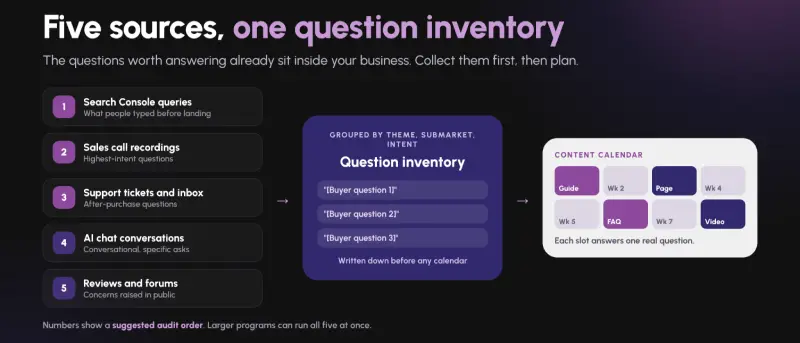
The five sources below surface those questions.
Source 1: Sales Call Recordings
The highest-intent questions in any Austin business sit in the first 15 minutes of sales calls. Your service page needs more than keywords: a direct answer to consumers’ queries.
Topic brainstorming cannot surface them because they are often phrased in ways that do not match any keyword tool.
“Do you handle the Google Business Profile thing after we move to the new office,” “what happens if my dental hygienist leaves mid-contract,” “will you write content that sounds like every other HVAC company or like us in South Austin.”
For Austin service businesses, the most valuable questions from this source usually concern process and trust.
Each of these becomes an article, a landing page section, or a short video. The buyers who had these questions and did not get them answered are the ones who ghosted after the call.
Austin-specific note: sales calls with East Austin creative businesses, South Congress boutiques, and Silicon Hills tech buyers often surface distinct question patterns by submarket.
A content strategy Austin program that groups the questions by submarket often finds that the same category produces different top questions in Mueller than in Round Rock.
Source 2: Support Tickets and Email Inbox
The questions that come after a purchase are different from the questions before it.
They cover implementation, troubleshooting, next steps, and advanced use. These questions almost never appear in a topic brainstorm, but they produce two of the highest-value content formats.
Knowledge base articles that reduce support cost, and expansion content that drives repeat purchase.
Tag each by topic and count the frequency. Any question that appears more than 5 times deserves its own content piece.
Any question that appears more than 20 times deserves a prominent one.
This source also feeds the content that makes existing customers buy again.
Pair the question inventory with email marketing services in Austin so the same answers reach existing customers through their inbox at the moment the question would have arrived.
Source 3: Google Search Console Search Queries
Google Search Console is the closest thing a business has to a real-time log of what people typed before they landed on the site.
The search queries report shows the exact phrasing of every impression. The surprising part is how many impressions come from questions the site does not answer well.
Pull the search queries report for the last 90 days. Filter to queries with more than 50 impressions and an average position worse than 15.
These are queries where Google thinks the site is relevant enough to show, but not relevant enough to rank well.
Each one is a content gap. Each gap is a potential article.
For Austin businesses, this source consistently surfaces the most volume. The Google Search Central documentation describes the queries report as a primary input for content strategy rather than generic to the category.
Each intent needs a different content format. Informational queries usually need a thorough guide. Commercial queries usually need a comparison or decision aid. Transactional queries usually need a service page refinement,
not a new article.
Pair the Search Console audit with an SEO audit to see how the query gaps connect to the technical and link profile side of the site, which affects how quickly new content can rank.
Source 4: AI Chat Conversations
AI chat traffic is the newest source, and the one most 2026 content programs are not yet tapping.
When a buyer asks ChatGPT, Claude, Gemini, or Perplexity a question about your category, the question itself is a content opportunity.
There are three ways to access this source.
- First, your own usage: run the questions your buyers ask through each of the major AI chat tools and watch what comes back.
- Second, your customer input: ask new customers in the first email after signup what they typed into AI chat before finding you.
- Third, the AI referrer data in your analytics: traffic coming from chat.openai.com, claude.ai, gemini.google.com, and perplexity.ai is tagged, and the landing page tells you what AI pointed the buyer toward.
For Austin professional services, there is a need for a meaningful share of pre-call buyer research to run through AI chat.
Content that gets cited in AI answers becomes a discovery channel the buyer never sees you earning.
The questions AI chat surfaces tend to be more conversational and more specific than keyword tools suggest.
A content piece that answers that question precisely tends to get cited more often by AI chat tools than a generic SEO services article.
Source 5: Review Sites and Public Forum Threads
The questions buyers ask publicly after they left a vendor are often the questions they wish the vendor had answered.
These questions sit in Google reviews, Yelp reviews, industry-specific review sites, Reddit threads, Austin-specific forums (Austin subreddits, Nextdoor Austin, local Facebook groups), and industry Slack communities.
Pull the last 6 to 12 months of public reviews for your own business and for 3 to 5 named competitors.
Ignore the sentiment and read the specific question or concern each reviewer raised. Group them by theme.
For Austin businesses with public category presence (restaurants, bars, service businesses, retail, professional services), this source surfaces the questions that matter most at the decision moment. A content piece that
answers one of these questions on your own site ranks for that question, gets cited in AI chat answers to that question, and routes buyers who were about to ask on Reddit directly to your business instead.
A program from credible content marketing in Austin sorts the question inventory by submarket and produces hyperlocal content that outperforms metro-level content.
The Austin-Specific Layer Across All Five Sources
Three Austin market characteristics change how the question inventory should be weighted:
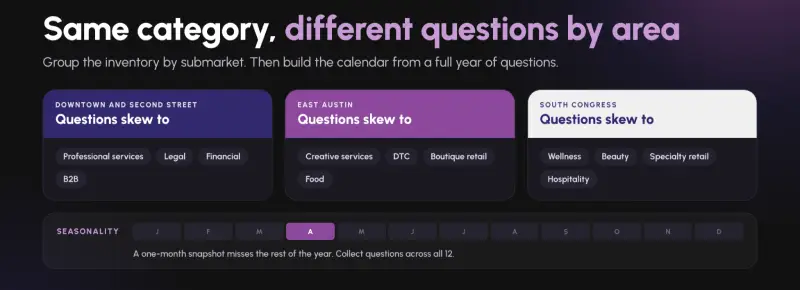
Austin seasonality shifts which questions dominate in which months. A content calendar built from a snapshot of one month’s questions misses the full year’s rhythm.
Austin submarkets show distinct question patterns. Downtown and Second Street District questions skew toward professional services, legal, financial, and B2B.
East Austin questions skew toward creative services, DTC, boutique retail, and food. South Congress and SoCo questions skew toward wellness, beauty, specialty retail, and hospitality.
Pair the content inventory with coordinated Austin SEO services so the organic coverage strategy and content production strategy share the same question set, which produces compounding returns rather than isolated outputs.
What ROILift Does for Austin Content Marketing Engagements
ROILift runs a 30-day source audit before writing any new content for an Austin engagement.
The five sources above get mined in parallel, the questions grouped by theme, submarket, and intent, and the full question inventory published in writing before the content calendar starts.
Monthly reporting carries pipeline attribution per content piece so the owner sees which pieces are producing qualified visits and which are sitting unread.
For Austin businesses that run multiple channels, pair the content build with coordinated paid search management so the paid and organic strategies share the same question set and buyer segments.
Frequently Asked Questions
What content formats does the question inventory produce?
Articles for most informational questions (1,200 to 2,500 words). Landing page sections for commercial questions (short, specific, embedded in existing pages). Case studies for competitor comparison questions. Email sequences for post-purchase questions. Video scripts for high-emotion or visual-explanation questions. Short-form FAQ pages for low-volume but high-intent questions. The format follows the question; a question about “how does your pricing work” rarely needs a 2,000-word article, while a question about “how to switch marketing agencies without losing rankings” often does.
Which of the five sources should an Austin business audit first?
Start with Google Search Console because the signal is specific to your site and the volume is highest. Add sales call recordings second because the questions are highest-intent. Add support tickets third because the content produces repeat revenue. AI chat and review mining come fourth and fifth, after the first three are producing content. Running all five in parallel from day one is possible for larger engagements.
What should content marketing services in Austin cost?
Published fees for Austin content engagements typically run $3,500 to $12,000 per month depending on volume, format mix, and source audit depth. Austin businesses with existing content programs often find a smaller $2,000 to $4,000 monthly retainer sufficient to audit the question inventory and prioritize the existing calendar before scaling production.
How is this different from “content marketing” that every agency pitches?
The question-sourcing approach starts from what actual buyers are asking in five specific places inside your business. The outputs look similar on paper, but the pipeline per piece typically runs 3 to 5 times higher. The visible difference is what the content calendar meeting looks like.
How long before the question-sourced content produces pipeline?
The first pieces usually produce qualified visits within 30 to 60 days because they rank faster, since they match search intent precisely. A full content calendar built on the question inventory starts compounding at 120 to 180 days. A realistic Austin SMB roadmap sees meaningful pipeline impact by day 90 to 120 of a focused engagement.
Can the question-sourcing approach work for Austin businesses with limited data in the five sources?
Yes, with adjustments. Austin businesses with limited sales call data skip. Businesses with no Search Console history start with AI chat and sales calls, then build Search Console data organically as the first pieces publish. Businesses with no public reviews lean more heavily on Reddit, Nextdoor, and industry Slack communities. The approach does not require every source to be rich; it requires the questions to be real.