table of Content
- 1.The Two-Audience Problem
- 2.Move 1: Content With First-Party Data
- 3.Move 2: Named Methods and Frameworks
- 4.Move 3: Author-Attributed Expertise
- 5.Move 4: Deep Topic Clusters, Not Shallow Topic Lists
- 6. Move 5: Citation-Earning Content
- 7. The New York-Specific Layer Across All Five Moves
- 8. What ROILift Does for New York Content Marketing Engagements
- FAQs
Key Takeaways
- Content marketing services in New York are competing in the most saturated content category in the United States.
- The two audiences are human buyers and AI or search algorithms. Content that compounds earns trust from both simultaneously. The content that earns trust from only one stalls.
- Five specific content moves pass the two-audience test: first-party data, named methods and frameworks, author-attributed expertise, deep topic clusters, and citation-earning assets.
It’s an unspoken fact that content marketing services in New York produce the slowest returns anywhere in the country.
New York categories are saturated by well-resourced local incumbents and the content programs of every agency.
Volume alone is not a signal of authority, and both the human buyers and the AI algorithms that decide which content ranks and gets cited have grown more skeptical.
Google’s Search Central documentation spells out the Experience, Expertise, Authoritativeness, and Trust framework the ranking systems use to judge content.
The Two-Audience Problem
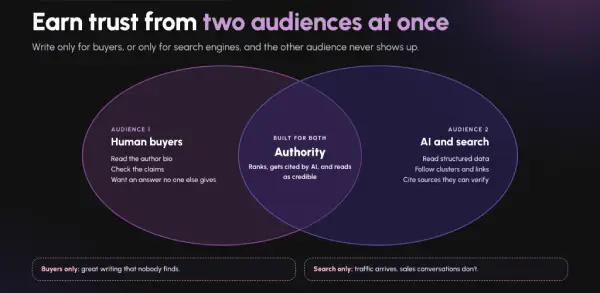
The content programs that stall in New York usually optimize for one audience and ignore the other.
Programs built only for search engines produce keyword-loaded, structurally rigid, template-shaped content.
And it only ranks for soft terms but reads as low-trust to human buyers and increasingly fails the E-E-A-T scoring that Google now applies at scale.
The traffic arrives; the sales conversations do not.
Programs built only for human buyers produce beautifully written, deeply researched content that nobody finds.
Only because it carries no structured data, no citation hooks, no topic cluster architecture, and no author authority signal.
The quality is real; the discovery is zero.
Programs built for both audiences at once produce content that ranks on Google, gets cited by AI models, and reads as credible. The compound effect is what the authority curve looks like when the five moves below all run in parallel.
Move 1: Content With First-Party Data
The single strongest authority signal is first-party data: original research, proprietary benchmarks, aggregated customer outcomes, survey findings, or methodology documentation that only your business can produce.
Every other authority move is a multiplier on this one.
For human buyers in competitive New York categories, first-party data answers a question no competitor can answer the same way.
For AI and search algorithms, first-party data earns citations, backlinks, and structured data markup that become permanent authority signals.
A single piece of original research in a competitive category typically produces 3 to 8 times the long-term traffic and citation value of a generic category guide of similar length.
For New York content marketing programs, the first-party data move usually looks like: an annual industry benchmark report based on aggregated client data, a public survey of a specific professional segment the business serves, a proprietary methodology documented with examples and outcomes, or a tracking study (how X metric changed across the year).
The work takes 4 to 10 weeks to produce the first piece and 1 to 2 weeks to maintain annually. The payoff compounds across years.
Pair the research with coordinated New York SEO services so the organic coverage strategy aligns with the citation-earning content and the two assets reinforce each other.
Move 2: Named Methods and Frameworks
The second move is giving your approach a specific name.
A generic article titled “How to improve your conversion rate” has no authority anchor.
Named methods and frameworks work because they do two things at once. For human buyers, the method name creates a mental shortcut that makes your approach memorable and quotable.
For AI and search algorithms, named entities earn knowledge-graph recognition over time, which compounds when the name appears across multiple content pieces, external citations, and author profiles.
Build the named method from real work. Pick the repeatable process your team already uses.
Give it a specific name (not jargon, not acronym-heavy). Document it in a cornerstone article.
Reference it by name in every subsequent piece. Within 6 to 12 months, the method name starts appearing in buyer conversations and AI chat answers.
Move 3: Author-Attributed Expertise
Human buyers read author bios to judge expertise.
AI and search algorithms read structured author data and cross-reference author claims against external profiles.
A content marketing agency New York program that attributes articles to named authors with real credentials produces measurably more authority signal.
The difference shows up in rankings for E-E-A-T-sensitive queries (health, finance, legal) and in AI citations.
Each author needs the same four signals:
- A real name with no obfuscation
- Bio naming specific experience and credentials
- Visible publishing history, and structured data
The author claims should be verifiable; any stretch that reviewers can disprove damages the whole signal.
For New York categories with strict expertise expectations, the author move is non-negotiable.
Content published anonymously in these categories loses to competitor content from named experts even when the anonymous piece is objectively better written.
Move 4: Deep Topic Clusters, Not Shallow Topic Lists
The fourth move sacrifices breadth for depth.
A content program publishing 40 shallow articles across 40 unrelated topics produces less authority than one publishing 15 articles organized into 3 deep topic clusters.
A topic cluster has one pillar article covering the topic comprehensively plus 4 to 8 supporting articles answering specific subtopic questions, all internally linked.
The cluster architecture signals topical authority to search algorithms and provides AI models with a coherent body of related content to cite from. Human buyers moving through the cluster absorb the full depth of the
business’s expertise rather than reading one article and leaving.
For New York content programs, the depth-over-breadth move is where the authority gap against incumbent competitors opens.
A new entrant with 3 complete topic clusters outranks a 5-year-old competitor with 60 scattered articles on E-E-A-T-sensitive queries.
Build each cluster with a question audit first, then produce the pillar and spoke articles over 60 to 120 days. Expect the full cluster to show traffic lift at 90 to 150 days and authority lift (citations, AI appearances) at 120 to 240 days.
Move 5: Citation-Earning Content
The fifth move is building content specifically to be cited by other content, by journalists, and by AI models. Furthermore, making it necessary to track your AI citations across engines in New York.
Citation-earning content is different from ranking-earning content; the format, structure, and signals are tuned for being quoted rather than visited.
What makes content citation-earning: specific statistics with clear attribution, named research or data (Move 1), quotable one-sentence conclusions, visual assets (charts, tables, decision matrices) that can be referenced, a stable URL that will not change, and structured data that makes extraction easier for AI models and journalists alike.
For SEO audit tied to a content marketing engagement, the citation-earning piece typically produces 10 to 30 referring domains within 12 months and shows up in AI chat responses within 6 to 18 months.
The traffic the piece generates directly is often small; the authority signal it creates for the rest of the site is large.
For New York business categories where trade publications, journalists, and industry newsletters cover the segment.
The citation-earning move produces the fastest authority lift because it unlocks earned media coverage that paid acquisition cannot buy.
The New York-Specific Layer Across All Five Moves
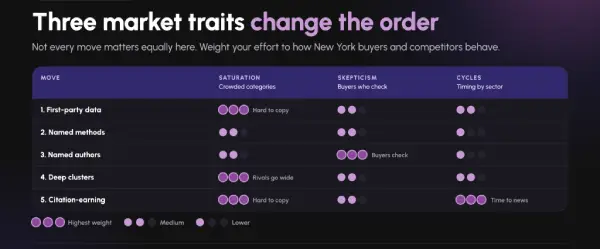
Three New York market characteristics change how the five moves should be weighted:
- New York category saturation is higher than anywhere else in the country.
- The content marketing New York competitive set in most B2B categories runs 50 to 200 active content producers, including national brands with teams of 10-plus writers.
Moves 1 (first-party data) and 5 (citation-earning content) produce the biggest proportional gains because they are the hardest for saturated competitors to imitate. Move 4 (depth over breadth) produces the next biggest gain because most saturated competitors publish wide rather than deep.
New York buyer skepticism is correspondingly high. U.S. Census Bureau education data for the New York-Newark-Jersey City MSA shows above-average advanced-degree concentration across most Manhattan and inner-ring suburbs, which translates into buyers who read bios, check claims, and verify sources. Move 3 (author-attributed expertise) carries more weight here than in less skeptical markets because the buyer actually checks.
New York seasonality and cycle timing differ by submarket. Financial services content cycles run on earnings calendars.
Real estate content peaks in spring and fall closing seasons. Legal and financial advisory content peaks around year-end tax and planning windows.
Media and creative content cycles run on awards and festival calendars.
A content strategy New York program timed to the specific cycle of its category produces earlier compound returns than one running an evenly paced calendar.
Pair the content build with coordinated email marketing services in New York so the authority-building content feeds a nurture program that moves subscribers from first article to decision moment.
What ROILift Does for New York Content Marketing Engagements
ROILift runs a 30-day authority baseline before writing any new content for a New York engagement.
The baseline measures current authority signals across all five moves.
How much first-party data exists, whether named methods are documented, which authors have bio and schema infrastructure, which topic clusters are complete versus scattered, and which pieces have earned citations.
The 90-day roadmap prioritizes the move with the biggest gap and the fastest authority-signal payoff for the specific business category.
No content marketing services in New York engagement begins without the authority baseline. A 90-day move prioritization and specific authority targets alongside traffic targets.
For New York businesses running multiple digital channels, pair the content build with coordinated paid search management so the paid and organic strategies share buyer segments and messaging.
Frequently Asked Questions
How do I measure the two-audience authority signal on my own content?
Track five numbers monthly. Referring domains per piece, AI chat appearances, author page impressions, and clicks. Named-method mentions in external content. Topic cluster depth score. The five numbers together tell you which moves are producing authority signal and which are not.
Which move should a New York business start with?
Start with Author-attributed expertise if your current content is anonymous or brand-bylined, because fixing it takes 1 to 2 weeks and produces baseline authority signal immediately. Start with Deep topic clusters if your content is scattered across unrelated topics.
What should content marketing services in New York cost?
For the initial 30-day authority baseline and infrastructure build run $4,000 to $15,000 depending on current state. New York businesses in less saturated subcategories often find a smaller $3,000 to $6,000 monthly retainer sufficient. A published rate card is a reasonable screening signal when choosing a content marketing agency New York partner.
How is this different from standard content marketing in less competitive markets?
In less saturated markets, volume publishing still works because the competitive set is smaller and the authority bar is lower. New York categories have enough high-quality competitors that volume alone does not break through. The outputs look similar on paper, but the signal density inside each piece is much higher.
How long before the authority moves show measurable return?
Author attribution produces visible signal within 30 to 60 days in search rankings and AI citations. Topic clusters show traffic lift at 90 to 150 days and authority lift at 120 to 240 days. First-party data and citation-earning content produce the biggest returns but the longest timeline: 180 to 540 days to compound authority lift.
Can the two-audience approach work for a New York business under 50 employees?
Yes, with scope adjustments. Smaller New York businesses build the five moves with lower volume and higher selectivity. One excellent first-party data piece per year, one named framework documented thoroughly, 2 to 3 named authors instead of 5 to 8, 2 to 3 deep topic clusters instead of 5 to 8, and 4 to 6 citation-earning pieces annually. The economics work because the moves compound; a smaller business that earns real authority outperforms a larger competitor that publishes more without the authority infrastructure.