SEO Migration Services in Phoenix: How to Move a Site Without Losing Organic Traffic
SEO Migration Services in Phoenix: How to Move a Site Without Losing Organic Traffic November 12, 2026 fogvibrant Instagram Facebook Linkedin X-twitter table of Content 1.How to Compare SEO Services in Austin Before You Hire an SEO Agency 2. SEO Agency in Austin That Offers True Local Search Results 3. Transparent SEO Services For Austin Businesses 4.Local Expertise Is What Separates Austin SEO Services 5. Additional Factors to Consider For Best Local SEO Services in Austin 6.Scorecard For Your Comparison to Choose the Best SEO Agency in Austin 7. Final Words: Now You Know What You Need to Ask in Discovery Call FAQs Key Takeaways SEO migration services in Phoenix protect organic traffic only when the migration runs on a documented timeline. The common mistake is timing the migration during a Phoenix peak demand window (monsoon season for roofing and HVAC, pool season for pool service. A credible website migration SEO Phoenix provider operates from a playbook, not a last-minute redirect list. This article shares the playbook on how you can retain organic traffic with SEO migration services in Phoenix. The point of SEO migration in Phoenix is to run a disciplined timeline from before anyone redesigns a wireframe after launch. With specific tasks, specific checks, and specific gates that stop the project if something is not ready. Phoenix migrations carry higher stakes than most US markets because the economy over-indexes on seasonal and emergency service categories. Google Search Central’s documentation on site moves with URL changes specifies exact technical handling that typically takes 8 to 12 weeks to execute correctly, which is why any migration timeline shorter than 90 days from kickoff to launch produces measurable traffic loss. Phase 1: Day Asset Inventory Catalog everything the current site has that produces organic value, before any redesign work touches it. Tasks: Export every URL with organic clicks from Google Search Console. Run a full Screaming Frog or Sitebulb crawl of the current site, capturing all URLs, canonicals, redirects, status codes, and schema types. Export the full backlink profile from Ahrefs, Semrush, or Majestic, flagging URLs with Domain Rating 30 or higher as high-value redirect targets. Export the current site’s XML sitemap and compare it to the crawl to identify orphan pages. Document all tracked keywords and their current ranking positions per URL. Document every schema block on the site using the Rich Results Test on each ranking page. Export Google Business Profile data (direct searches, discovery searches, directions, calls) for the last 12 months as a baseline. If the planned launch date falls between June 15 and September 30 (monsoon season), confirm the business is not in roofing, water damage, HVAC, or air filtration. Monsoon-driven demand spikes make any ranking loss costly. For those categories, delay launch to October or push forward to before June 15. Phase 2: Preservation Planning Build the migration spec that the design and development team will implement. Tasks: Map every old URL to its new URL. Document which pages are being redesigned versus which are being rewritten (redesign preserves content, rewrite changes content; rewrites carry more ranking risk). Build the schema spec for the new site, naming the exact schema types and properties each page template must implement. Build the internal linking spec: every ranking page’s existing internal links get documented, with their anchor text and source pages. Document the navigation structure and hub page connections so topical authority flows do not break. Produce a redirect file in the format the developer needs with all 301 redirects pre-built. Phase 3: Staging Site Verification Confirm on a staging site that every element of the migration spec is implemented correctly before production goes live. Tasks: Run a full Screaming Frog crawl of the staging site, matching against the migration spec. Verify every redirect in the file returns the correct destination with a 301 status code (not 302, not chained, not broken). Validate every schema block on the staging site using Google’s Rich Results Test. Confirm every priority internal link from the old site exists on the new site. Spot-check 20 ranking pages against their content inventory; confirm word count, heading structure, and specific content blocks are preserved. Test Core Web Vitals; mobile LCP, INP, and CLS must meet or beat the current site. Confirm Google Analytics or GA4 tracking is implemented on the staging site with the same properties as production. Confirm Google Tag Manager, call tracking, and any other third-party tracking tools are properly configured on staging. Every item above passes verification on the staging site. If any item fails, delay launch until it is fixed. Launching with a failed verification is the single most common cause of major traffic loss in Phoenix SEO migration services. Phase 4: Launch Go live with the new site and immediately start monitoring. Tasks: DNS switch to new site (time the switch for off-peak Phoenix hours, typically early morning local time). Submit updated XML sitemap to Google Search Console within 2 hours of DNS switch. Check 20 priority pages manually: load in browser, verify content, verify tracking fires, verify forms submit. Monitor Google Search Console for Coverage errors in real time. Monitor server logs for 404 patterns. Phase 5: First Week Monitoring The goal here during this phase is to catch any migration failures that did not surface in the first 4 hours. Tasks: The goal here during this phase is to catch any migration failures that did not surface in the first 4 hours. Tasks: Daily check of Google Search Console for Coverage errors and crawl errors. Check the ranking tracker for priority queries (expect some fluctuation; flag drops over 10 positions). Daily check of Google Business Profile for any disconnection from the new site. Daily check of Core Web Vitals on 5 priority pages. Check of form submission rate and call volume against baseline. 404 logs from the server; any new 404 patterns get root-caused and fixed within 24 hours. No coverage errors unresolved, no priority ranking drops over 10 positions sustained for more than
SEO Lead Generation Services in Phoenix: From High-Intent Searches to Phone Calls
SEO Lead Generation Services in Phoenix: From High-Intent Searches to Phone Calls November 5, 2026 fogvibrant Instagram Facebook Linkedin X-twitter table of Content 1.How to Compare SEO Services in Austin Before You Hire an SEO Agency 2. SEO Agency in Austin That Offers True Local Search Results 3. Transparent SEO Services For Austin Businesses 4.Local Expertise Is What Separates Austin SEO Services 5. Additional Factors to Consider For Best Local SEO Services in Austin 6.Scorecard For Your Comparison to Choose the Best SEO Agency in Austin 7. Final Words: Now You Know What You Need to Ask in Discovery Call FAQs Key Takeaways SEO lead generation services in Phoenix work when the goal is leads, not rankings. The biggest lever is attribution tracing: knowing exactly which Google query, which lead channel, and which page element caused each received call. The common mistake is assuming every call comes from the same place. A credible SEO lead generation agency Phoenix businesses hire traces real calls backward every month and rebalances SEO investment based on which traces are producing the best cost per qualified call. The most useful question in Phoenix SEO lead generation is not “how many leads did we get” or even “where did they come from.” If your current SEO lead generation services provider in Phoenix cannot answer that for any call that landed last month, the retainer is paying for visibility, not calls. And visibility without attribution is how Phoenix businesses end up ranked well and ringing less. Here are three real Phoenix call traces, walked backward from the ring to the originating search, and what each one reveals about SEO lead generation Phoenix businesses need to actually invest in. Why SEO Lead Generation Services in Phoenix Need to Be Measured Ranking tells you where your page sits in the search results. Measurement tells you whether that position is producing phone calls, form submissions, or direction requests. These are two entirely different questions, and Phoenix SEO plans that answer only the first miss the one that pays for itself. The practical reason is that Phoenix’s search behavior fractures by query type more than most metros. Google Search Central’s documentation on local search features confirms that the actions a mobile user takes from local results (call, directions, website visit, form submission) vary by query intent and surface type. Phoenix amplifies the fracture because its household mix includes retirees, winter visitors, in-migrating professionals, and multi-generational households. Each with different default actions on the same query. A single ranking number averaged across these behaviors tells you nothing useful. Measuring per-channel call volume and per-query action rates tells you where the retainer should invest next month. The three call traces below do exactly that: each starts with a real phone call at a Phoenix business Trace 1: The 2 PM July Emergency AC Call The call: Scottsdale homeowner, Tuesday afternoon in late July, outdoor temperature 112°F. Called an HVAC contractor’s direct line. Mentioned the AC system stopped cooling an hour earlier and the house was climbing past 85°F. Walking the trace backward: The call came through a tracking number assigned to the Google Business Profile listing. Specifically, the click-to-call button on the mobile Google Maps result for the query “AC repair near me emergency Scottsdale.” That listing appeared in the Local Pack (map pack) because the HVAC contractor had the category correctly set to “HVAC contractor” with “AC repair” as a service. Additionally, the service area included Scottsdale with specific sub-ZIPs, 47 Google reviews from the last 90 days, and a 4.8 average. The homeowner never visited the contractor’s website. The call originated entirely within Google’s Local Pack, with the click-to-call button the only action taken. What this trace reveals: Emergency Phoenix calls almost never route through traditional organic service pages. They route through Google Business Profile, Local Pack visibility, and click-to-call. Phoenix businesses investing exclusively in website content for emergency categories (AC, plumbing, electrical, auto repair, urgent dental, 24-hour locksmith) leave most of this call volume unclaimed. The SEO moves that caused the call: Review velocity: 47 reviews in 90 days, driven by a post-service automated review request. Service area accuracy: Specific sub-ZIPs instead of “Phoenix metro” Category precision: “HVAC contractor” primary, “AC repair” and “AC installation” as specific services Photo freshness: Recent summer service photos uploaded weekly Response-time signaling: GBP Q&A section included typical response time and after-hours availability None of those are traditional SEO deliverables. All of them are what produces emergency call volume in Phoenix. Trace 2: The September Planned Roof Replacement Call The call: Chandler homeowner, Wednesday evening in mid-September. Called a commercial-and-residential roofing contractor after submitting a form earlier that afternoon. Mentioned reviewing three contractors over the past week and choosing this one to speak with first. Walking the trace backward: The call followed a form submission from the contractor’s “Chandler Roof Replacement” page. The form submission was triggered by a page visit. The page visit came from a Google click on the organic result by Roofing SEO. The query itself was high-intent and planned, with “cost” as the qualifier indicating the visitor was researching pricing specifically. The page ranked third because it had: published pricing ranges (most Chandler roofing pages did not), named case studies in specific Chandler submarkets. Detailed FAQ schema answering “how long does a roof replacement take,” and an author byline with contractor license number. What this trace reveals: Planned Phoenix service calls route through traditional organic content, but only when the content answers the specific pricing, timeline, and process questions that other Phoenix pages avoid. A generic “Roofing Services Chandler” page would not have produced this call because the visitor’s query had “cost” as the qualifier, and generic pages do not address cost. The SEO moves that caused the call: Published pricing ranges on the page. Named Chandler and Ahwatukee case studies with specific
Dental SEO Services in Los Angeles: The Search Terms That Matter Before a Patient Books
Dental SEO Services in Los Angeles: The Search Terms That Matter Before a Patient Books October 30, 2026 fogvibrant Instagram Facebook Linkedin X-twitter table of Content 1.How to Compare SEO Services in Austin Before You Hire an SEO Agency 2. SEO Agency in Austin That Offers True Local Search Results 3. Transparent SEO Services For Austin Businesses 4.Local Expertise Is What Separates Austin SEO Services 5. Additional Factors to Consider For Best Local SEO Services in Austin 6.Scorecard For Your Comparison to Choose the Best SEO Agency in Austin 7. Final Words: Now You Know What You Need to Ask in Discovery Call FAQs Key Takeaways The highest-intent query is never “dentist near me.” It is a specific procedure name paired with a submarket or a trust signal. Review signals and author credentials matter more in dental SEO Los Angeles than in most local service categories. A credible SEO for dentists Los Angeles retainer tracks bookings by query type, not just rankings or traffic, so you can see which search intent actually fills your schedule. A patient searching for a dentist in Los Angeles does not type one query or an entire book in one go. Queries move forward over the course of two or three days, as their decision gets clearer. Each query signals a different intent and requires a different piece of content to intercept it. Most dental SEO services in Los Angeles target only the generic query. Here’s how the content should move and how the dental SEO services in Los Angeles will help you with it. The Six-Query Ladder a Patient Climbs Before Booking Dentistry sits inside what Google’s Search Quality Rater Guidelines treat as a Your Money or Your Life (YMYL) category. This means the content standard, author credential bar, and review signals all weigh more heavily than in other local service categories. Think of patient search as a ladder, not a single query. Each rung has a different intent and a different converting content type. Symptom Query Patients at the bottom of the ladder search symptoms first and not the solutions. “Why does my tooth hurt when I bite down,” “jaw pain on one side,” “sensitive teeth cold water.” These are not booking queries yet; they are information queries. What content wins here: Symptom guides that explain probable causes in plain language, with author credential signals. Content that names when to see a dentist versus wait, which builds trust before the sale. Internal links down the ladder to procedure pages. Most dental SEO company in Los Angeles retainers skip this entirely. That is fine as a strategic choice. Diagnosis Query Once the symptom gets a name, the patient searches the diagnosis. “What is a cracked tooth,” “symptoms of a root canal infection,” “signs of gum disease.” Still mostly informational, but now specific. What needs to be developed here: Condition pages that explain what the diagnosis actually means. Original clinical photography where legitimate. References to peer-reviewed sources or ADA guidance, which lift YMYL credibility. Content marketing services at this rung should feel like a dentist wrote it, because Google’s helpful content signals weight that in YMYL categories. Solution Query These are the queries where SEO for dentists in Los Angeles starts to produce real revenue, because the patient is comparing procedures and prices. Procedure pages with real cost ranges. Comparison content. Author bylines from a specific dentist on your team, not a generic “team” byline. FAQ sections handling the uncomfortable questions. Provider Query This is where the local pack dominates and where Google Business Profile signals outweigh website content. What plays as an arsenal here is: Google Business Profile completeness. Reviews on Google first, with velocity, not just volume. Submarket-specific landing pages. Open now” accuracy on evenings and Saturdays, because weekend emergencies drive high-value bookings. Trust Query Before booking, patients research the dentist specifically, doctor reviews, complaints, and pricing. Even if your website never ranks for these, the way the SERP displays other people’s reviews and content about you decides whether the patient calls. What matters here: Response rate to Google and Yelp reviews (positive and negative). Author pages on your own site with real credentials, publications, and years practicing. An “About the Dentist” page that actually reads as a dentist wrote it. Third-party review platform profiles (Healthgrades, Zocdoc) kept current. The Decision Query The Centers for Disease Control and Prevention’s oral health data documents how often adults search for dental care across the US, and that volume concentrates in metros like Los Angeles with wide income and insurance variation. All of that shapes how dental SEO Los Angeles actually works. “Dentist near me open Saturday,” “emergency dental Los Angeles’ queries convert at the highest rate but have the lowest volume. What content wins: Mobile-first booking page that loads in under two seconds A tracked phone number above the fold Clear hours, parking information, and insurance accepted Online booking link if your practice management system supports it The LA-Specific Signals That Change the Game Three LA realities shift the dental SEO plan beyond the generic playbook: Spanish-Language Search In East LA, Boyle Heights, Koreatown, Mid-City Google processes Spanish-language queries from these submarkets differently, and bilingual landing pages (not just translations) rank where English-only pages do not. If your practice serves these neighborhoods and your dentist SEO Los Angeles plan is English-only, you are missing a measurable share of bookings. Celebrity and Media-Adjacent Cosmetic Dentistry Beverly Hills and West Hollywood have unusually high “celebrity cosmetic dentist” and “veneer influencer” query volume. These queries convert at very high per-patient value when the content and author credentials match the search intent. Insurance Network Complexity Los Angeles has one of the most fragmented dental insurance networks in the US. “In-network dentist Delta Dental Pasadena” and similar queries convert well because many patients filter by insurance before anything else. If your service pages do not name the insurance networks you accept, you
Plumbing SEO Services in Austin: Where Local Search Leads Actually Come From?
Plumbing SEO Services in Austin: Where Local Search Leads Actually Come From? October 30, 2026 fogvibrant Instagram Facebook Linkedin X-twitter table of Content 1.How to Compare SEO Services in Austin Before You Hire an SEO Agency 2. SEO Agency in Austin That Offers True Local Search Results 3. Transparent SEO Services For Austin Businesses 4.Local Expertise Is What Separates Austin SEO Services 5. Additional Factors to Consider For Best Local SEO Services in Austin 6.Scorecard For Your Comparison to Choose the Best SEO Agency in Austin 7. Final Words: Now You Know What You Need to Ask in Discovery Call FAQs Key Takeaways Google Business Profile and review velocity are the two biggest levers for Austin plumbers, well ahead of website content or backlinks. The most common mistake is treating the website as the primary lead source. For plumbing, the website is often the third-ranked lead source behind GBP and review platforms. A credible plumber SEO Austin retainer measures leads by source, not just by website traffic. Austin is a plumbing-dense market that is influenced by real weather pressure. Environmental conditions and an increase in population shape the plumbing SEO services in Austin landscape. Usually, emergency and recurring call volumes are high, which means the way leads actually arrive is more varied than most plumbers assume. The Seven Real Lead Sources for Austin Plumbers The City of Austin’s water quality data notes that Austin water sits in the hard-to-very-hard range, which drives recurring call volume for scale buildup, water heater issues, and fixture problems. And the brutal truth is not every lead comes from Google or from the website. Here is the honest ranking, by volume, for a mature single-location plumbing operation in Austin. Most Lead Generation: Google Business Profile and the Map Pack GBP is the number one source of first-time plumbing leads in Austin, by a wide margin. Google’s documentation of local ranking factors names relevance, distance, and prominence as the three signals that decide the local pack, and prominence is driven heavily by reviews. For emergency queries like “plumber near me” or “burst pipe Austin,” the map pack takes the vast majority of clicks before the website appears. What a credible plumbing marketing Austin plan does for GBP every month: 5 to 7 posts (Job completion, Team photos, before and after, if appropriate). Track and respond to all reviews within 24 hours. Keep services and categories up-to-date when your service mix changes. Get honest feedback on seed quality from actual buyer questions and answers. Monitor monthly ranking positions of your top 10 queries for each of your submarkets. If your retainer spends more on blog posts than on GBP, you are pointed at the wrong source. Review Sites (Google, Yelp, Nextdoor, Angi, Thumbtack) Review sites are the second-largest source of first-time leads, and the first-largest source of warm leads from buyers already comparing options. What matters here: Volume: Your competitors likely have hundreds of reviews. New entrants need 10 to 15 new reviews per month, every month. Velocity: Google weighs recent review activity. 20 old reviews from 2022 lose to 20 fresh reviews from this quarter. Response Rate: Respond to every review, both positive and negative, within 24 hours. Platform Spread: Google first, then whichever platform your buyers actually use. Service Pages on Your Own Website While comparing SEO services in Austin, ensure they stress creating individual service pages. It wins the specific queries that GBP cannot answer. What converts on a service page: Strong grasp of submarkets, e.g., “serving Austin, Pflugerville, Round Rock, Cedar Park, Georgetown.’ A clear price range or starting price, even if the final quote varies. Tracked phone number prominent on mobile, within the first scroll. Reviews or testimonials embedded on the page, with real client first names and dates. What underperforms: generic “benefits of hiring a professional plumber” blog posts, 400-word thin service pages, and anything with no local context. Direct Searches When you have been in a business for years, and locals are directly searching your business on Google. It’s a clear sign your business has reached a credible stage. These show up in Search Console as branded searches, and they usually convert at the highest rate of any source. Most plumbers never measure this, which means they underinvest in brand presence for returning buyers. Referrals from Realtors, Property Managers, and Insurance Adjusters Austin’s real estate market generates steady plumbing lead volume through three professional networks. Realtors handling pre-sale inspections, property managers handling tenant repairs, and insurance adjusters handling water damage claims after a freeze. This source does not come from SEO directly. It comes from presence: your business showing up when a realtor Googles “plumber Round Rock” to recommend one, or when an insurance adjuster searches for an approved vendor. GBP, reviews, and a credible website support this source without any content work. Social Media and Nextdoor Posts Austin has a specific social media pattern for plumbing. Neighborhoods like Mueller, East Austin, and the Lake Travis area are rarely sourced by SEO work directly, but your SEO signals (reviews, GBP) support the sale once the neighbor-recommended lead starts researching. Paid Search and Local Service Ads Google Local Services Ads and Google Ads sit at the top of the search page but produce leads at a higher cost per lead. This mode of funnel can also be considered while partnering with an SEO agency in Austin for your plumbing service. They are useful in summer and winter emergency windows, less useful in steady months. The right play is to use paid for near-term pipeline while SEO compounds in the background, and to run both channels against the same booked-call metric. The Austin-Specific Signals Most Plumbers Miss Three Austin realities shift the lead-source ranking above: Freeze-event spikes When a winter storm hits Austin, emergency plumbing search volume spikes 10x inside 48 hours. If your GBP is slow to respond with
HVAC SEO Services in Phoenix: What It Takes to Turn Search Into Service Calls

HVAC SEO Services in Phoenix: What It Takes to Turn Search Into Service Calls October 28, 2026 fogvibrant Instagram Facebook Linkedin X-twitter table of Content 1.How to Compare SEO Services in Austin Before You Hire an SEO Agency 2. SEO Agency in Austin That Offers True Local Search Results 3. Transparent SEO Services For Austin Businesses 4.Local Expertise Is What Separates Austin SEO Services 5. Additional Factors to Consider For Best Local SEO Services in Austin 6.Scorecard For Your Comparison to Choose the Best SEO Agency in Austin 7. Final Words: Now You Know What You Need to Ask in Discovery Call FAQs Key Takeaways HVAC SEO services in Phoenix win or lose at the Google Business Profile and map pack level, not the website level, because the search is almost always urgent and almost always on mobile. Review velocity is the single biggest lever most Phoenix HVAC companies underfund, and it moves the local pack faster than content or links. Content for HVAC marketing Phoenix should answer specific service questions a homeowner types during an outage, not generic “benefits of a tune-up” articles. A credible HVAC SEO Phoenix retainer connects every monthly report to booked service calls, not traffic. If calls are not in the dashboard, the campaign is not being measured against the thing that matters. Phoenix is the hottest part of the US. The National Weather Service Phoenix Forecast Office records regular stretches of 115°F-plus temperatures across the Phoenix-Mesa-Chandler metro. And each summer, the query for “AC not working” rises, which is the opportunity for HVAC contractors in this city. Every HVAC search in July or August is a buyer standing in a hot house, phone in hand, scrolling the map pack for the first business that looks competent and reachable. That is the real buyer behavior behind HVAC SEO services in Phoenix. This piece is about building for it. What a Phoenix HVAC Search Actually Looks Like The buyer behavior in HVAC search is not like other local services. Three patterns show up consistently: Mobile-first and urgent: Most searches happen from a phone, in a hot house, at a hot time of day. Page speed matters at the physical device level, not just as a Google ranking signal. Map pack dominant: The three local pack results take the vast majority of clicks for emergency HVAC queries. If you are not in the top three, you are competing for scraps. Call-driven, not form-driven: HVAC buyers call, they do not fill out forms. GBP “call” taps and tracked phone numbers on your site are the real conversion metric, not form submissions. This changes what SEO for HVAC companies in Phoenix actually has to deliver. Rankings and traffic are secondary. Phone rings are the real scoreboard. The Phoenix HVAC Call Funnel Think of the campaign as a four-stage funnel. Every stage has a specific lever, and every stage has to be measured. Stage 1: Query to Impression The homeowner types “AC repair near me,” “emergency AC Chandler,” or “HVAC Scottsdale open now.” Your job is to appear in that result set. What makes you appear: Google Business Profile completeness and category accuracy Service area pages that match submarkets (Tempe, Mesa, Scottsdale, Chandler, Gilbert, Glendale, Peoria, Surprise, Avondale, Goodyear) Business hours accurately marked as “open now” when relevant Proximity to the searcher, which you cannot control but can influence through location pages What to track: impressions in Search Console for emergency and submarket queries, and GBP Insights for views by category of query. Stage 2: Impression to Click The homeowner types “AC repair near me,” “emergency AC Chandler,” or “HVAC Scottsdale open now.” Your job is to appear in that result set. What makes you appear: Rating above 4.5 stars. Review count that is competitive with your top three local competitors. At least 10 photos on the GBP, including team and equipment shots. A GBP description that names your service area and specialties plainly. Open” status when the search happens, especially on weekends and evenings. What to track: GBP calls, direction requests, and website clicks against impressions. Stage 3: Click to Call Once they click, the homeowner lands on your GBP card or a service page. Your job is to get them to tap the call button. What drives the call: A prominent, tracked phone number above the fold on mobile. A clear “we serve your area” signal. Social proof (reviews, badges, service years) within the first scroll. A page that loads in under 2 seconds on mobile per Google’s Core Web Vitals thresholds, documented in Google Search Central’s page experience guidance. What to track: tracked phone calls from organic and from GBP, call duration (shorts calls that disconnect fast often indicate a mismatch), and bounce rate on service pages. Stage 4: Call to Service If calls are coming in but not converting to booked work, that is a dispatcher problem, not an SEO problem, and your HVAC marketing Phoenix campaign cannot fix it. But the agency should still measure it. What to track: booked calls divided by total calls from organic. If that number drops below 50%, run a call-audit week before changing the SEO agency in Phoenix. Why GBP Beats Your Website for Phoenix HVAC Most HVAC companies spend 80% of their SEO budget on their website and 20% on GBP. HVAC businesses in Phoenix should flip that. The local SEO service pack is where the clicks live, and the local pack is driven by Google Business Profile signals, not your website. What a credible HVAC SEO Phoenix retainer does to your GBP every month: Posts 4 to 8 updates with photos (truck photos, team photos, service completions where legitimate). *Monitors and responds to every review within 24 hours. *Updates services and categories as your service mix changes. *Adds 10 to 20 new photos monthly, geotagged where supported. *Runs Q&A seeding and monitoring, so buyers see answers before they call. *Tracks
SEO Services in Seattle: What Changes When You’re Competing in a Tech-Heavy Market?

SEO Services in Seattle: What Changes When You’re Competing in a Tech-Heavy Market? October 28, 2026 fogvibrant Instagram Facebook Linkedin X-twitter table of Content 1.How to Compare SEO Services in Austin Before You Hire an SEO Agency 2. SEO Agency in Austin That Offers True Local Search Results 3. Transparent SEO Services For Austin Businesses 4.Local Expertise Is What Separates Austin SEO Services 5. Additional Factors to Consider For Best Local SEO Services in Austin 6.Scorecard For Your Comparison to Choose the Best SEO Agency in Austin 7. Final Words: Now You Know What You Need to Ask in Discovery Call FAQs Key Takeaways SEO services in Seattle operate on a higher content floor than most US metros. AI search visibility is non-optional in Seattle. The tech-market playbook does not apply to every Seattle business. Local service businesses with consumer audiences should run a standard local SEO plan, not a tech-market one. We get the inquiry every time. Our product sits in a Seattle tech category. Why does that matter for SEO services in Seattle specifically? It matters because a generic SEO playbook plan won’t work here. The buyer base is more technical than almost any other US metro, and a generic “fix titles, publish blog posts, build links” plan assumes you are running a generic plan. So What Changes With SEO Services in Seattle? First and foremost, the content floor is higher. The average Seattle B2B SaaS or cloud competitor publishes benchmark posts, documentation, and comparison pages that already satisfy the standards Google published in its helpful content guidance. Your services retainer should fund one benchmark-grade comparison page a month. Apart from this, two documentation-style tutorials per month, one data study or original research piece per quarter, and ongoing GBP and local work only if you have a physical office that walk-ins can reach. Content with a technical author’s byline and real benchmarks will out-earn 20 generic blog posts every quarter. Additionally, if your SEO company’s plan does not include an AI visibility layer with AI SEO and GEO services, you are leaving a disproportionate amount of Seattle buyer intent on the table. How Do I Tell If My Seo Agency In Seattle Can Actually Execute? Ask for three content samples that would pass a product manager’s review. Not blog posts. Comparison pages, benchmarks, or tutorials. If the agency has to go find them from “a previous project we did years ago,” or if the samples are 600 words with no numbers in them, they will not survive against Seattle’s content floor. Also ask who writes. If the content team has no engineering, data, or domain backgrounds, their output will read like marketing copy to your buyers. Furthermore, what needs to be evaluated is: Link strategy for tech publications: Can the agency name actual Seattle and national tech outlets they have placed links in? Their AEO reporting infrastructure: Not a line item in a slide deck. A real monthly report that shows whether your business is being cited in ChatGPT, Perplexity, Claude, and Google AI Overviews, with the actual queries that trigger those citations. Access policy: Google Search Console, Google Analytics 4, and Google Business Profile in your name, not theirs, from week one. Their response to a core update: Ask them what they did for a current client after the last Google core update. If the answer names a specific client, a specific drop or gain, and a specific action taken within 10 business days, they are the one who knows the playground. Signals That a Particular SEO Agency in Seattle Won’t Survive Visit the agency’s blog. Read three posts. If their own site is 800-word listicles with generic SEO advice and no data behind any claim, that is exactly what your retainer will produce. Agencies cannot write content for your audience that they could not write for themselves. Their content is an honest preview of your content. Four more honest signals you can read in under 10 minutes: No named author on their blog posts: If their own writers hide behind “team” bylines, your content will have the same anonymous feel, and AI engines and Google’s helpful content system both penalize that in 2026. No case studies with real numbers: Vague “we grew traffic” claims with no client name, no date, no starting position. If their own proof is thin, your proof will be thinner. A pricing page that only says “contact us for a custom quote.”: This signals the agency charges each client whatever they can get, not against a documented service tier. Their own site is not fast: If a Seattle SEO services provider cannot pass Core Web Vitals on their own domain, they will not fix yours. When This Seattle SEO Playbook Does Not Apply to You The tech-market shifts matter when at least one of these applies to your business: *When your buyer is a technical professional, developer, data analyst, or engineering decision maker *The competition is a software, cloud, SaaS, or technical services company that publishes at depth *Your product solves a technical problem that benefits from documentation-style content If none of these sounds like it resonates with you, your Seattle SEO services plan should look like a standard local or SMB plan. A Capitol Hill coffee shop or a Fremont retail store is not competing against a tech brand for anything. Running the tech-market playbook on a non-tech business inflates the budget and produces content your actual buyers do not care about. The ROILift SEO Service Approach to Seattle What makes ROILift different and a leading SEO company in Seattle is structured data on every money page. Real credentials marked for E-E-A-T, and monthly tracking of brand mentions across ChatGPT, Perplexity, Claude, and Google AI Overviews. Content writing services that produce content written by writers with product and B2B backgrounds. Comparison pages are benchmarked against real competitors
How Much Do SEO Services in Indianapolis Cost?
How Much Do SEO Services in Indianapolis Cost? October 28, 2026 fogvibrant Instagram Facebook Linkedin X-twitter table of Content 1.How to Compare SEO Services in Austin Before You Hire an SEO Agency 2. SEO Agency in Austin That Offers True Local Search Results 3. Transparent SEO Services For Austin Businesses 4.Local Expertise Is What Separates Austin SEO Services 5. Additional Factors to Consider For Best Local SEO Services in Austin 6.Scorecard For Your Comparison to Choose the Best SEO Agency in Austin 7. Final Words: Now You Know What You Need to Ask in Discovery Call FAQs Key Takeaways Compare deliverables, not just monthly retainers. SEO packages can range from basic Google Business Profile management to comprehensive campaigns. Request a detailed, data-backed quote. Bought links, spam tactics, and low-value automated content can put your website at risk, so avoid cheap SEO tactics. Treating SEO services cost in Indianapolis as a budget line is how most campaigns end up being a flat line. This piece is about the math underneath the price tag. Before we get to the math, one piece of context that explains why SEO pricing in Indianapolis sits where it does. According to the U.S. Small Business Administration’s 2024 metropolitan profile, small businesses accounted for 99% of businesses in the Indianapolis metro area and employed 43.1% of its workforce. This highlights the importance of making marketing investments count, especially for businesses working with limited budgets Rewriting the Question You Should Actually Ask Most buyers walk into an SEO conversation asking, “What does this cost per month?” That question has no useful answer. A $500 retainer that produces nothing is more expensive than a $4,000 retainer that produces 40 qualified leads a month. The right opening question is: “How many leads does this retainer need to produce for me to break even, and how long will that take?” With this, you stop comparing retainer numbers across agencies and start comparing lead math. The Three Cost Drivers in Indianapolis Three variables decide where your pricing for SEO services in Indianapolis lands. Any credible provider should price against these before quoting. Driver 1: Your Category’s Ranking Difficulty A Fountain Square cafe, a Mass Ave law firm, and a Carmel orthodontist compete in three different search markets. The difficulty of your category decides how much content and link work the campaign actually needs. Google itself documents this in Google Search Central’s guidance on how Search works, where relevance, quality, usability, and context all contribute to ranking. The more competitive your category, the more work each of those four requires. Three brackets: Low to medium competition: Specialty retail, niche B2B, suburban services. Expect $1,000 to $2,000 a month. Medium competition: Home services, dental, HVAC, local professional services. Expect $1,500 to $3,500 a month. High competition: Personal injury law, cosmetic surgery, cosmetic dentistry, bariatric medicine, real estate. Expect $3,500 to $7,500 a month. Driver 2: Your Site’s Starting Position A site with 50 referring domains, clean technical health, and already-indexed service pages starts cheaper, because the basics are already cleared. A fresh or neglected site starts more expensive, because the first 90 days have to rebuild technical foundations before any growth work compounds. If LCP, INP, and CLS are not in the “Good” range, every other investment runs into a slower ceiling, which means the retainer has to do remedial work before compounding work. Driver 3: Your Number of Locations Each location is another Google Business Profile, another set of citations, and another local landing page. This creates price variance, as SEO services in Phoenix cost different from Indianapolis. The SEO packages Indianapolis providers quote should scale cleanly with location count, not multiply by it. Two locations is not twice the price. Four locations usually is. What Each Monthly Budget Actually Buys You Instead of starting with a budget and asking what it buys, start with the output you need and work backward. Here is what each price point realistically produces for a single-location Indianapolis SMB in a medium-competition category. Monthly spend Realistic output Under $500 A freelancer handling GBP, basic on-page edits, and 1 to 2 blog posts $750 to $1,500 Full local SEO, 2 to 4 content pieces, light technical work, light outreach, basic reporting $1,500 to $2,500 Technical SEO depth, 4 to 6 content pieces, named account manager, review generation workflow, dashboard reporting $2,500 to $5,000 Multi-channel strategist, 6 to 10 content pieces, active outreach, structured link building, lead attribution reporting $5,000+ Full team: strategist, content lead, outreach lead, technical specialist, custom dashboards tied to revenue Note what this table does not say. It does not say the $500 package will produce leads. It says what the money buys you in terms of work hours and deliverables. Whether that work actually produces leads depends on your category, your site, and the agency’s execution, not the retainer size alone. The ROI Math in Three Simple Steps With ROILift Any SEO services cost Indianapolis conversation should end with a math check. ROILift uses this exact three-step frame on discovery calls, because it is the fastest way to size a retainer against reality instead of hope. Step 1. Multiply your average customer value (one deal, not lifetime) by your typical close rate on qualified leads. That is your value per qualified lead. Step 2. Divide the proposed monthly retainer by that number. The result is the number of qualified leads the retainer needs to produce each month to break even on cost. Step 3. Ask the agency whether that lead number is realistic for your category and your site, at month six and at month twelve. If the answer is no, the retainer is wrong-sized. If the answer is yes with specifics, you have a plan. Why Cheap SEO Is Almost Always the Most Expensive Option The temptation to pick the $300 package is real. Why it usually fails is that the
SEO Services in Columbus: How to Tell Whether an Agency Is Actually Working
SEO Services in Columbus: How to Tell Whether an Agency Is Actually Working October 28, 2026 fogvibrant Instagram Facebook Linkedin X-twitter table of Content 1.How to Compare SEO Services in Austin Before You Hire an SEO Agency 2. SEO Agency in Austin That Offers True Local Search Results 3. Transparent SEO Services For Austin Businesses 4.Local Expertise Is What Separates Austin SEO Services 5. Additional Factors to Consider For Best Local SEO Services in Austin 6.Scorecard For Your Comparison to Choose the Best SEO Agency in Austin 7. Final Words: Now You Know What You Need to Ask in Discovery Call FAQs Key Takeaways Traffic growth does not guarantee business growth. Evaluate SEO services in Columbus by qualified leads, calls, and conversions rather than overall traffic alone. Use Google Search Console and Google Business Profile Insights to compare reported performance with your own data. Monthly reports should include keyword movement, page-level Search Console data, named referring domains, local search performance, and leads attributed to organic search. The dashboard is up, and to the right, traffic has grown 40; your agency sends a slide deck every fourth Tuesday with a lot of green arrows. You pay the invoice. And still, you cannot name a single customer who came in because of SEO services in Columbus this quarter. If that scenario sounds familiar, you are not alone, and you are not reading your reports wrong. Why This Problem Occurs With SEO Reporting in Columbus? The problem is that it has been treated as one of the country’s most representative test markets by national brands. The Columbus Dispatch has written about this test-market history more than once. The same demographic honesty that makes Columbus a reliable testing ground for consumer products. And this is where the SEO campaign is easy to hide here. Nothing in a Columbus report screams “wrong” because the numbers look like they could be right. Here is Why Columbus Reports Can Fool You The result for anyone buying Columbus SEO services: a monthly report can grow in several directions at once without any of the growth connecting to your pipeline. The stats and numbers in particular carry a lot of weight in reports, and most of them are almost useless on their own. Impressions Impressions grow when the number of times your site appears in search results. Google decides to show your pages for more queries, not when you win more customers. A page can get 100,000 impressions for the wrong intent and generate zero clicks. Total Organic Traffic Traffic up 40% means nothing if the traffic landed on your blog instead of your service pages. Zoom in on which pages gained traffic. If the growth sits on content that cannot convert, you got entertainment, not business. Keyword Rankings for Terms You Never Agreed If a report shows wins on “what is SEO” or “how search engines work,” you are watching an agency pad its scorecard. Those terms do not attract Columbus buyers. Backlinks Acquired From Unnamed Sources “15 new backlinks this month” is a line item. “Links from the Columbus Dispatch, OSU alumni blog, and Dublin BID newsletter” is a result. Ask every month to see the referring domains by name. Any Columbus SEO services report that leans on these four numbers to tell a growth story needs a second read. They are the easiest to grow and the easiest to decouple from revenue. Four Numbers to Rely On With SEO Services in Columbus Now the inverse. These four numbers do not lie, because they tie directly to growth and true lead conversion. Clicks on Your Money Pages Not sitewide impressions, but clicks on your service and location pages, broken down one page at a time. If those pages are not getting shown for intent-heavy queries by month three, nothing downstream will fix itself. Google Business Profile Requests and Calls This is the hardest number to fake. If the campaign is working, people in Short North, Clintonville, Dublin, Westerville, Upper Arlington, Grove City, or Powell are increasingly asking Google how to get to you, or tapping the call button. GBP Insights shows this at the submarket level. Form Fills and Calls Attributed to Organic Not total leads. Leads with a tracked source. If your SEO reporting Columbus setup cannot tell you which pages produced which leads by month four, the measurement is broken, which is just as bad as the SEO being broken. Share of Search For Your Top Five Commercial Queries Rank tracking at the citywide average lies to you. Share of search for “cosmetic dentist German Village” or “roofer Dublin” tells you how much of the available clicks you are winning in your submarket. Ask the agency to track it monthly against your top three Columbus competitors. The 20-Minute Columbus SEO Diagnostic Open your most recent agency report side by side with Google Search Console and Google Business Profile Insights, both of which you should have access to in your own name. 1. Note impressions and clicks on your top 10 pages, not sitewide. If service and location pages are not among the top 10 gainers, the content strategy is misaligned. 2. Open GBP Insights. Compare direction requests and calls this quarter versus last. 3. Count leads tagged as organic for the last 90 days. Compare to the prior 90. If no leads are tagged at all, lead tracking is the first fix. 4. Any claim in the report that does not match what you just saw in your own tools is a question for the next meeting. Not an accusation, a question. Three Scenarios: Patient, Review, or Switch By month six, you should be able to place your campaign in one of three buckets. Each has a different right move. Patient (Campaign is Working, Keep Going) Three of the four honest numbers are moving. Service page impressions are
SEO Services in Charlotte: What Should Be Included in a Monthly Retainer?
SEO Services in Charlotte: What Should Be Included in a Monthly Retainer? October 27, 2026 fogvibrant Instagram Facebook Linkedin X-twitter table of Content 1.How to Compare SEO Services in Austin Before You Hire an SEO Agency 2. SEO Agency in Austin That Offers True Local Search Results 3. Transparent SEO Services For Austin Businesses 4.Local Expertise Is What Separates Austin SEO Services 5. Additional Factors to Consider For Best Local SEO Services in Austin 6.Scorecard For Your Comparison to Choose the Best SEO Agency in Austin 7. Final Words: Now You Know What You Need to Ask in Discovery Call FAQs Key Takeaways A credible monthly retainer for SEO services in Charlotte covers technical SEO, on-page work, content, link building, Google Business Profile management, review generation, reporting, and a named account manager, all listed in writing before you sign. The right scope for your retainer depends on: your business type, your competition in Charlotte, and the state of your site today. Watch for scope that quietly expands. Website edits, migration work, and paid media management should be billed separately. No one wants to be misled by a monthly retainer for SEO services in Charlotte. Each hour, each deliverable, and each achievement should be on point that the agency stands on. Understanding the value behind your SEO investment starts with recognizing the competitive landscape your business operates in. For a city like Charlotte, the U.S. Bureau of Labor Statistics indicates a population of nonfarm employment of well over 1.3 million, and that includes a significant number of financial services jobs, healthcare jobs, and professional services jobs. In a metro that dense, a vague retainer is money lost. Here is exactly what should be in yours. The Short Answer: What a Credible Retainer Covers Every monthly retainer SEO service in Charlotte should include ten line items, with specific deliverables under each. Here is the shortlist at a glance. Line item What it covers Technical SEO Site audits, Core Web Vitals fixes, schema, crawl error cleanup On-page SEO Title tags, meta descriptions, headings, internal linking Content production Blog posts, service pages, landing pages, with named writers Link building Outreach to real editorial sites, digital PR, local partnerships Google Business Profile Optimization, posts, Q&A, review management Local citations Audit, cleanup, new submissions where relevant Analytics and reporting Dashboard access, named analyst, monthly review Account management Named manager, response-time commitment, meeting cadence Strategy reviews Quarterly plan reviews with written outcomes Keyword and competitor tracking Monthly tracking of positions and competitor movement Anything less than this is not a retainer. It is a partial scope with gaps the agency can fill in later with change orders. Deliverables That Should Always Be in a Charlotte SEO Retainer These ten line items apply whether you are a Dilworth dental clinic, a Ballantyne law firm, or a Plaza Midwood restaurant. A Documented Technical SEO Plan Core Web Vitals is not optional. Google Search Central documents LCP, INP, and CLS as part of the page experience signals used in ranking, which means a slow or unstable page in a competitive Charlotte category is losing traffic every day it stays unfixed. The retainer should fund a quarterly technical audit covering Core Web Vitals (LCP, INP, CLS), crawl errors, schema, and mobile usability. Fixes should be ranked by traffic and lead impact, not alphabetically. On-Page Work on Your Most Important Pages Expect title and meta rewrites, heading structure, internal linking, and schema on your top 10 to 20 pages each quarter. Service pages and local landing pages come first. Content Production With Named Writers Four to eight pieces a month is a healthy mid-tier Charlotte SEO services retainer. The retainer should name who writes, what gets written, and the editorial cadence. Link Building With Method Links per month with no explanation means zero adherence to quality. Expect outreach to NC publications and industry sites, digital PR angles tied to Charlotte stories, and a clear policy against bought links and private blog networks. Google Business Profile Management Monthly posts, Q&A monitoring, photo updates, and category or service-area optimization. GBP is where map pack rankings in Uptown, SouthPark, and NoDa are won. A Review Generation Workflow With Accountable Manager The retainer should fund outreach to recent customers, response templates for new reviews, and monthly reporting on review velocity against your top three competitors. Expect a response within one business day and a scheduled monthly review meeting on your calendar. Local citation audit and Reporting Dashboard Charlotte directories, NC business associations, industry-specific listings. Expect a quarterly citation report in the retainer. Moreover, not a monthly PDF. A live dashboard tracking rankings, map pack impressions, traffic, and leads by landing page. A great UI design makes navigation smooth and frustration-free. Users should find what they need quickly without unnecessary steps. UX research helps designers understand user behavior, ensuring that every interaction feels natural and intuitive. Properly structured layouts, clear call-to-actions, and easy-to-read typography all contribute to a better experience. Deliverables That Depend on Your Business Type Each industry requires a different set of deliverables, with some belonging in Charlotte SEO services retainers and none with others. Ask the agency to tell you which apply to you and why. * Financial services and legal firms: YMYL-compliant content review, author credential schema, authority linking from NC Bar and industry sites. *Healthcare and dental practices: HIPAA-aware content review, Healthgrades and Zocdoc profile management, before-and-after schema where legitimate. *Ecommerce brands: Ecommerce SEO services provide product schema, category page optimization, duplicate content cleanup, Shopify or WooCommerce technical assessment. *Multi-location businesses: Dedicated location pages for each office, GBP management for each location, location-specific review generation. *Real estate agencies: Neighborhood page strategy for Charlotte submarkets (Myers Park, Elizabeth, University City), listing schema, StreetEasy-equivalent review signals. *Restaurants and hospitality: Menu schema, photo cadence, UGC generation, Yelp and TripAdvisor response monitoring. If you are in any of these verticals and
How Long Does It Take for SEO Services in Denver to Produce Results?
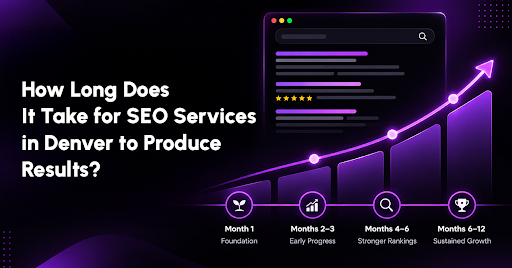
How Long Does It Take for SEO Services in Denver to Produce Results? October 27, 2026 fogvibrant Instagram Facebook Linkedin X-twitter table of Content 1.How to Compare SEO Services in Austin Before You Hire an SEO Agency 2. SEO Agency in Austin That Offers True Local Search Results 3. Transparent SEO Services For Austin Businesses 4.Local Expertise Is What Separates Austin SEO Services 5. Additional Factors to Consider For Best Local SEO Services in Austin 6.Scorecard For Your Comparison to Choose the Best SEO Agency in Austin 7. Final Words: Now You Know What You Need to Ask in Discovery Call FAQs Key Takeaways Three variables decide your actual timeline: your site’s starting point, your category’s link density in Denver, and the quality of your conversion path. Any Denver SEO services provider should score your business on all three before quoting a result date. Watch three leading signals every month from month one: indexed pages, map pack impressions, and keyword positions moving out of the double digits. The projection is all about getting basics right and achieving desired results. There is no promised timeline for when you can expect results while partnering with SEO services in Denver. SEO guarantees best practices that help you get visible, but not success. Actual results depend on your market’s current condition, industry competition, keyword difficulty, content quality, and the effectiveness of your conversion funnel. Eventually leading us towards the most important part of the discussion. Variables That Decide Your Denver Timeline The timeline is not a flat number. It is a function of three things any credible SEO service provider Denver businesses hire should assess before quoting a result date. 1. Market Density The U.S. Bureau of Labor Statistics Denver area economic summary places the metro’s nonfarm employment at well over 1.6 million With growth concentrated in professional services, healthcare, and leisure and hospitality. That mix matters, because the timeline for an SEO campaign in Cherry Creek dental is not the timeline for a plumber in Aurora, and no credible SEO agency in Denver pretends they are the same. Low to medium competition (specialty retail, niche B2B, suburban services): 6 to 9 months to meaningful lead growth. Medium competition (dental, HVAC, home services, local legal): 9 to 12 months. High competition (personal injury law, cosmetic surgery, cannabis dispensaries, real estate): 12 to 18 months. 2. Your Site’s Starting Point A site with clean technical health, a few dozen referring domains, and already-indexed service pages starts the race early. Preparation of strategy and a personalized blueprint for an SEO agency in Denver becomes easier. Moreover, it also becomes a litmus test to identify whether the agency is credible or not. If they fail to provide these underlying reports before partnering: Core Web Vitals: LCP, INP, CLS on top pages Backlink profile: referring domains, anchor profile, toxic links On-page services: titles, meta descriptions, headings, internal linking Google Business Profile completeness and review velocity Keyword position baseline for your target set 2. Conversion Funnel If you are not getting the result in the Denver market, the entire blame is not on SEO. There might be the reason that you have poor conversion funnel, your landing pages, forms, phone tracking, or chat are weak, traffic rises but leads stay flat for months. What needs to be done is: Landing page clarity, one offer per page, one primary CTA, proof above the fold. Fewer required fields, mobile-first design. Phone call tracking: dynamic number insertion so SEO calls are attributable. What Expected Timeline Looks Like With SEO Services in Denver It’s not about growth but the work that is being done. Each month, a step-by-step strategy lays out that looks something like: Month 1 to 3 *Indexed pages growing 15% to 30% as new content and fixes land. *Core Web Vitals moving into Google’s “Good” range. *Google Business Profile completeness at 100% with first review-generation sequences active. *5 to 15 new referring domains for a healthy SMB. Month 3 to 6 *Keyword positions climbing from 50+ into the 20 to 40 range for target terms. *Map pack impressions up 10% to 25% month over month. *First lift in form fills and calls attributed to organic. *Content velocity steady, no gaps. Month 6 to 9 *Direction requests and clicks to call from GBP for a single-location business. *Lead volume from organic up 10% to 25% over baseline. *Backlink profile with 20 to 40 new referring domains from real sites. Month 9 to 12 *Starts to hit the target keywords in the top 10. *Lead volume from organic up over month-one baseline. *Cost per lead from organic dropping as traffic compounds against a flat retainer. *Named landing pages and keywords tied to specific lead counts. Why Textbook SEO Projections Fall Apart in the Real World Most “SEO timeline” articles quote one number for everyone, which is why most of them are useless. A blog that tells a dentist in Highlands and a cannabis dispensary in RiNo that they will both see results in “3 to 6 months” is doing them both a disservice. Three reasons textbook projections mislead Denver businesses: They Ignore Variables: A site with healthy technical health moves on a different curve than a six-month-old site with 4 referring domains and five crawl errors. The same campaign, the same budget, the same agency, two completely different timelines. They Flatten Category Competition: A specialty retailer in a Denver suburb and a personal injury law firm competing citywide should never read the same timeline chart. The link gap alone can push the real timeline by 6 to 12 months either direction. Conversion Path Not Optimized: Every textbook projection pretends traffic equals leads. In practice, broken landing pages, form friction, and missing phone tracking can hide six months of real SEO progress inside a flat lead report. The real timeline for